
The Mental Model Every AI Agent Engineer Should Have
A viewer asked what AI Engineers actually code all day. Here is the mental model I keep coming back to — the seven problems that AI Agent Engineers and AI Architects really solve, for learning, problem solving and interviews.
A viewer asked me a question that a lot of people quietly have:
"If you've worked as an AI Engineer, what kind of coding do we actually do? Cloud gives us Bedrock AgentCore and Vertex to build a whole RAG pipeline or an agent without any technical expertise. So in the real world, how do we do it?"
It's a fair question. If the platform builds the RAG pipeline for you, what is left to engineer?
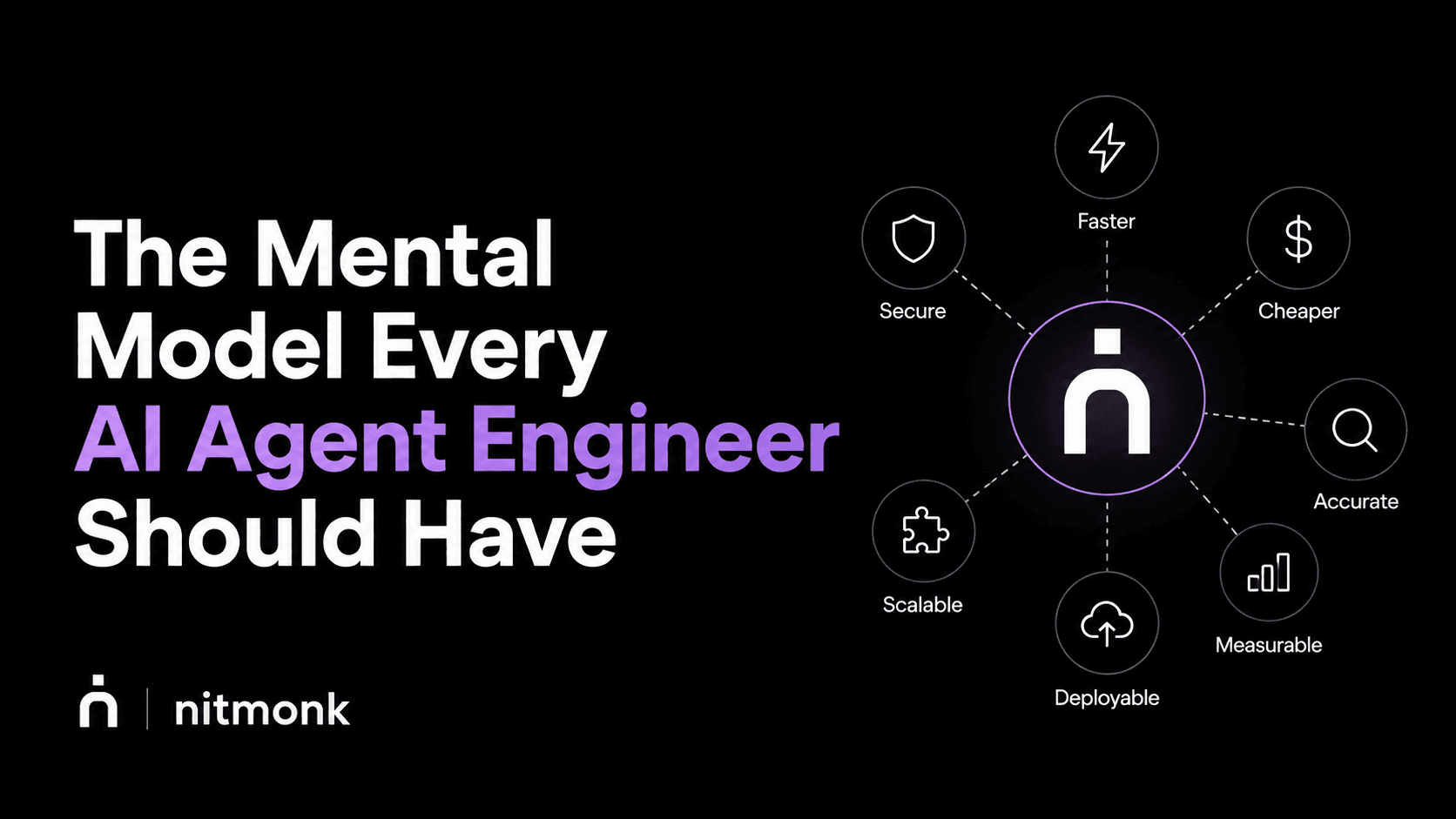
The answer is: almost everything that matters. The demo is easy. Making it fast, cheap, secure, accurate, deployable and measurable is the job. Over the years I've boiled that down to a mental model I use for everything — how I learn a new topic, how I debug a broken agent, and how I answer interview questions. If you internalise these seven problems, you'll never again wonder "what do AI engineers actually build?"
1. Make it faster — latency
A working agent that takes 40 seconds to answer is a broken product. Latency is an engineering problem: streaming, parallel tool calls, caching, smaller/cheaper models for the easy hops, cutting retrieval down to what actually matters. Every architecture decision has a latency budget attached to it, and your job is to spend it wisely.
2. Make the agent cheaper — token cost
Every token is billed, and a naive agent burns them: bloated context, re-retrieving the same documents, re-sending history on every loop, retrying failed tools. Cost engineering is prompt compression, context pruning, routing cheap queries to cheap models, and caching. This is where working memory earns its keep — on the second loop the agent reads what it already found instead of paying to fetch it again.
3. Make it secure — prompt injection, guardrails, RAG poisoning, tool poisoning
The moment your agent reads untrusted text — a web page, a document, a tool result — it can be hijacked. Prompt injection, RAG poisoning (malicious content in your knowledge base), and tool poisoning are real attack surfaces. Security work here is guardrails, input/output validation, least-privilege tool scoping, and treating everything the model reads as data, not instructions.
4. Solve hallucination — retrieval done properly
Hallucination is usually a retrieval failure in disguise. You fix it with engineering, not hope:
- Hybrid search — combine BM25 (keyword) with semantic search so you catch both exact matches and meaning.
- Chunking — how you cut the document decides what can ever be found.
- Re-ranking — reorder candidates with cross-encoders for relevance, after a fast bi-encoder first pass.
Grounded generation on top of good retrieval is what stops the model inventing the gaps.
5. MCP tool poisoning — and scaling to 100+ tools
MCP is powerful, but two problems show up fast. First, tool poisoning — a malicious tool description can manipulate the agent. Second, scale: when you have 100+ tools connected, you can't stuff every tool into the prompt. The answer isn't "call a different agent for each" — it's progressive discovery: surface the right tools for the task at hand instead of overwhelming the model with all of them.
6. Deployment — AgentCore, Vertex, and CI/CD
A notebook that works once isn't a system. Real deployment means shipping to AgentCore on Bedrock or Vertex, with a proper CI/CD pipeline — versioning, staged rollouts, rollback. This is the "boring" engineering that separates a demo from something a company can actually depend on.
7. Observability and evals — traces and metrics
You can't improve what you can't measure. Apply traces with LangFuse so you can see exactly what your agent did, then run evaluation with DeepEval or Ragas to get real metrics on how good your agent is — and whether your last change made it better or worse. Without this, you're flying blind.
Why this is the whole game
Look back at my videos — the roadmap, the enterprise problems, the interviews — they all map onto these seven. That's not an accident. This is the mental model.
So when someone asks "what do AI engineers code?", the honest answer is: we make the model faster, cheaper, safer, more accurate, more scalable, deployable and measurable. The platform gives you a starting point. Everything after that is engineering — and that's the fun part.
If you want to go deep on any one of these, start with the free video tracks or play with the interactive labs. Pick a pillar, and go make one number better.
Advertisement
Found this useful? Add your ❤️