
YC AI Startup Bets
AI That Acts in the Real World
YC bet: agents, robots and systems in the physical world.
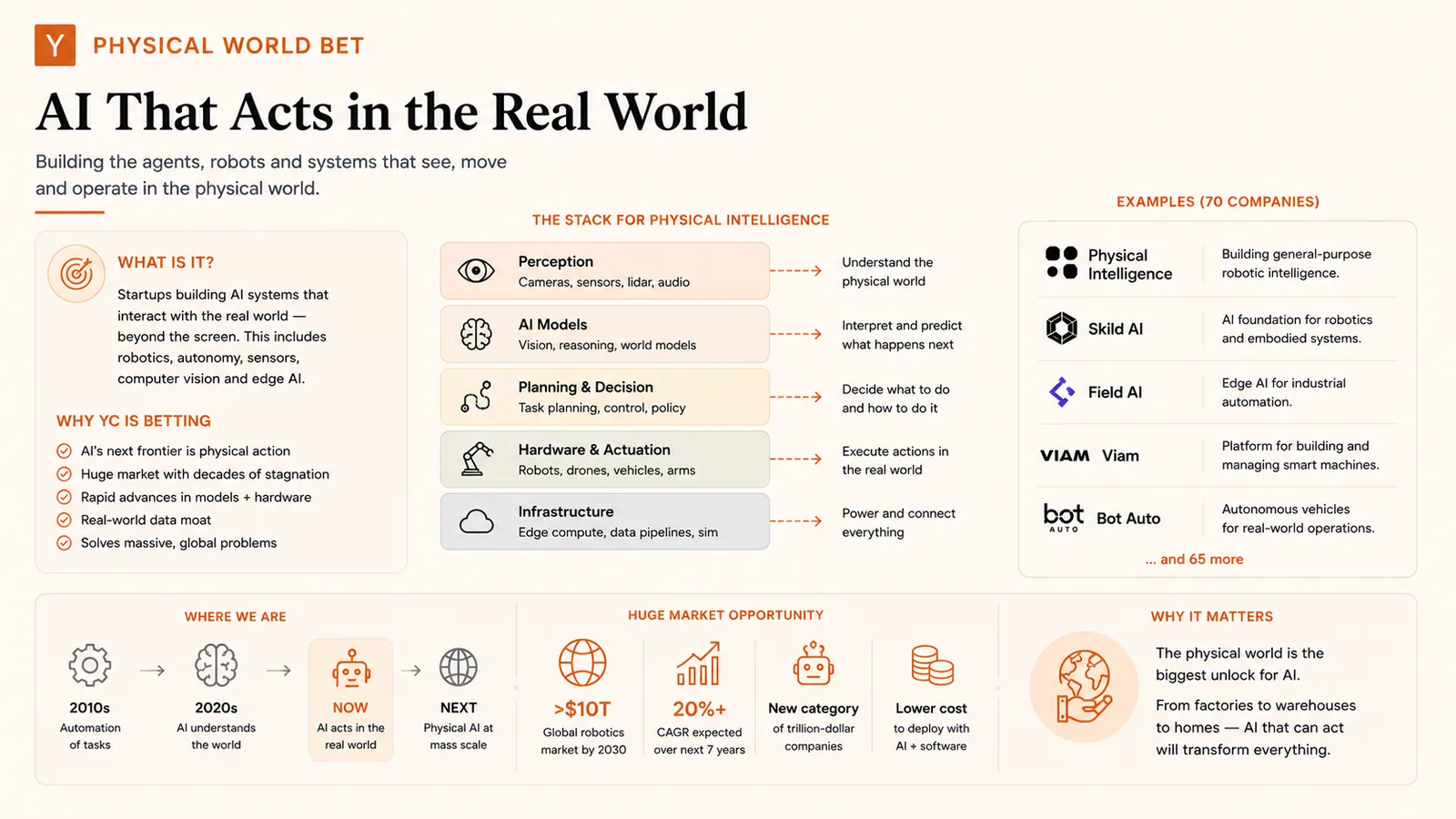
The 'physical world' bet is that AI's next frontier is physical action — building the agents, robots and systems that see, move and operate in the real world, beyond the screen.
In simple terms
AI that acts in the physical world — robotics, autonomy, sensors and edge AI.
How it works
- 1The stack for physical intelligence: perception (cameras, sensors, lidar), AI models (vision, reasoning, world models).
- 2Planning & decision (task planning, control, policy) and hardware & actuation (robots, drones, vehicles, arms).
- 3Infrastructure (edge compute, data pipelines, simulation) ties it together.
- 4AI understands the world, decides what to do, and executes actions in it.
- 5This moves AI from understanding to acting at physical scale.
Key points
- AI's next frontier is beyond the screen: robotics, autonomy, computer vision, edge AI.
- Huge market with decades of stagnation now unlocked by better models plus hardware.
- Solves large, global problems (factories, warehouses, homes).
- A real-world data moat is a key advantage.
Why it matters
The physical-world bet points to a massive opportunity: applying modern AI to robots and autonomous systems that transform how physical work gets done.
Frequently asked questions
- What does 'AI in the physical world' mean?
- AI systems that perceive and act in reality — robots, drones, vehicles and embodied agents.
- Why now?
- Better AI models plus improving hardware and simulation make real-world autonomy newly practical.