
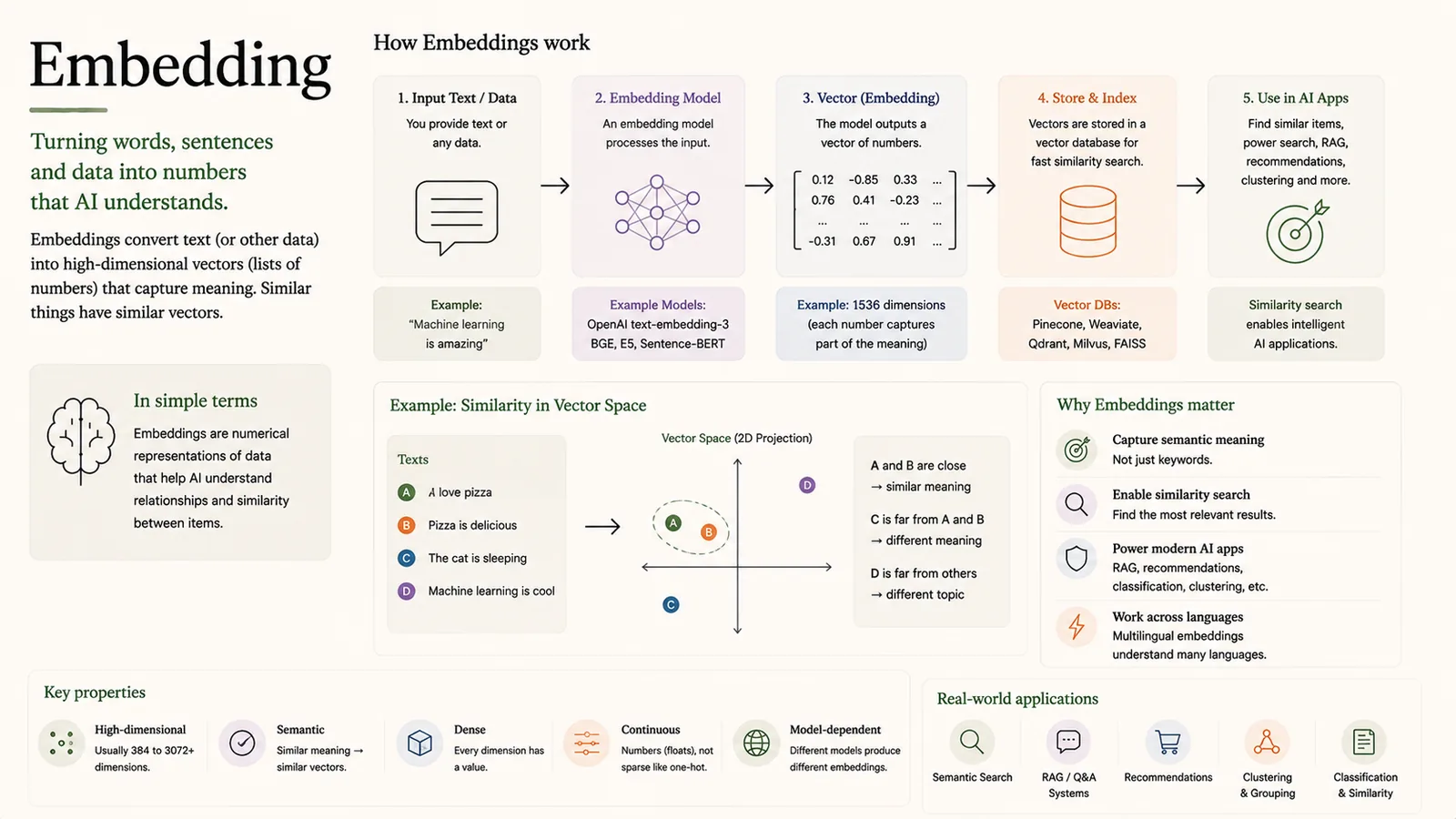
Embeddings convert text (or other data) into high-dimensional vectors — lists of numbers — that capture meaning. Similar things get similar vectors, which is what makes semantic search possible.
In simple terms
Turning words, sentences and data into numbers that capture meaning.
How it works
- 1Input text/data: you provide text or other data.
- 2Embedding model: a model processes the input.
- 3Vector: it outputs a vector (e.g. 1536 dimensions) that represents meaning.
- 4Store & index: vectors are stored in a vector database for fast similarity search.
- 5Use in AI apps: find similar items, power search, RAG, recommendations and clustering.
Key points
- Captures semantic meaning, not just matching keywords.
- Similar meanings sit close together in vector space.
- Popular models: OpenAI text-embedding-3, BGE, E5, Sentence-BERT.
- Powers semantic search, RAG, clustering and classification.
Why it matters
Embeddings are the foundation of modern AI search and RAG. By turning meaning into geometry, they let systems find relevant information even when the exact words differ.
Frequently asked questions
- Why are embeddings better than keyword search?
- They match meaning, so 'car' and 'automobile' are close even though the words differ.
- What uses embeddings?
- Semantic search, RAG, recommendations, clustering, deduplication and classification.
More in Tokens & Embeddings
Token
The basic unit of text AI models read and generate.
Tokenization
Breaking text into tokens the model can read.
Tokenizer
Breaks text into tokens the model can understand.
Token Embeddings
Turning tokens into meaningful vectors.
Context Window
How much text an AI can consider at once.
Cosine Similarity
Measuring similarity by the angle between vectors.