
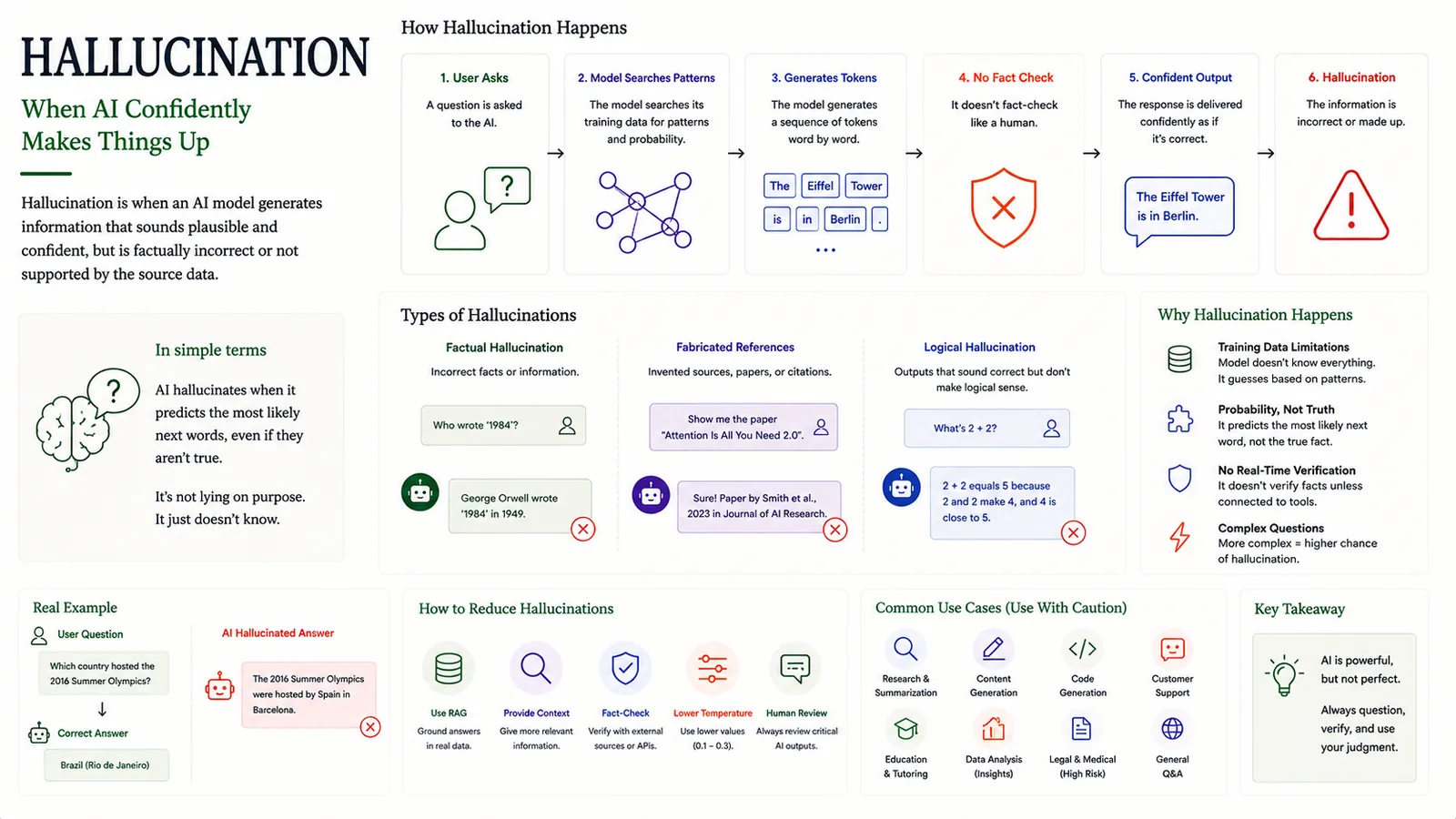
Hallucination is when an AI model generates information that sounds plausible and confident but is factually incorrect or unsupported by the source data. The model isn't lying on purpose — it predicts the most likely next words, even when they aren't true.
In simple terms
When AI confidently makes things up.
How it works
- 1A question is asked to the AI.
- 2The model searches its training data for patterns and probability.
- 3It generates a sequence of tokens word by word.
- 4It doesn't fact-check — the response is delivered as if it's correct.
- 5The result can be information that is incorrect or made up.
Key points
- Types include factual, fabricated references, and logical hallucinations.
- Causes: training data limits, probability-based prediction, no real-time verification.
- Reduce it with RAG/grounding, better retrieval, evals and guardrails.
- Always verify important AI outputs — the model can be confidently wrong.
Why it matters
Hallucination is the core reliability risk of LLMs. Understanding why it happens — and mitigating it with grounding, retrieval and guardrails — is essential for trustworthy AI products.
Frequently asked questions
- Why do models hallucinate?
- They predict likely text from patterns, without a built-in fact-checker, so plausible-but-wrong answers can slip through.
- How do I reduce hallucinations?
- Ground answers with RAG, use better retrieval and citations, lower temperature, and add output guardrails and evals.