
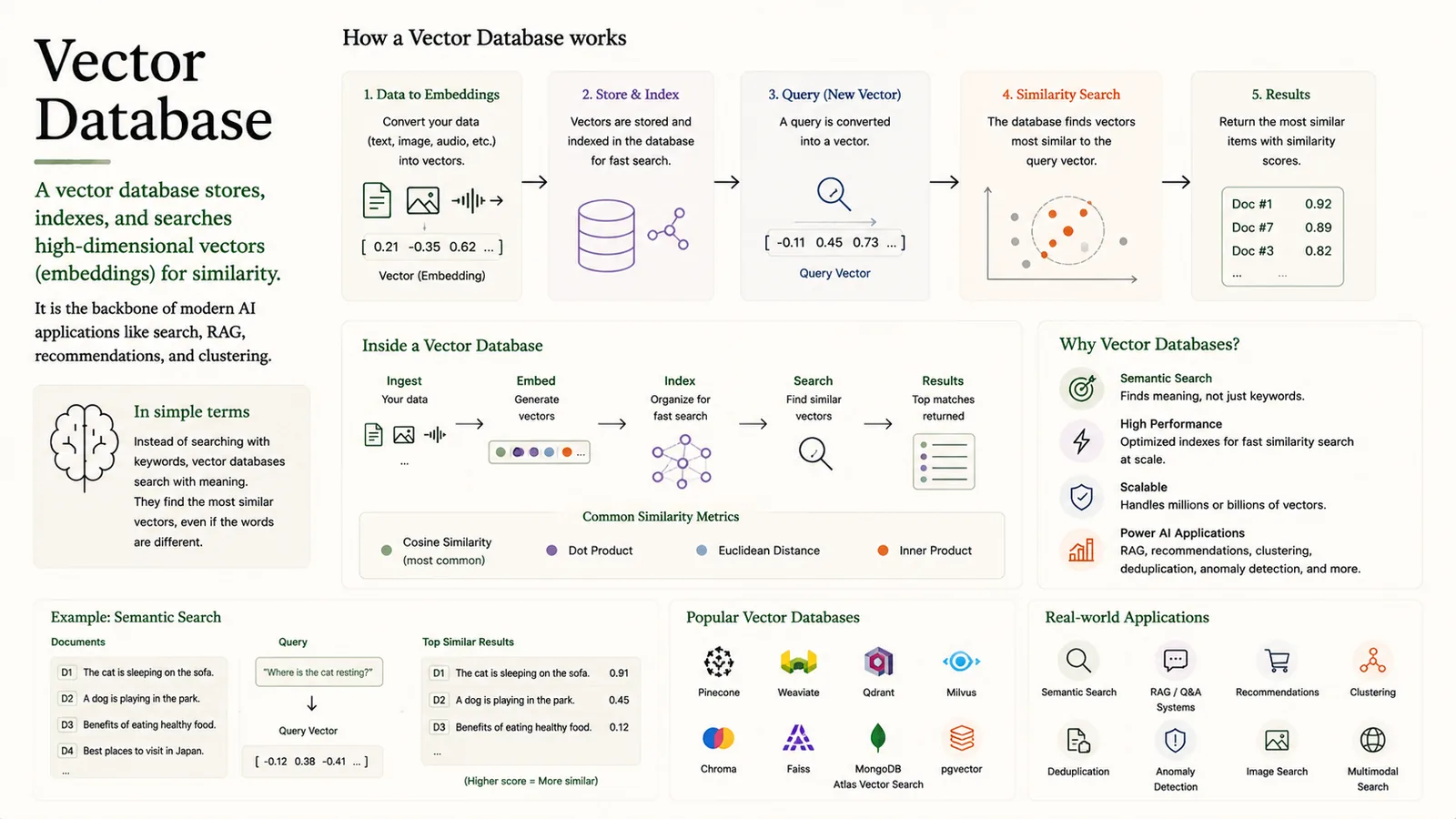
A vector database stores, indexes and searches high-dimensional vectors (embeddings) for similarity. It's the backbone of modern AI applications like semantic search, RAG, recommendations and clustering.
In simple terms
A database that finds items by meaning — searching embeddings for the closest matches.
How it works
- 1Data to embeddings: convert your data (text, image, audio) into vectors.
- 2Store & index: vectors are stored and indexed for fast search.
- 3Query (new vector): a query is converted into a vector.
- 4Similarity search: the database finds vectors most similar to the query vector.
- 5Results: it returns the most similar items with similarity scores.
Key points
- Searches by meaning, not exact keywords.
- Optimised indexes make similarity search fast at scale.
- Handles millions or billions of vectors.
- Popular options: Pinecone, Weaviate, Qdrant, Milvus, Chroma, FAISS.
Why it matters
Vector databases are what make RAG and semantic search practical at scale. They turn embeddings into fast, meaning-based lookups over huge collections of data.
Frequently asked questions
- How is it different from a normal database?
- A normal database matches exact values; a vector database finds the closest items by meaning using similarity metrics.
- What similarity metric is used?
- Most commonly cosine similarity, along with dot product or Euclidean distance.