
Startup Case Studies
Rote — AI for Auto-Body Claims
Case study: an AI employee that recovers underpaid insurance claims.
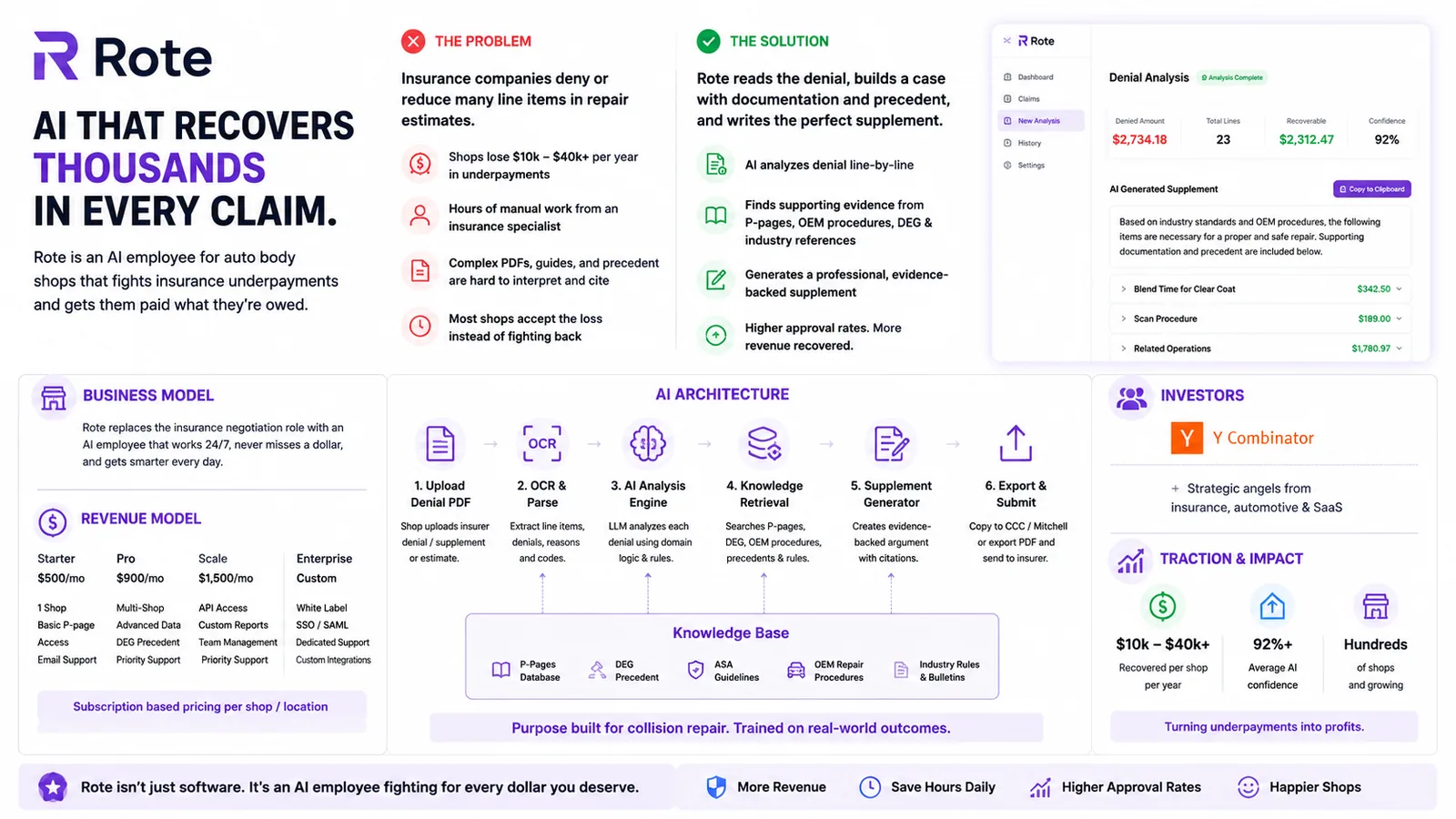
This is a case study of Rote, an example AI startup that acts as an AI employee for auto-body shops, fighting insurance underpayments and getting shops paid what they're owed. It illustrates how a focused vertical AI product is structured.
In simple terms
A vertical AI product example: an AI 'employee' that recovers underpaid auto-body insurance claims.
How it works
- 1The problem: insurance companies deny or reduce line items in repair estimates, costing shops thousands.
- 2Rote reads the denial line by line and builds a documented, precedent-backed case.
- 3AI architecture: upload denial PDF → OCR & parse → AI analysis → knowledge retrieval → supplement generation → export & submit.
- 4A knowledge base holds P-pages, DEG precedents, OEM procedures and industry rules.
- 5Result: higher approval rates and recovered revenue for the shop.
Key points
- A focused, vertical AI product solving one expensive, specific problem.
- Combines OCR, retrieval over a domain knowledge base, and generation.
- Subscription pricing per shop/location with tiered plans.
- Turns insurance underpayments into recovered profit.
Why it matters
This case study shows how to structure a real vertical AI product — a clear problem, a domain knowledge base, and a retrieval-plus-generation pipeline that delivers measurable business value.
Frequently asked questions
- What makes this a good AI use case?
- A narrow, expensive, document-heavy problem where retrieval over domain knowledge plus generation clearly saves money.
- What's the architecture?
- Upload → OCR/parse → analysis → knowledge retrieval → supplement generation → export & submit.