
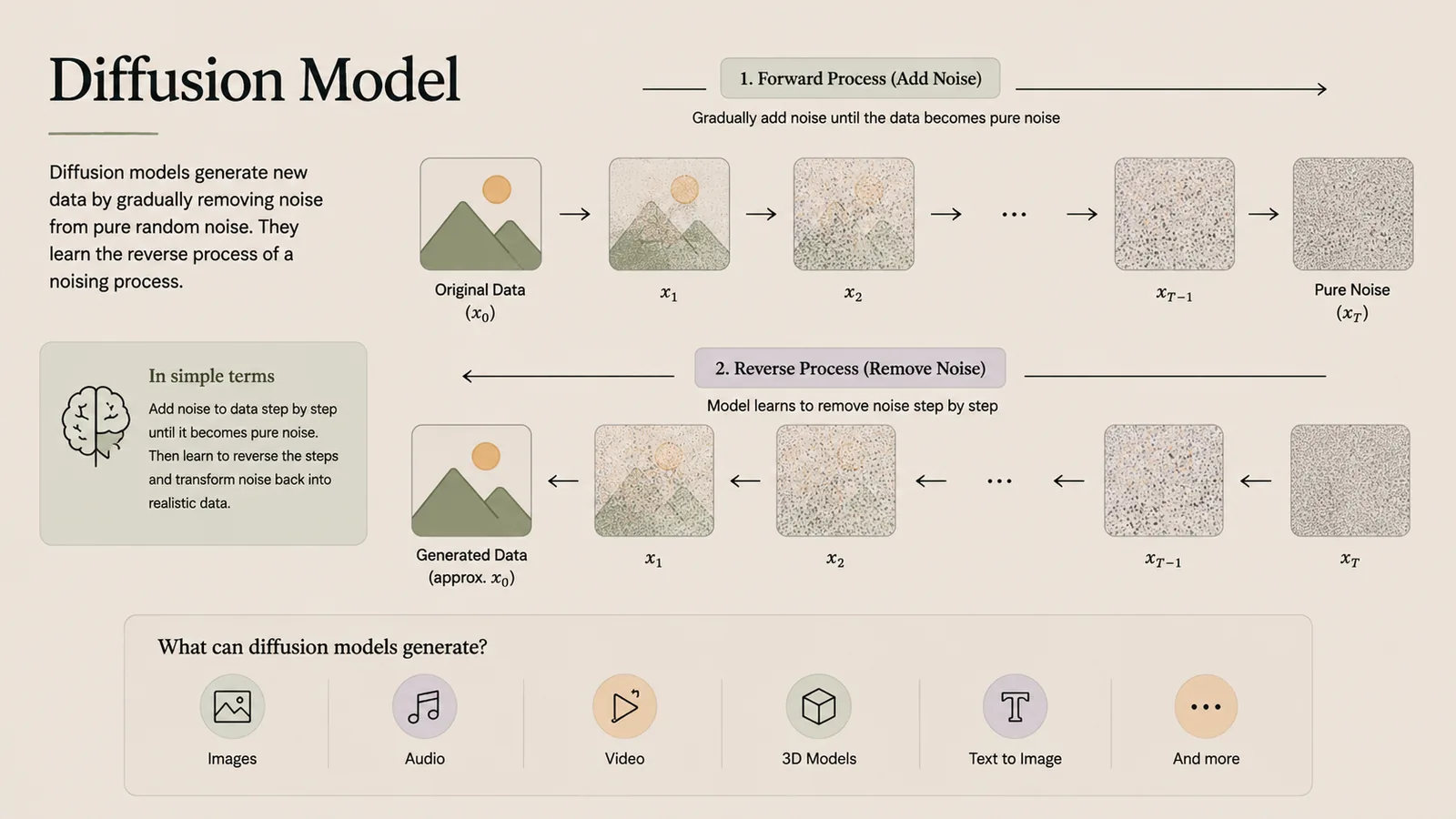
Diffusion models generate new data by gradually removing noise from pure random noise. They learn the reverse of a process that slowly adds noise to data, so they can turn noise back into realistic images, audio or video.
In simple terms
Add noise to data step by step until it's pure noise, then learn to reverse it into new data.
How it works
- 1Forward process (add noise): gradually add noise to real data until it becomes pure noise.
- 2The model learns what noise was added at each step.
- 3Reverse process (remove noise): starting from pure noise, the model removes noise step by step.
- 4Each step makes the sample cleaner and more realistic.
- 5The final result is new, realistic generated data (approximately like the training data).
Key points
- Diffusion learns the reverse of a noising process.
- Generation starts from random noise and denoises toward an image.
- Powers image, audio, video, 3D and text-to-image generation.
- Modern text-to-image tools (like Stable Diffusion) work in a compressed latent space for speed.
Why it matters
Diffusion models are behind today's best text-to-image systems. Their step-by-step denoising produces high-quality, diverse results and has largely overtaken GANs for image generation.
Frequently asked questions
- Why start from noise?
- The model was trained to reverse a noising process, so it can begin at pure noise and iteratively refine it into a clean sample.
- Are diffusion models better than GANs?
- For image generation they usually produce higher quality and more diverse results, and train more stably.