
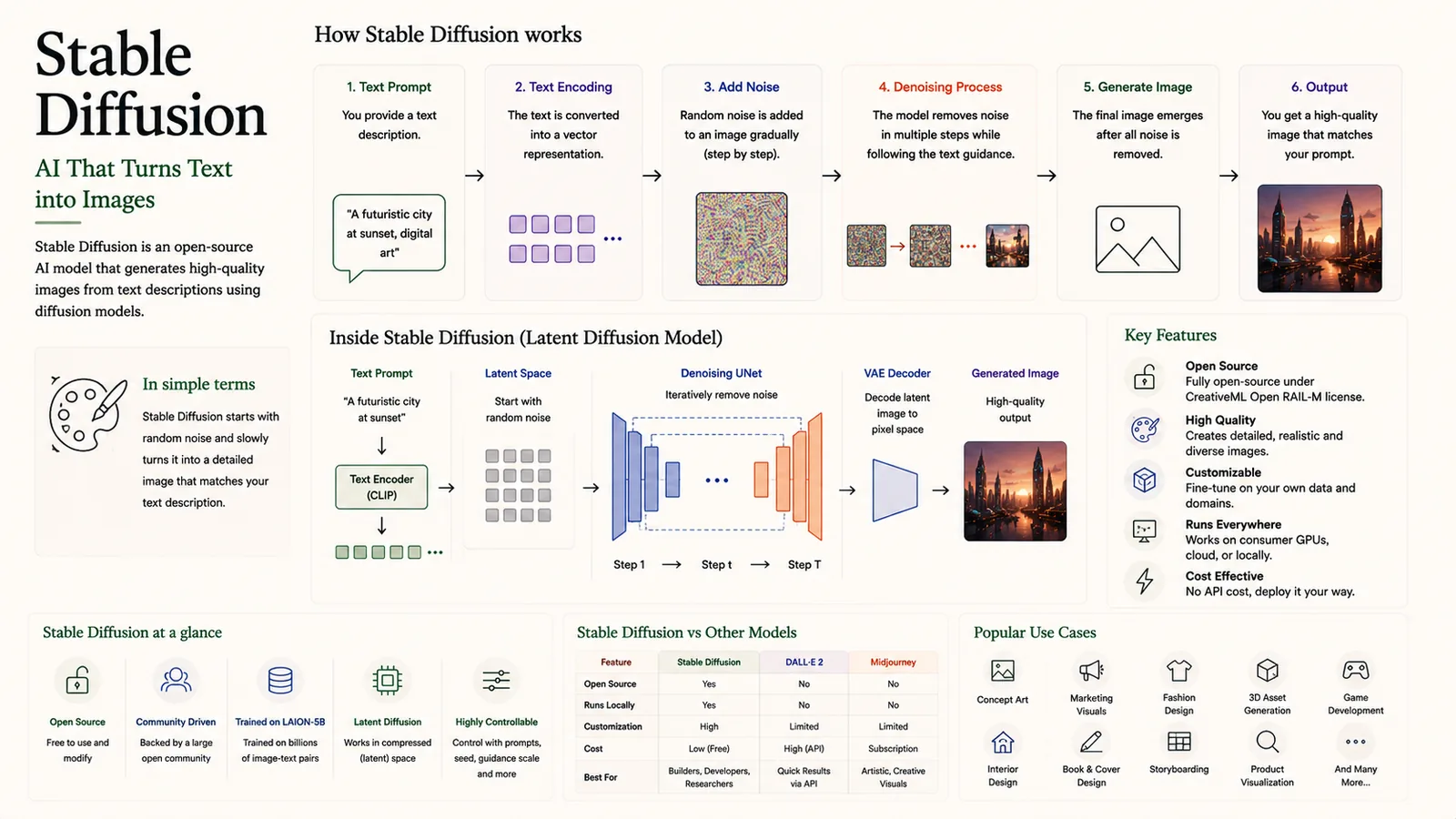
Stable Diffusion is an open-source AI model that generates high-quality images from text descriptions using diffusion. Because it is open, it can be downloaded, run locally and fine-tuned for your own styles.
In simple terms
An open-source text-to-image model that starts from noise and refines it into an image matching your prompt.
How it works
- 1Text prompt: you provide a text description.
- 2Text encoding: the text is converted into a vector representation (via CLIP).
- 3Add noise: the process starts from random noise in a compressed latent space.
- 4Denoising process: a UNet removes noise step by step, guided by your text.
- 5Generate image: a VAE decoder converts the latent result to a full image.
- 6Output: a high-quality image matching your prompt.
Key points
- Open source — free to use, run locally and modify.
- Works in a compressed latent space, which makes it efficient.
- Highly controllable with prompts, seeds and guidance scale.
- Runs on consumer GPUs, cloud, or locally with no API cost.
Why it matters
Stable Diffusion put powerful image generation in everyone's hands — free, local and customisable. Its open ecosystem sparked a huge wave of fine-tuned models, tools and creative applications.
Frequently asked questions
- How is it different from DALL·E?
- Stable Diffusion is open source and can run locally for free; DALL·E is a hosted service. Both use diffusion.
- What is 'latent space' here?
- A compressed representation where the denoising happens, making generation far faster than working on full-resolution pixels.