
Image & Generative Models
GAN (Generative Adversarial Network)
Generator vs. discriminator, competing to improve.
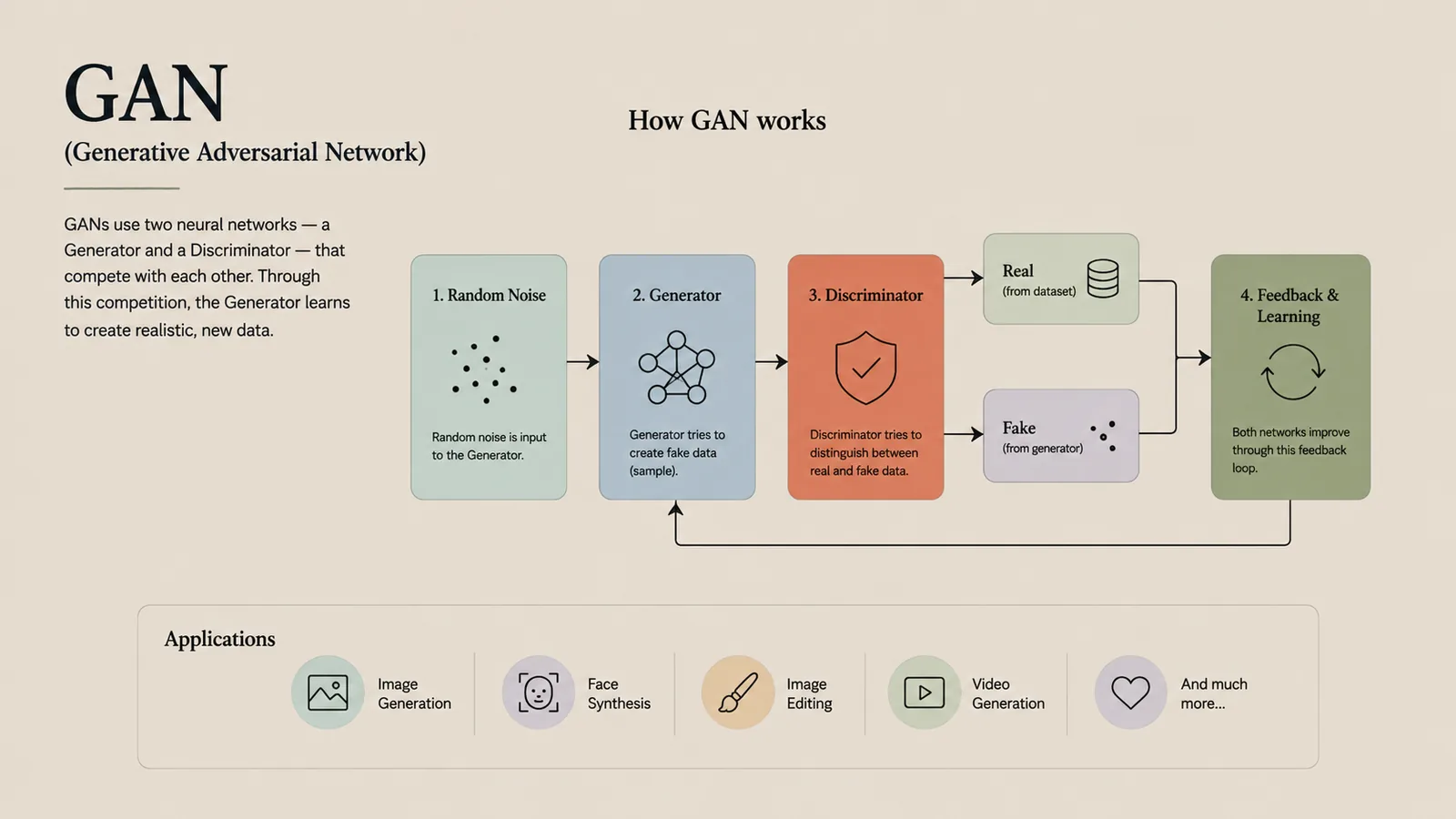
A GAN (Generative Adversarial Network) uses two neural networks — a Generator and a Discriminator — that compete with each other. Through this competition, the Generator learns to create realistic, new data.
In simple terms
Two networks compete: one fakes data, the other spots fakes — and both get better.
How it works
- 1Random noise is fed into the Generator.
- 2The Generator tries to create fake data (a sample).
- 3The Discriminator tries to tell real data (from the dataset) apart from fake data (from the generator).
- 4Feedback & learning: both networks improve through this feedback loop.
Key points
- The Generator learns to fool the Discriminator; the Discriminator learns to catch fakes.
- They train together until the fakes look realistic.
- Great for image generation, face synthesis, image editing and video generation.
- Training can be unstable and needs care to balance the two networks.
Why it matters
GANs produced some of the first strikingly realistic AI-generated faces and images. The adversarial idea — pitting two networks against each other — remains a landmark technique in generative modelling.
Frequently asked questions
- What do the two networks do?
- The Generator creates fake samples; the Discriminator judges real vs fake. Their competition drives realism.
- What are GANs used for?
- Image generation, face synthesis, photo editing, super-resolution and video generation.