
Enterprise Explainers
Enterprise AI Agent Architecture
What an enterprise AI agent actually consists of.
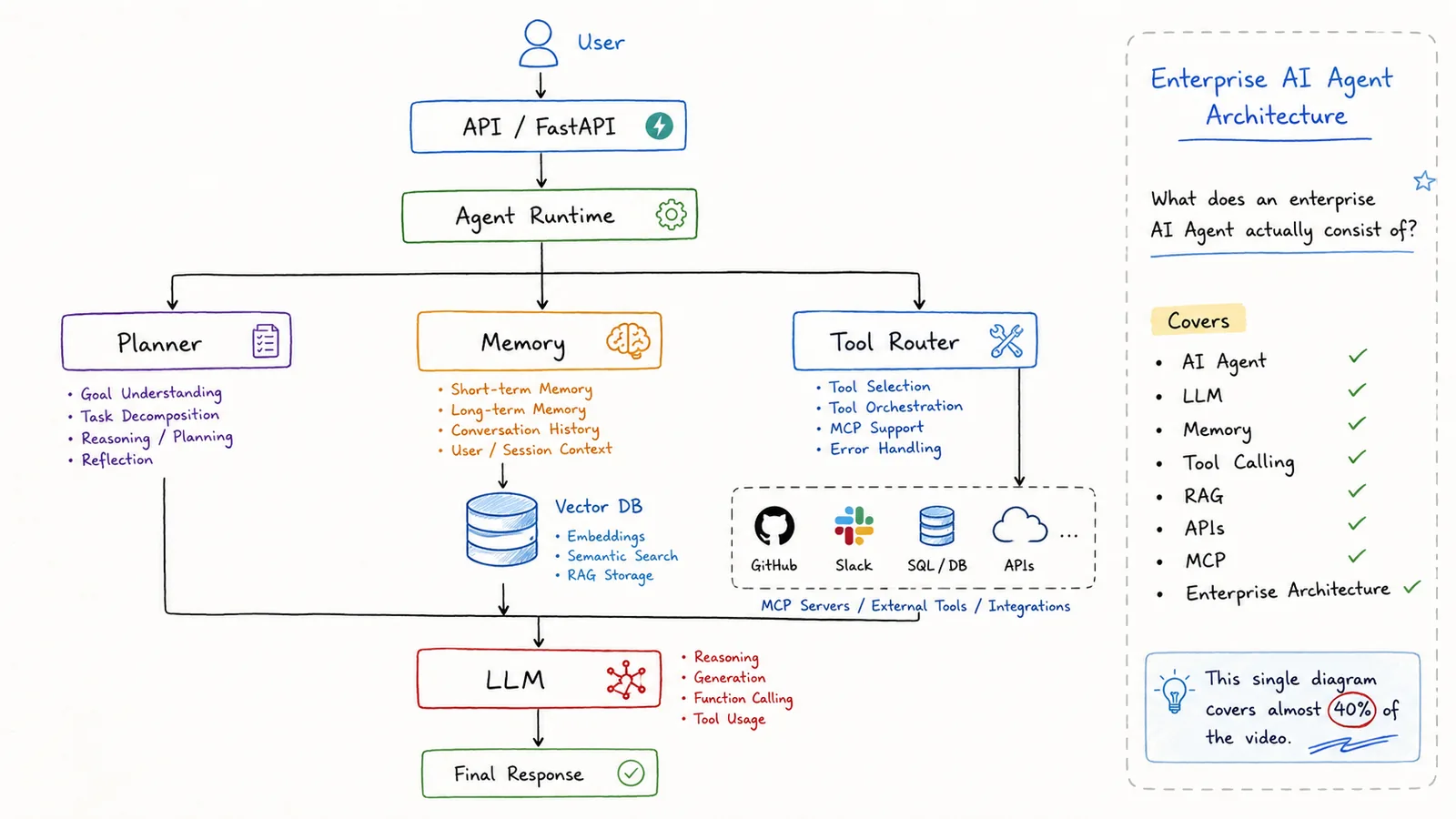
This single diagram captures what an enterprise AI agent actually consists of — and covers roughly 40% of everything you need to know. It shows the core parts working together.
In simple terms
The essential anatomy of an enterprise AI agent in one diagram.
How it works
- 1A user request comes in via an API / FastAPI layer to the agent runtime.
- 2A planner handles goal understanding, task decomposition and reasoning.
- 3Memory (short-term, long-term, conversation, user context) is backed by a vector DB for RAG.
- 4A tool router selects and orchestrates tools (MCP servers, GitHub, Slack, SQL/DB, APIs).
- 5The LLM reasons, generates and calls functions, returning the final response.
Key points
- Covers AI agent, LLM, memory, tool calling, RAG, APIs, MCP and enterprise architecture.
- The planner, memory and tool router are the three core pillars.
- The vector DB powers semantic search and RAG storage.
- One diagram that captures most of what an enterprise agent needs.
Why it matters
A compact mental model of an agent's core parts — planner, memory, tools, LLM — makes everything else easier to learn and design.
Frequently asked questions
- What are an agent's core parts?
- A planner, memory (with a vector DB for RAG), a tool router, and the LLM that reasons and generates.
- Where does RAG fit?
- In the memory layer — a vector DB stores embeddings for semantic retrieval.