
Enterprise Explainers
One Interface, Every Model
Orchestrate any LLM through one unified integration layer.
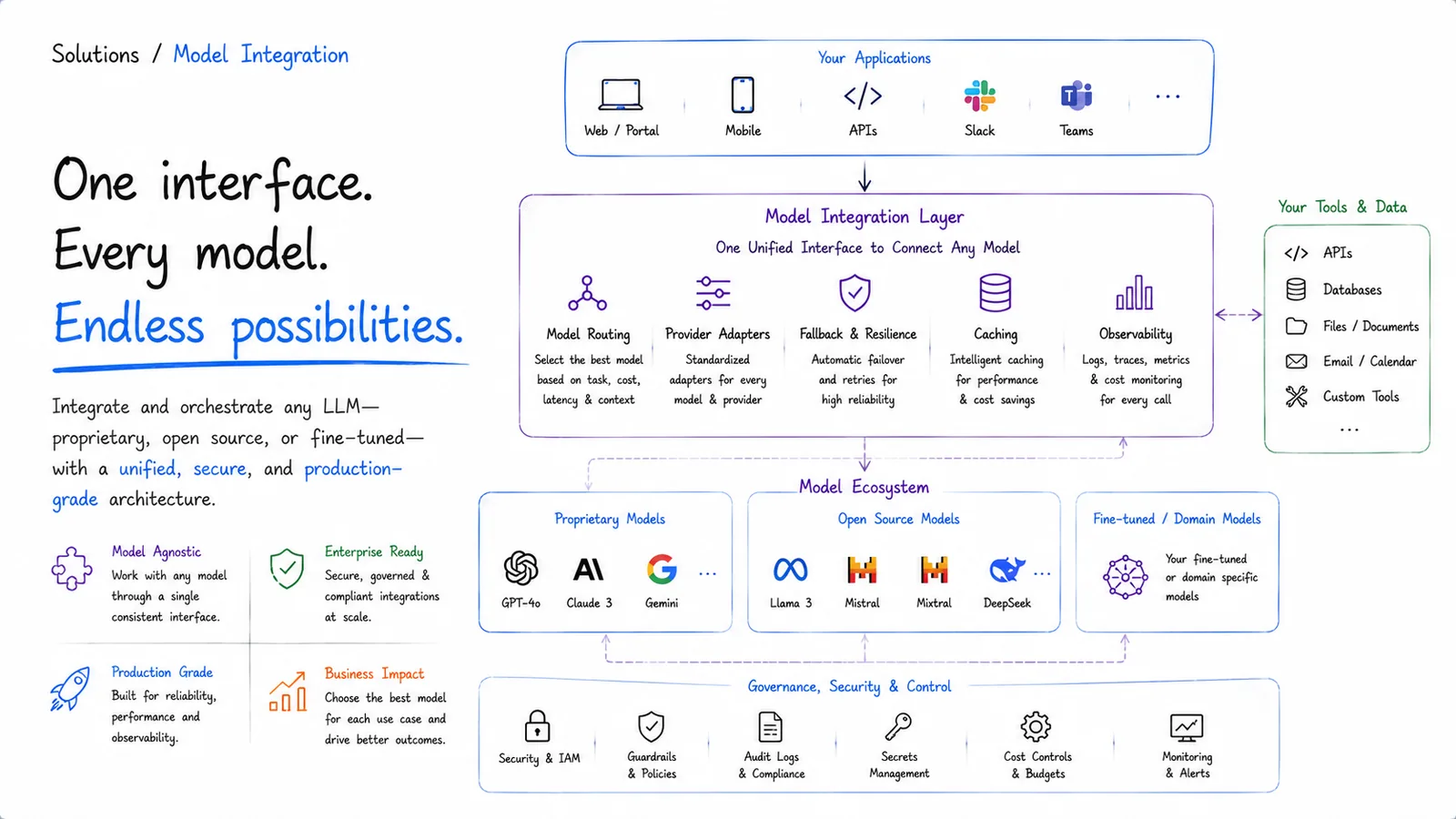
This shows a model integration layer — one unified interface to connect any LLM, so you can integrate and orchestrate any model (proprietary, open source or fine-tuned) with a single, secure, production-grade architecture.
In simple terms
One interface to connect and orchestrate any model — proprietary, open source or fine-tuned.
How it works
- 1Your applications (web, mobile, APIs, Slack, Teams) call one integration layer.
- 2The layer handles model routing, provider adapters, fallback & resilience, caching and observability.
- 3It connects to the model ecosystem: proprietary (GPT-4o, Claude, Gemini), open source (Llama, Mistral, DeepSeek) and fine-tuned/domain models.
- 4It reaches tools & data: APIs, databases, files, email/calendar and custom tools.
- 5Governance, security and control wrap everything.
Key points
- Model agnostic — work with any model through one consistent interface.
- Production grade — reliability, performance and observability built in.
- Model routing picks the best model per task, cost and latency.
- Choose the best model for each use case and drive better outcomes.
Why it matters
A model integration layer avoids lock-in and lets you route each request to the best model — key for cost, reliability and flexibility as models change fast.
Frequently asked questions
- What does a model integration layer do?
- It gives one unified interface to route, adapt, cache and observe requests across many LLM providers.
- Why route between models?
- To pick the best model per task on cost, latency and quality, and to fall back if one fails.