
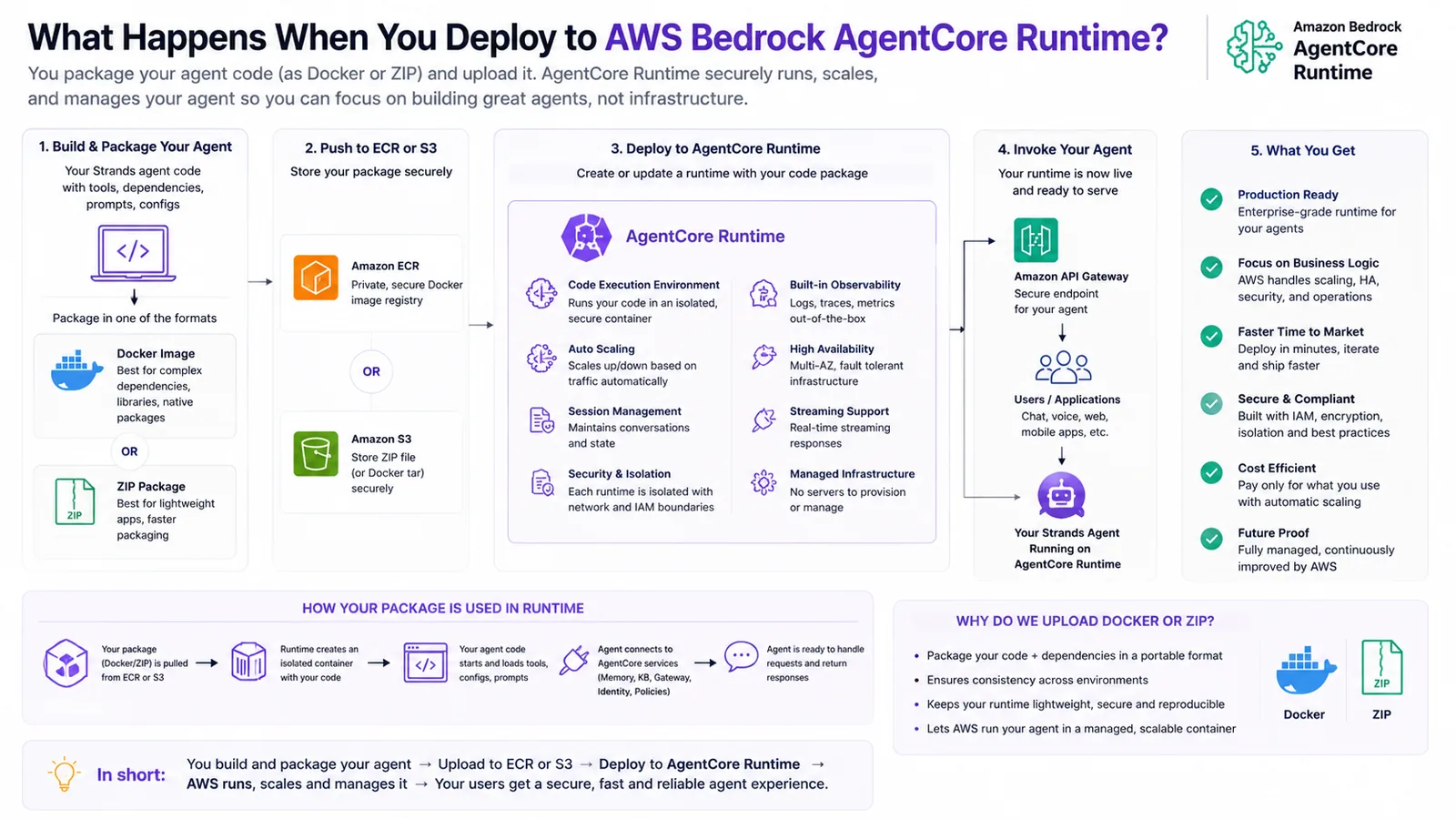
This explains what happens when you deploy to AWS Bedrock AgentCore Runtime: you package your agent code and upload it, and AgentCore securely runs, scales and manages it so you focus on building agents, not infrastructure.
In simple terms
Package your agent, push it, and AgentCore Runtime runs and scales it for you.
How it works
- 1Build & package your agent (as a Docker image or ZIP) with tools, dependencies and config.
- 2Push to ECR or S3 to store the package securely.
- 3Deploy to AgentCore Runtime — create or update a runtime with your package.
- 4Invoke your agent live via API Gateway to users/applications.
- 5You get a production-grade, auto-scaling, observable runtime.
Key points
- Docker image is best for complex dependencies; ZIP for lightweight, faster packaging.
- The runtime provides an isolated execution environment, auto scaling and session management.
- Built-in observability, high availability and managed infrastructure.
- You pay only for what you use, with automatic scaling.
Why it matters
Deployment is where many agents stall. AgentCore Runtime removes the infrastructure burden — you package the agent and it handles running, scaling and managing it securely.
Frequently asked questions
- Docker or ZIP?
- Docker for complex native dependencies; ZIP for lightweight agents and faster packaging.
- What does the runtime manage?
- Isolated execution, auto scaling, session management, observability and high availability.
More in AWS Bedrock AgentCore
Insurance Support Agent on AgentCore
Reference architecture on AWS Bedrock AgentCore.
Why Strands Framework for AgentCore
Strands vs building agents yourself.
What Happens When a User Runs a Query
End-to-end AgentCore flow and how charges apply.
Lifecycle of an Enterprise AI Agent
Development to production on AgentCore.
What AgentCore Manages For You
The ~15 systems AgentCore replaces.
Inside Runtime (Internal Brain)
Step-by-step execution inside AgentCore Runtime.