
AWS Bedrock AgentCore
Inside Runtime (Internal Brain)
Step-by-step execution inside AgentCore Runtime.
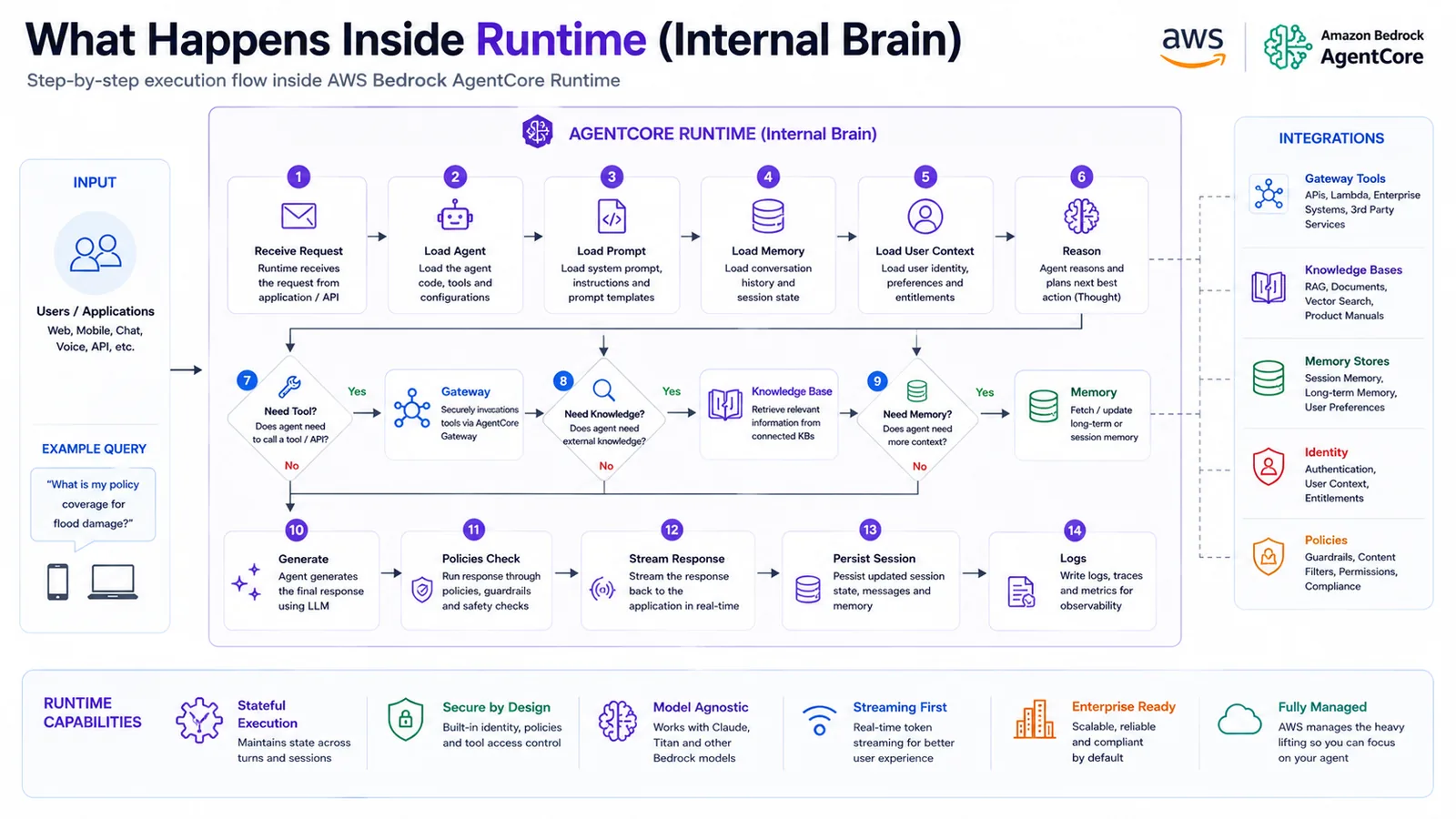
This is a step-by-step view inside AWS Bedrock AgentCore Runtime — the internal brain — showing exactly how a request is processed from receipt to logging.
In simple terms
A 13-step tour of what the AgentCore Runtime does with each request.
How it works
- 1Receive the request from the application/API and load the agent, prompt and config.
- 2Load memory (conversation history, session state) and user context.
- 3Reason and plan the next action; if a tool is needed, call it via the gateway.
- 4If knowledge is needed, retrieve from connected knowledge bases; update memory as needed.
- 5Generate the final response, run policy/guardrail checks, stream it back, persist session and write logs.
Key points
- Runtime capabilities: stateful execution, secure by design, model agnostic, streaming-first.
- It integrates gateway tools, knowledge bases, memory stores, identity and policies.
- Enterprise-ready: scalable, reliable and fully managed.
- It maintains state across turns and sessions.
Why it matters
Understanding the runtime's internal steps demystifies how an agent actually executes — useful for debugging, optimising and trusting the system.
Frequently asked questions
- Is the runtime model-specific?
- No — it's model agnostic, working with Claude, Titan and other Bedrock models.
- Does it keep state?
- Yes — it maintains conversation and session state across turns.
More in AWS Bedrock AgentCore
Insurance Support Agent on AgentCore
Reference architecture on AWS Bedrock AgentCore.
Why Strands Framework for AgentCore
Strands vs building agents yourself.
Deploy to AgentCore Runtime
Packaging and shipping an agent to AgentCore.
What Happens When a User Runs a Query
End-to-end AgentCore flow and how charges apply.
Lifecycle of an Enterprise AI Agent
Development to production on AgentCore.
What AgentCore Manages For You
The ~15 systems AgentCore replaces.