
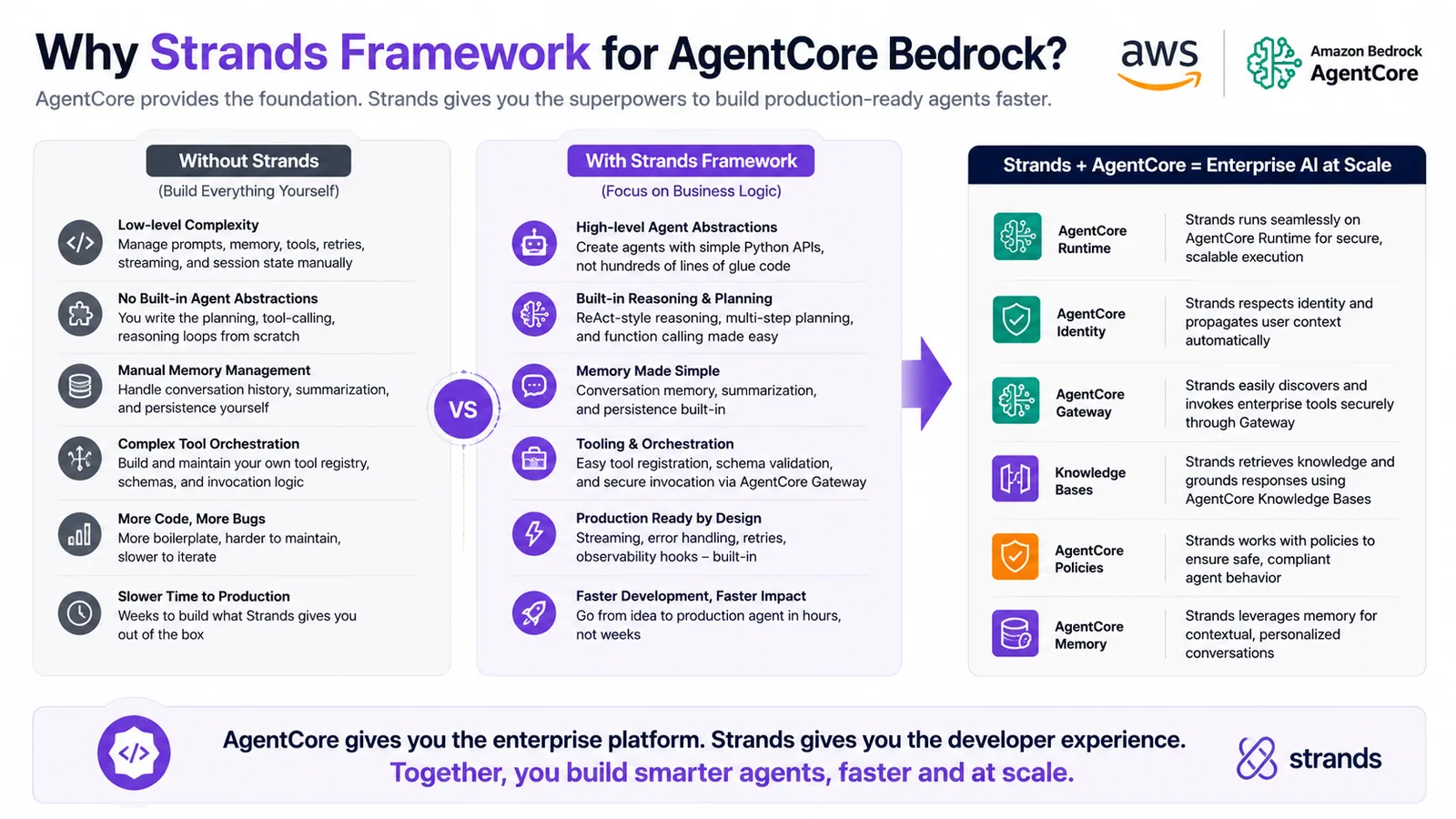
This compares building agents yourself versus using the Strands framework on AgentCore. AgentCore provides the foundation; Strands gives the developer superpowers to build production-ready agents faster.
In simple terms
Strands gives you high-level abstractions so you build agents in hours, not weeks.
How it works
- 1Without Strands: you manage complexity, write planning and tool-calling loops, and handle memory manually.
- 2With Strands: high-level abstractions create agents with simple Python APIs.
- 3Built-in reasoning & planning (ReAct-style) and easy tool registration.
- 4Memory is built in; tool orchestration goes through the AgentCore Gateway.
- 5Strands + AgentCore = enterprise AI at scale.
Key points
- Strands runs on AgentCore Runtime for secure, scalable execution.
- It respects AgentCore identity and propagates user context automatically.
- Memory, policies and observability are handled for you.
- Go from idea to production agent in hours, not weeks.
Why it matters
Frameworks like Strands remove the boilerplate of building agents, letting developers focus on business logic while AgentCore handles the enterprise runtime.
Frequently asked questions
- What does Strands add over raw AgentCore?
- High-level abstractions for agents, reasoning, tools and memory, so you write far less glue code.
- Does Strands handle security?
- It respects AgentCore identity and policies, propagating user context automatically.
More in AWS Bedrock AgentCore
Insurance Support Agent on AgentCore
Reference architecture on AWS Bedrock AgentCore.
Deploy to AgentCore Runtime
Packaging and shipping an agent to AgentCore.
What Happens When a User Runs a Query
End-to-end AgentCore flow and how charges apply.
Lifecycle of an Enterprise AI Agent
Development to production on AgentCore.
What AgentCore Manages For You
The ~15 systems AgentCore replaces.
Inside Runtime (Internal Brain)
Step-by-step execution inside AgentCore Runtime.