
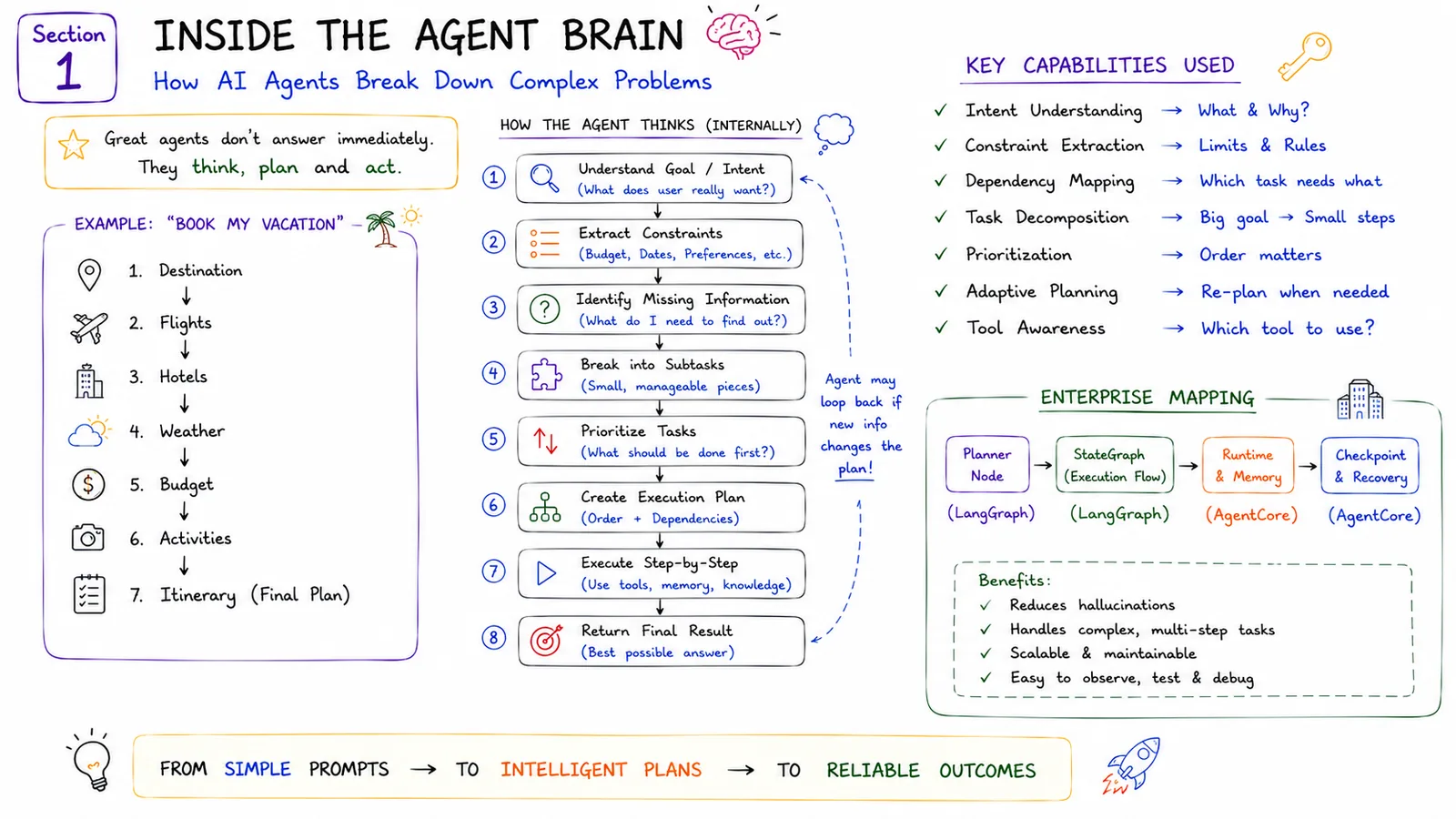
This looks inside the agent brain — how AI agents break down complex problems. Great agents don't answer immediately; they think, plan and act.
In simple terms
Agents break a big goal into small steps, plan them, and execute one by one.
How it works
- 1Understand the goal / intent — what does the user really want?
- 2Extract constraints (budget, dates, preferences) and identify missing information.
- 3Break the goal into subtasks and prioritise them.
- 4Create an execution plan (order + dependencies).
- 5Execute step by step using tools, memory and knowledge, then return the result.
Key points
- Key capabilities: intent understanding, constraint extraction, dependency mapping, task decomposition, adaptive planning.
- Maps to LangGraph (planner node, execution flow) and AgentCore (runtime, memory, recovery).
- Reduces hallucinations and handles complex, multi-step tasks.
- From simple prompts → intelligent plans → reliable outcomes.
Why it matters
Understanding how an agent decomposes problems explains why agents are more capable than one-shot models — and how to design them to plan and recover reliably.
Frequently asked questions
- How does an agent handle a complex task?
- It understands the goal, extracts constraints, breaks it into prioritised subtasks and executes them in order.
- Why plan before acting?
- Planning reduces hallucination and lets the agent handle multi-step tasks that a single answer can't.
More in Agent Brain Deep-Dive
Section 2 · Reasoning Patterns
ReAct, Plan-Execute, Reflection, Tree-of-Thoughts, Self-Consistency.
Section 3 · Planning Graphs Instead of Prompts
Stateful graphs that plan, decide and act.
Section 4 · Memory in AI Agents
Working, long-term, semantic and episodic memory.
Section 5 · Reasoning Engine
Think, observe, reflect and refine until confident.
Section 1.5 · How Agents Decide What To Do Next
The observe → decide → act → learn loop.