
Agent Brain Deep-Dive
Section 5 · Reasoning Engine
Think, observe, reflect and refine until confident.
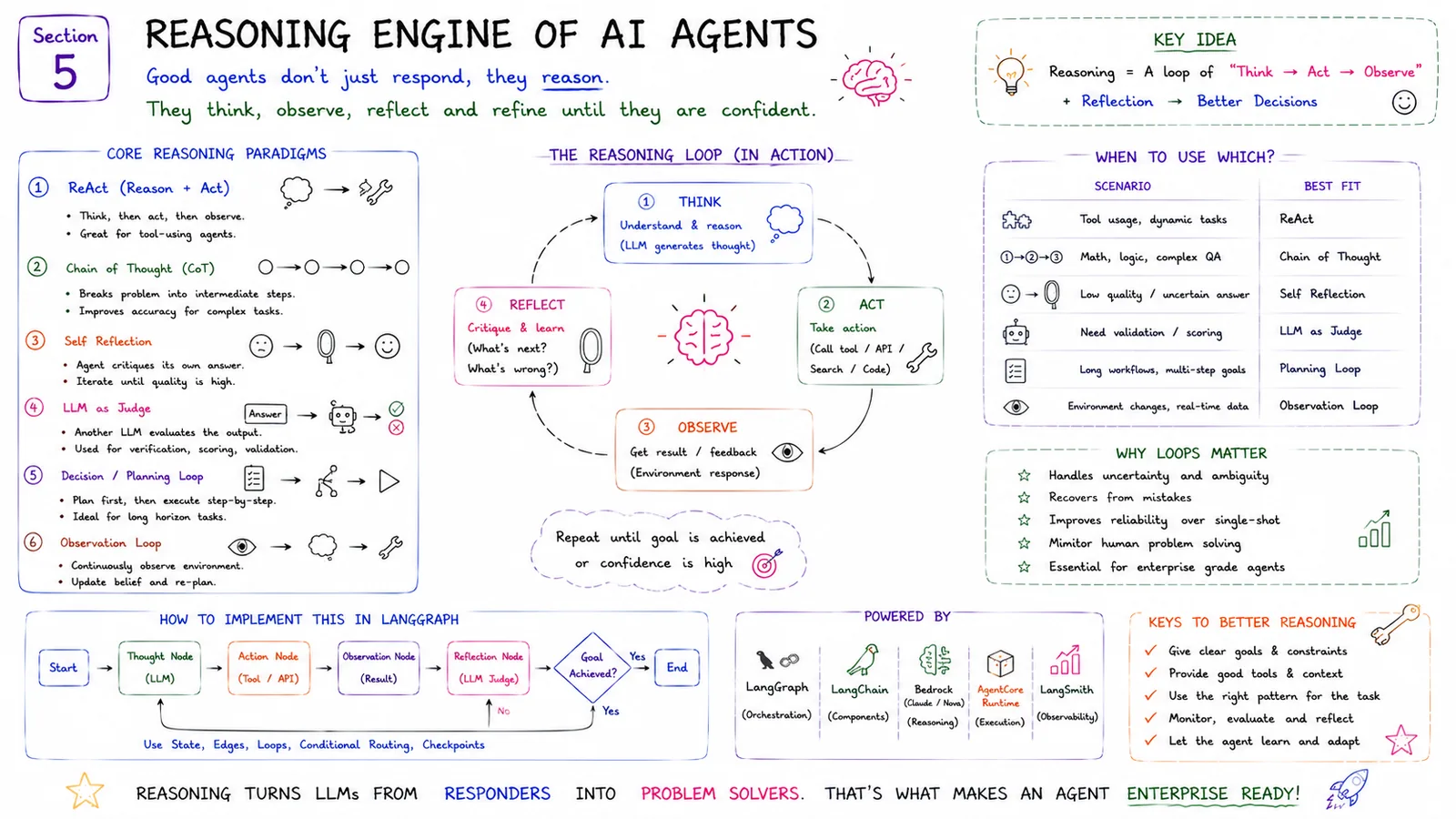
Good agents don't just respond, they reason. This explains the reasoning engine of AI agents — the loop of think → act → observe → reflect that continues until the agent is confident.
In simple terms
Agents think, act, observe and reflect in a loop until they're confident in the answer.
How it works
- 1Think: understand and reason (the LLM generates a thought).
- 2Act: take an action (tool call, API, search or code).
- 3Observe: get the result / feedback from the environment.
- 4Reflect: critique and learn — what's next, what went wrong?
- 5Repeat until the goal is achieved or confidence is high.
Key points
- Core paradigms: ReAct, Chain-of-Thought, Self-Reflection, LLM-as-Judge, planning loop, observation loop.
- Loops handle uncertainty, recover from mistakes and improve reliability.
- Implement with LangGraph state, edges, loops and conditional routing.
- Reasoning turns LLMs from responders into problem solvers.
Why it matters
The reasoning loop is what makes an agent enterprise-ready: it can plan, act, check its own work and refine until the result is trustworthy.
Frequently asked questions
- What is the reasoning loop?
- Think → act → observe → reflect, repeated until the goal is met or confidence is high.
- Why do loops matter?
- They let agents handle ambiguity, recover from mistakes and improve reliability over a single pass.
More in Agent Brain Deep-Dive
Section 1 · Inside the Agent Brain
How AI agents break down complex problems.
Section 2 · Reasoning Patterns
ReAct, Plan-Execute, Reflection, Tree-of-Thoughts, Self-Consistency.
Section 3 · Planning Graphs Instead of Prompts
Stateful graphs that plan, decide and act.
Section 4 · Memory in AI Agents
Working, long-term, semantic and episodic memory.
Section 1.5 · How Agents Decide What To Do Next
The observe → decide → act → learn loop.