
Agent Brain Deep-Dive
Section 2 · Reasoning Patterns
ReAct, Plan-Execute, Reflection, Tree-of-Thoughts, Self-Consistency.
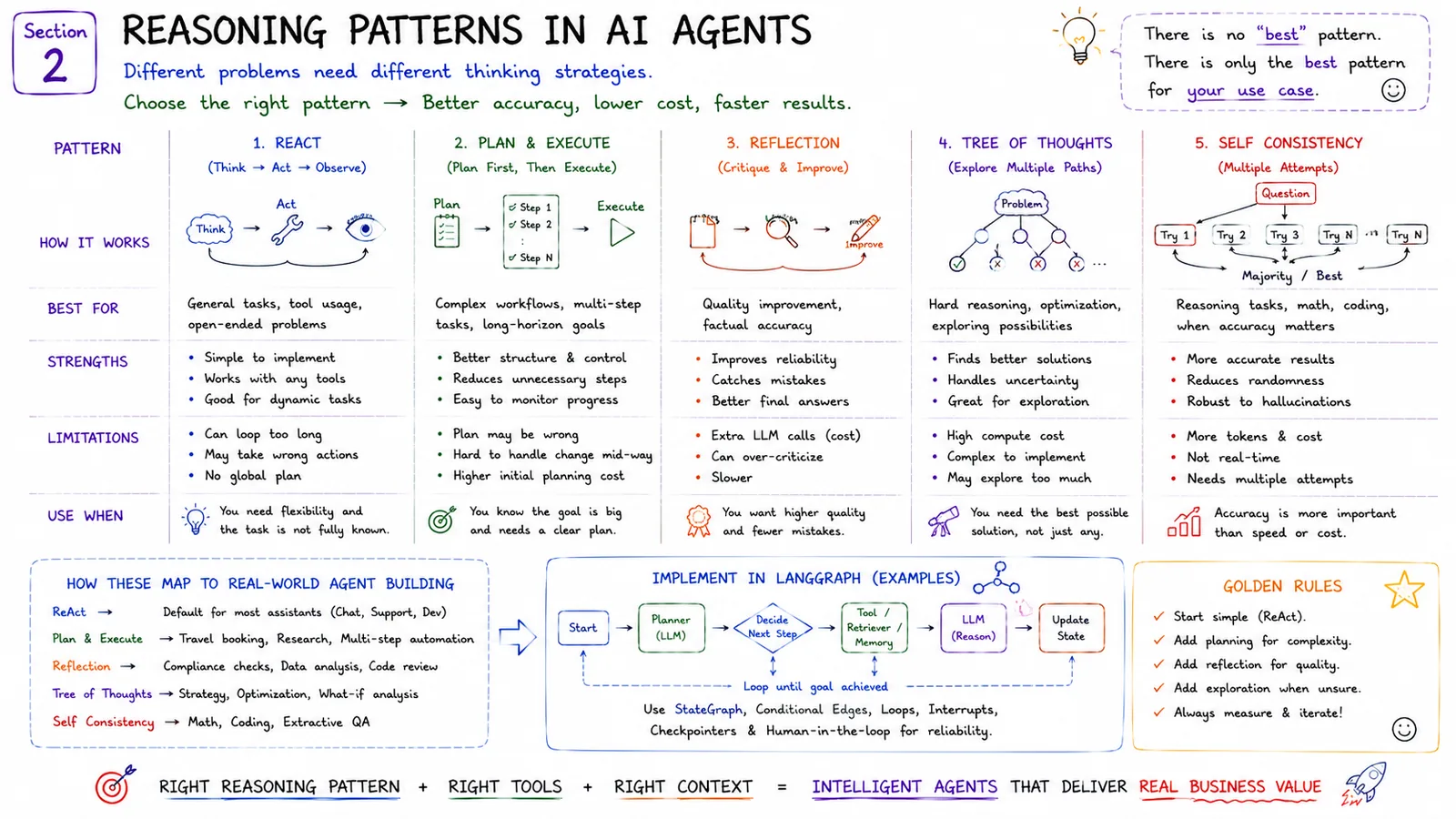
Different problems need different thinking strategies. This compares reasoning patterns in AI agents — ReAct, Plan-and-Execute, Reflection, Tree-of-Thoughts and Self-Consistency — and when to use each.
In simple terms
There's no single best reasoning pattern — pick the right one for the task.
How it works
- 1ReAct (think → act → observe): good for tool use and open-ended problems.
- 2Plan-and-Execute (plan first, then execute): good for complex, multi-step workflows.
- 3Reflection (critique → improve): improves quality and factual accuracy.
- 4Tree-of-Thoughts: explores multiple paths for hard reasoning.
- 5Self-Consistency: multiple attempts, take the majority answer.
Key points
- ReAct is simple and works with tools; Plan-and-Execute reduces mid-way changes.
- Reflection catches self-mistakes; Tree-of-Thoughts finds better solutions but costs more.
- Self-Consistency boosts accuracy on reasoning-heavy tasks.
- Golden rules: start simple (ReAct), add planning/reflection for complexity, always measure.
Why it matters
Choosing the right reasoning pattern balances accuracy, cost and speed. It's a core decision when designing capable, efficient agents.
Frequently asked questions
- What is ReAct?
- A pattern interleaving reasoning (thoughts) with acting (tool calls and observations), step by step.
- When use Tree-of-Thoughts?
- For hard problems where exploring multiple reasoning paths finds a better solution — at higher cost.
More in Agent Brain Deep-Dive
Section 1 · Inside the Agent Brain
How AI agents break down complex problems.
Section 3 · Planning Graphs Instead of Prompts
Stateful graphs that plan, decide and act.
Section 4 · Memory in AI Agents
Working, long-term, semantic and episodic memory.
Section 5 · Reasoning Engine
Think, observe, reflect and refine until confident.
Section 1.5 · How Agents Decide What To Do Next
The observe → decide → act → learn loop.