
Agent Brain Deep-Dive
Section 3 · Planning Graphs Instead of Prompts
Stateful graphs that plan, decide and act.
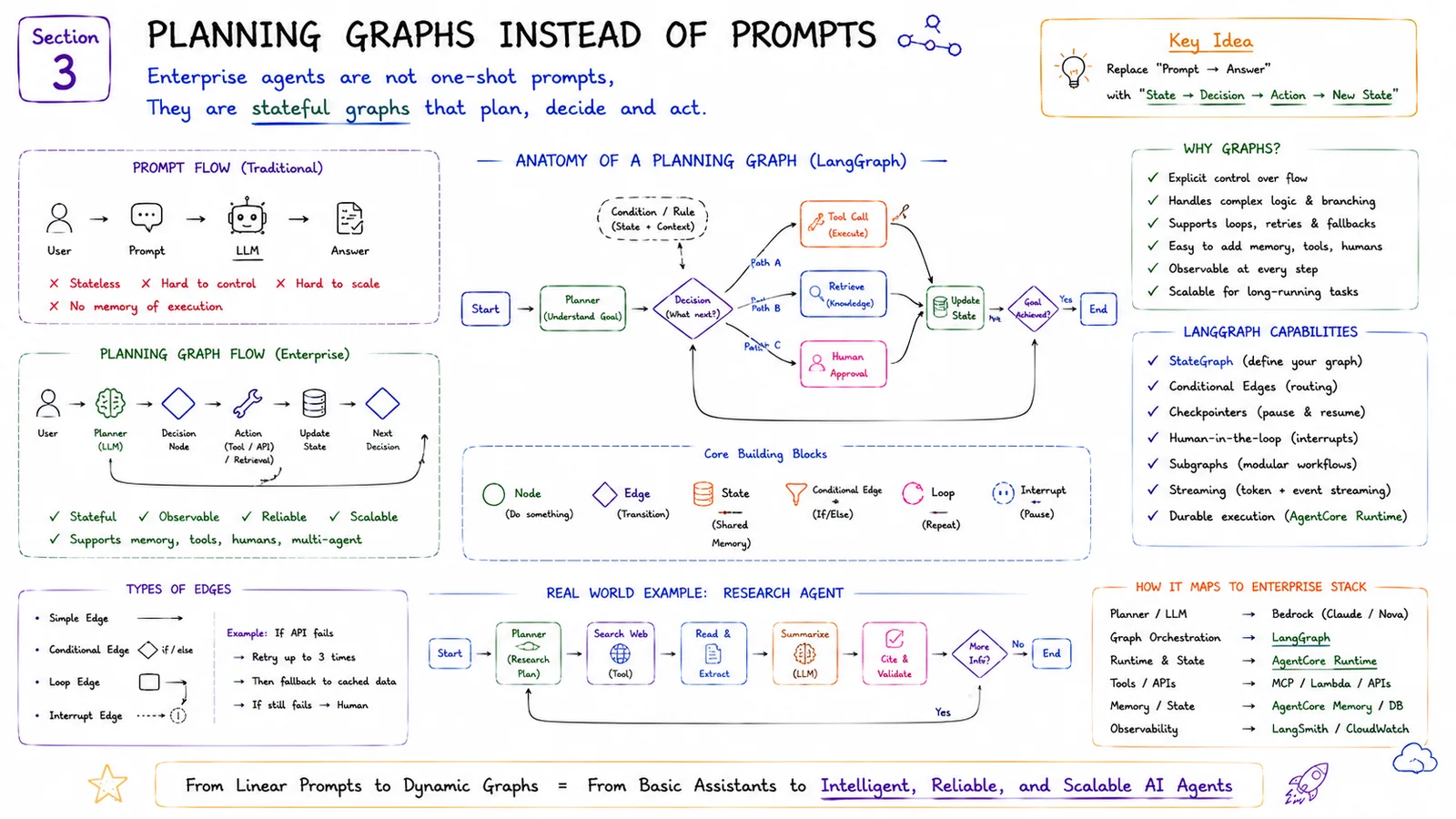
Enterprise agents are not one-shot prompts — they are stateful graphs that plan, decide and act. This explains planning graphs instead of prompts: replace 'prompt → answer' with 'state → decision → action → new state'.
In simple terms
Model agents as stateful graphs of nodes and edges, not single prompts.
How it works
- 1A planning graph has a planner node that understands the goal.
- 2Conditional edges route to tool calls, retrieval or human approval based on state.
- 3Nodes do work; edges are transitions (simple, conditional, loop or interrupt).
- 4State is updated after each step, and the graph loops until done.
- 5Example (research agent): plan → search → read/extract → summarise → cite → validate → end.
Key points
- Graphs give explicit control over flow, branching and loops.
- They support memory, retries, fallbacks and human-in-the-loop.
- LangGraph provides StateGraph, conditional edges, checkpointers and streaming.
- From linear prompts to dynamic graphs = from basic assistants to reliable agents.
Why it matters
Real workflows have branches, loops and approvals that a single prompt can't express. Planning graphs make agents controllable, observable and reliable.
Frequently asked questions
- Why graphs instead of prompts?
- Graphs handle branching, loops, retries and human approval explicitly, which single prompts can't.
- What are the core building blocks?
- Nodes (do work), edges (transitions), state, conditional edges, loops and interrupts.
More in Agent Brain Deep-Dive
Section 1 · Inside the Agent Brain
How AI agents break down complex problems.
Section 2 · Reasoning Patterns
ReAct, Plan-Execute, Reflection, Tree-of-Thoughts, Self-Consistency.
Section 4 · Memory in AI Agents
Working, long-term, semantic and episodic memory.
Section 5 · Reasoning Engine
Think, observe, reflect and refine until confident.
Section 1.5 · How Agents Decide What To Do Next
The observe → decide → act → learn loop.