
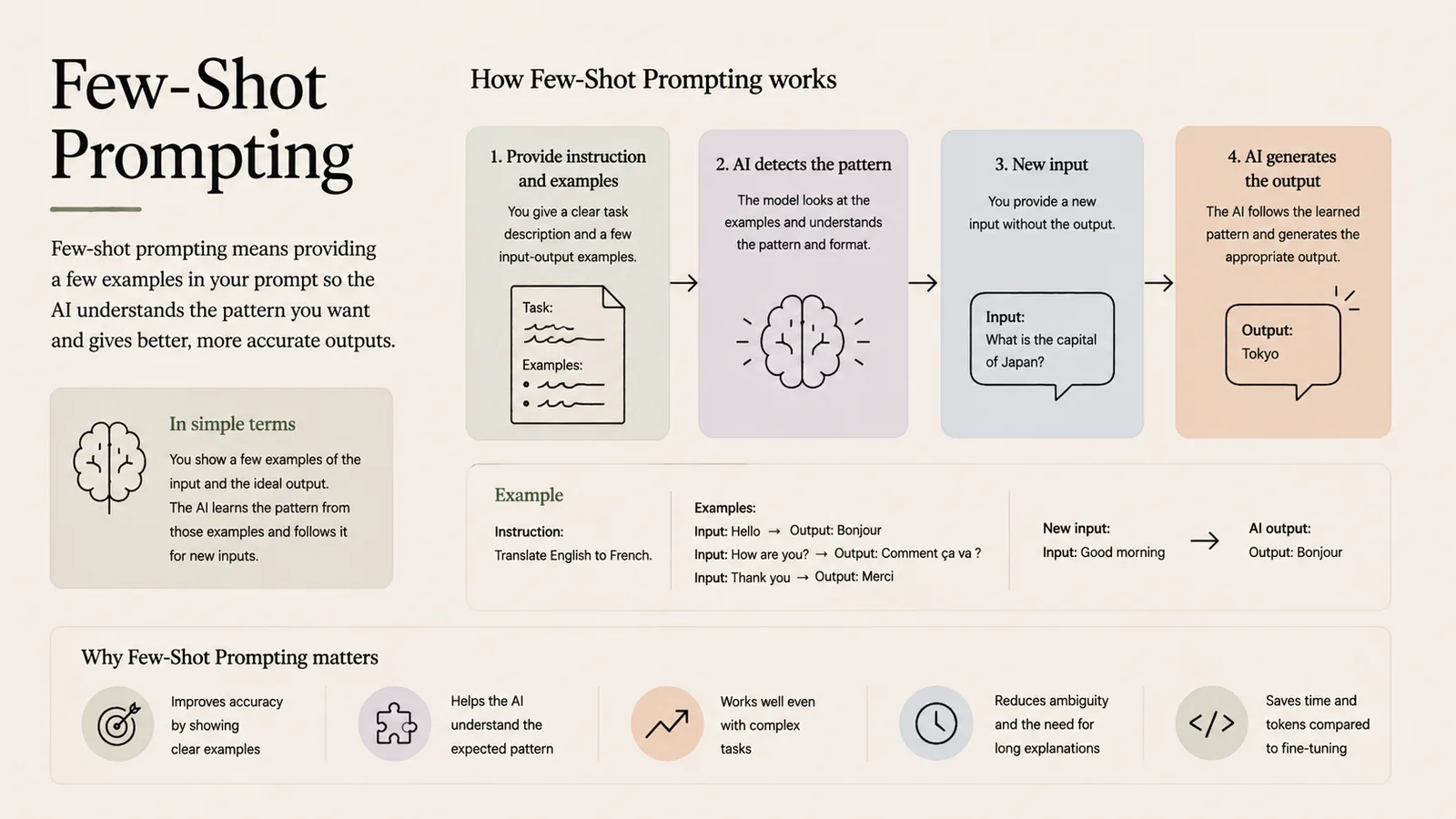
Few-shot prompting means providing a few examples in your prompt so the AI understands the pattern you want and gives better, more accurate outputs. You show the model what good looks like, then ask it to continue.
In simple terms
Show the AI a few examples of the input and ideal output, and it follows the pattern.
How it works
- 1Provide instruction and examples — give a clear task description plus a few input–output examples.
- 2AI detects the pattern — the model studies the examples and understands the format.
- 3New input — you provide a new input without the output.
- 4AI generates the output — it follows the learned pattern to produce the answer.
Key points
- Improves accuracy by showing clear examples.
- Helps the AI understand the exact format you expect.
- Works well even for complex or unusual tasks.
- Reduces ambiguity and can replace the need for fine-tuning.
Why it matters
Few-shot prompting is a fast, no-training way to get consistent, well-formatted output. A couple of good examples often beats paragraphs of instructions.
Frequently asked questions
- How many examples should I include?
- Usually two to five — enough to show the pattern without wasting context tokens.
- When should I use few-shot over zero-shot?
- When the task has a specific format or is ambiguous, examples make the expected output crystal clear.
More in Prompting
Prompt
The input you give an AI — and how to write better ones.
Prompt Engineering
The art of giving AI the right instructions.
System Prompt
Sets the AI's behavior, personality and rules.
Zero-Shot Prompting
Ask the AI to do a task with no examples.
Chain-of-Thought Prompting
Make the AI reason step by step.