
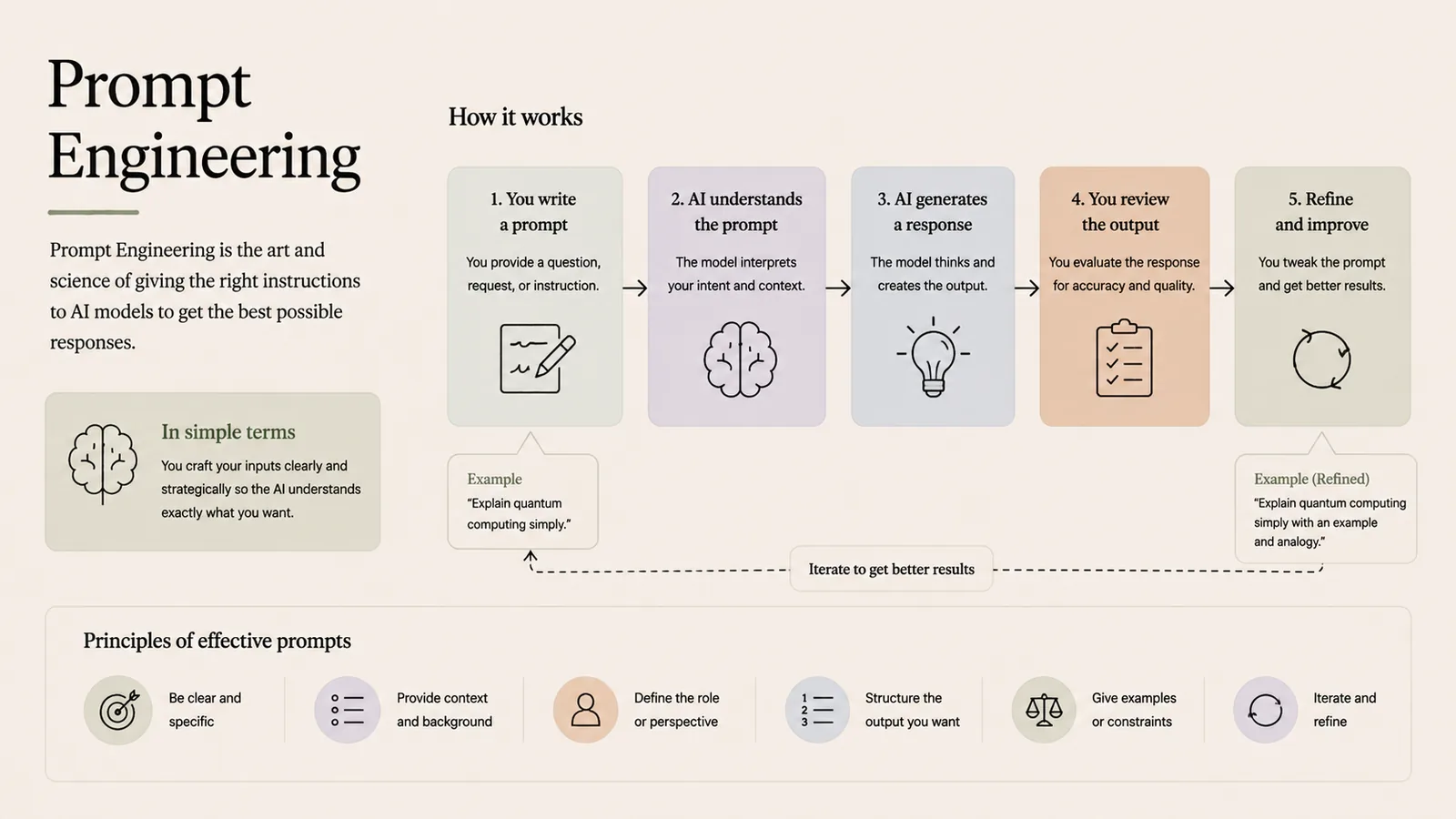
Prompt engineering is the art and science of giving AI models the right instructions to get the best possible responses — without retraining the model. It structures instructions, context and examples to reliably steer output.
In simple terms
Crafting your inputs clearly and strategically so the AI does exactly what you want.
How it works
- 1You write a prompt — a question, request or instruction.
- 2AI understands — the model interprets your intent and context.
- 3AI generates — it thinks and creates the output.
- 4You review — evaluate the response for accuracy and quality.
- 5Refine and improve — tweak the prompt for better results.
Key points
- Be clear and specific; provide context and background.
- Define the role or perspective the AI should take.
- Structure the output you want; give examples or constraints.
- Iterate — prompt engineering is a loop, not one shot.
Why it matters
Prompt engineering is the cheapest, fastest way to improve AI output. Before fine-tuning or new tools, better prompts often close most of the quality gap.
Frequently asked questions
- Is prompt engineering still needed with smart models?
- Yes — clear instructions, context and examples still reliably improve results, even for capable models.
- What's the fastest way to improve a prompt?
- Add context, state the exact output format, and give one or two examples of what good looks like.
More in Prompting
Prompt
The input you give an AI — and how to write better ones.
System Prompt
Sets the AI's behavior, personality and rules.
Few-Shot Prompting
Give a few examples so the AI learns the pattern.
Zero-Shot Prompting
Ask the AI to do a task with no examples.
Chain-of-Thought Prompting
Make the AI reason step by step.