
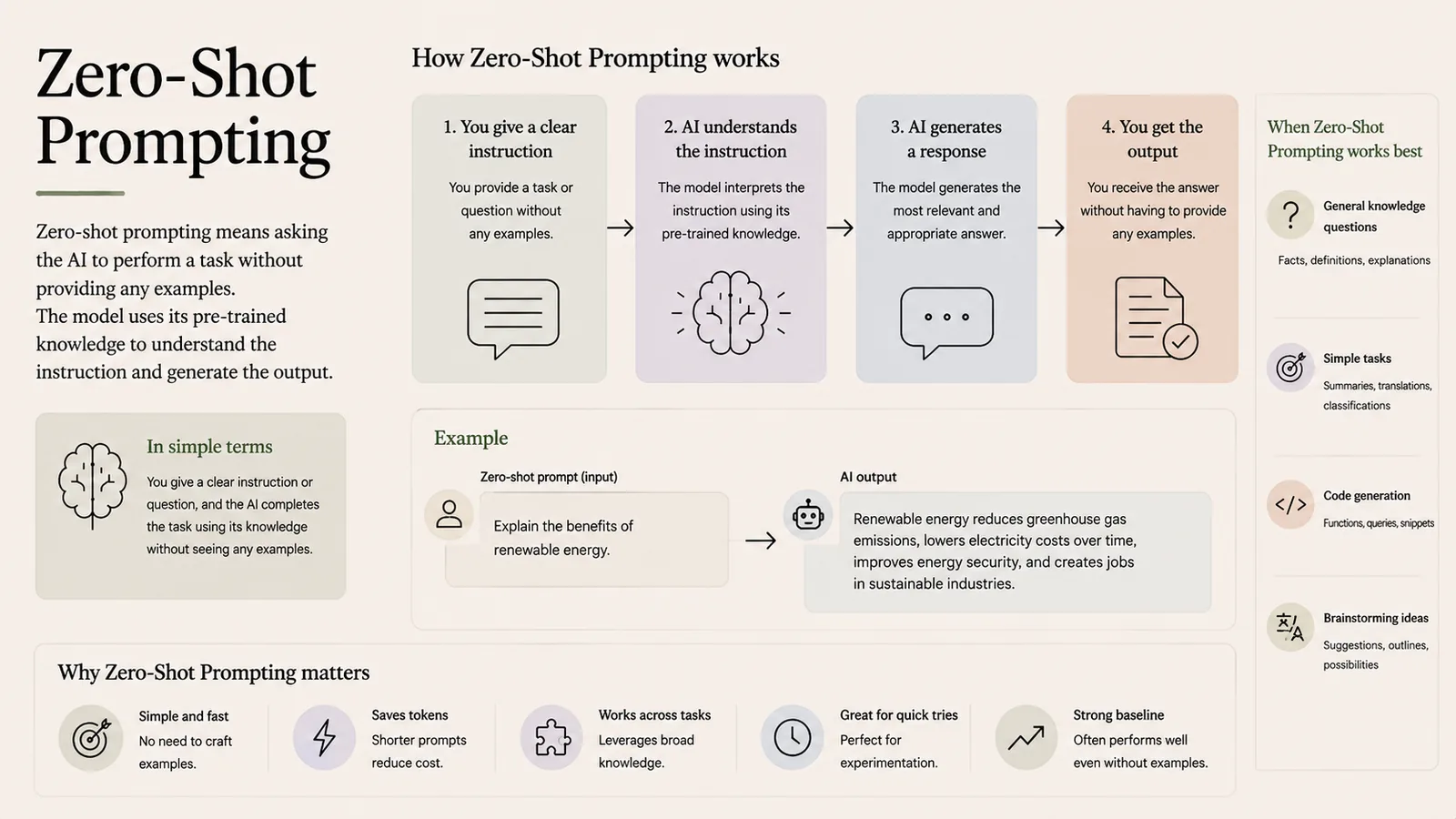
Zero-shot prompting means asking an AI to perform a task without providing any examples. The model uses its pre-trained knowledge to understand the instruction and produce an answer.
In simple terms
Ask the AI to do a task directly, with no examples — it relies on what it already knows.
How it works
- 1You give a clear instruction — a task or question with no examples.
- 2AI understands — it interprets the instruction using its pre-trained knowledge.
- 3AI generates — it produces the most relevant, appropriate answer.
- 4You get the output — the answer, without having provided examples.
Key points
- Simple and fast — no need to craft examples.
- Saves tokens because prompts are shorter.
- Works across many tasks by leveraging broad knowledge.
- A strong baseline; add examples (few-shot) only if needed.
Why it matters
Zero-shot is the quickest way to get an answer and often works surprisingly well. It's the default starting point; you add examples only when the task needs more guidance.
Frequently asked questions
- When does zero-shot work best?
- For general knowledge, definitions, summaries and simple tasks where the model's training already covers it.
- What if zero-shot output is inconsistent?
- Switch to few-shot: adding a couple of examples usually fixes format and consistency issues.
More in Prompting
Prompt
The input you give an AI — and how to write better ones.
Prompt Engineering
The art of giving AI the right instructions.
System Prompt
Sets the AI's behavior, personality and rules.
Few-Shot Prompting
Give a few examples so the AI learns the pattern.
Chain-of-Thought Prompting
Make the AI reason step by step.