
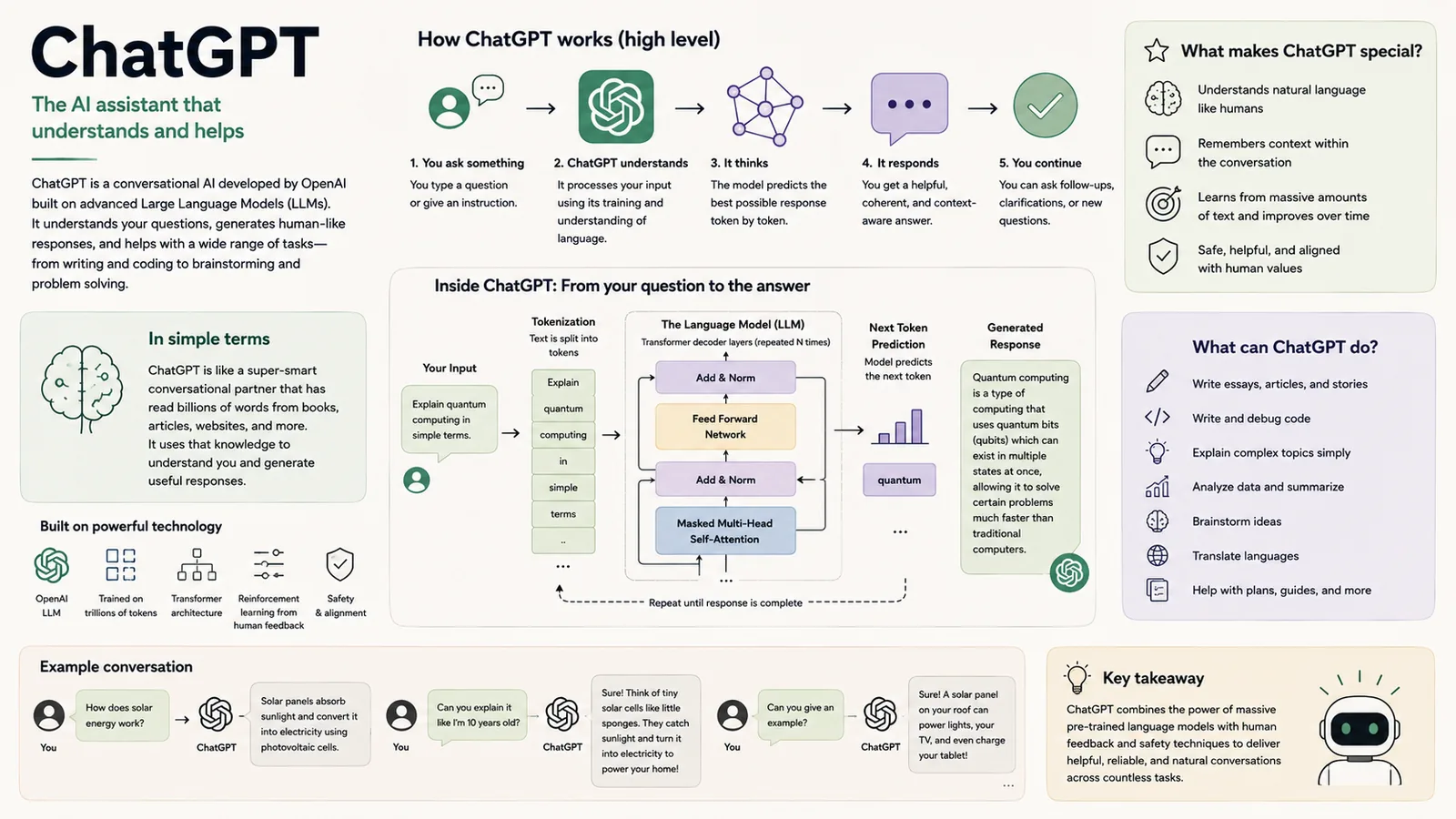
ChatGPT is a conversational AI from OpenAI built on advanced large language models. It understands your questions, generates human-like responses, and helps with writing, coding, brainstorming and problem solving.
In simple terms
A super-smart conversational partner that has read billions of words and uses that to help you.
How it works
- 1You ask something — type a question or give an instruction.
- 2ChatGPT understands — it processes your input using its training and language understanding.
- 3It thinks — the model predicts the best response token by token.
- 4It responds — you get a helpful, coherent, context-aware answer.
- 5You continue — ask follow-ups, clarifications or new questions.
Key points
- Built on a transformer LLM, trained on trillions of tokens.
- Remembers context within a conversation.
- Refined with reinforcement learning from human feedback (RLHF) for safety and helpfulness.
- Can write, code, explain, analyse, brainstorm and translate.
Why it matters
ChatGPT brought LLMs to the mainstream by wrapping them in a simple chat interface. It combined powerful pre-trained models with human feedback to deliver reliable, natural conversations across countless tasks.
Frequently asked questions
- Is ChatGPT the same as GPT?
- GPT is the underlying model; ChatGPT is the chat product built on top of it, tuned for conversation and safety.
- Does ChatGPT remember everything?
- It remembers within the current conversation's context window; older messages can fall out of context as the chat grows.
More in Language Models
Large Language Model (LLM) — The Basics
Massive data → training → understanding → generation.
What is a Large Language Model (LLM)?
Inside an LLM — tokenization, embeddings, transformer.
GPT (Generative Pre-trained Transformer)
How GPT predicts text, one token at a time.
GPT-4
OpenAI's multimodal model — text and images.
Claude
Anthropic's helpful, harmless and honest AI assistant.
PaLM / Bard
Google's conversational AI powered by PaLM.