
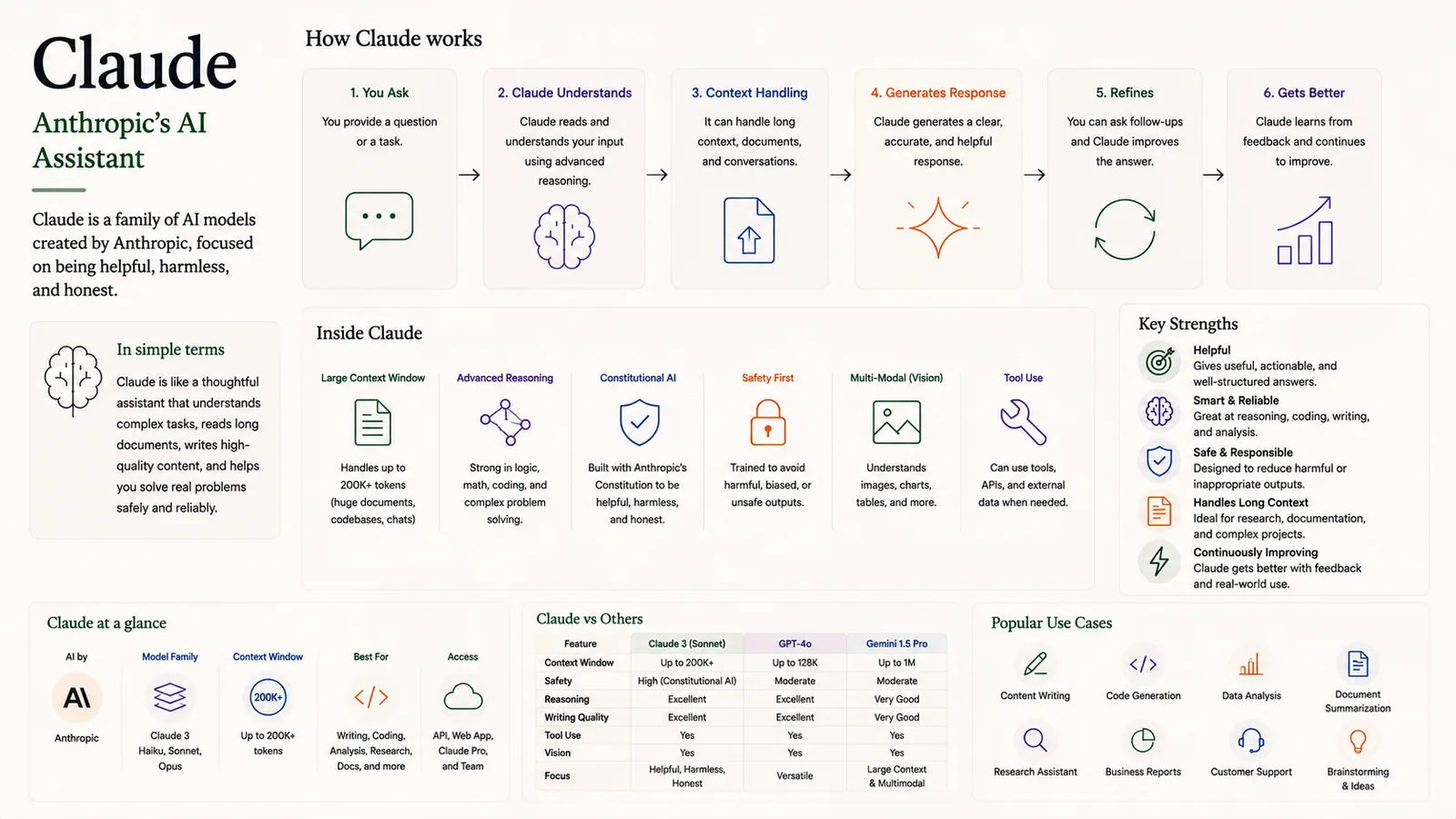
Claude is a family of AI models created by Anthropic, focused on being helpful, harmless and honest. It handles long documents, complex reasoning and coding, with a large context window and a safety-first design.
In simple terms
A thoughtful assistant that reads long documents, reasons carefully and helps you solve real problems safely.
How it works
- 1You ask — provide a question or a task.
- 2Claude understands — it reads and understands your input using advanced reasoning.
- 3Context handling — it works with long context, documents and conversations.
- 4Generates response — a clear, accurate, helpful answer.
- 5Refines — you can ask follow-ups and Claude improves the answer.
Key points
- Very large context window — handles huge documents and long chats.
- Strong reasoning across math, coding and complex problems.
- Built with Constitutional AI to be helpful, harmless and honest.
- Multimodal — understands images, charts and tables, and can use tools.
Why it matters
Claude is well suited to research, long-document analysis, writing and coding where accuracy and safety matter. Its large context window makes it strong at reasoning over big inputs in one go.
Frequently asked questions
- What is Constitutional AI?
- Anthropic's training method that uses a set of guiding principles (a 'constitution') to make Claude more helpful and less harmful.
- What is Claude good at?
- Long-context reading, careful reasoning, coding, writing and analysis — especially over large documents.
More in Language Models
Large Language Model (LLM) — The Basics
Massive data → training → understanding → generation.
What is a Large Language Model (LLM)?
Inside an LLM — tokenization, embeddings, transformer.
GPT (Generative Pre-trained Transformer)
How GPT predicts text, one token at a time.
GPT-4
OpenAI's multimodal model — text and images.
ChatGPT
From your question to the answer, step by step.
PaLM / Bard
Google's conversational AI powered by PaLM.