
Large Language Model (LLM) — The Basics
Massive data → training → understanding → generation.
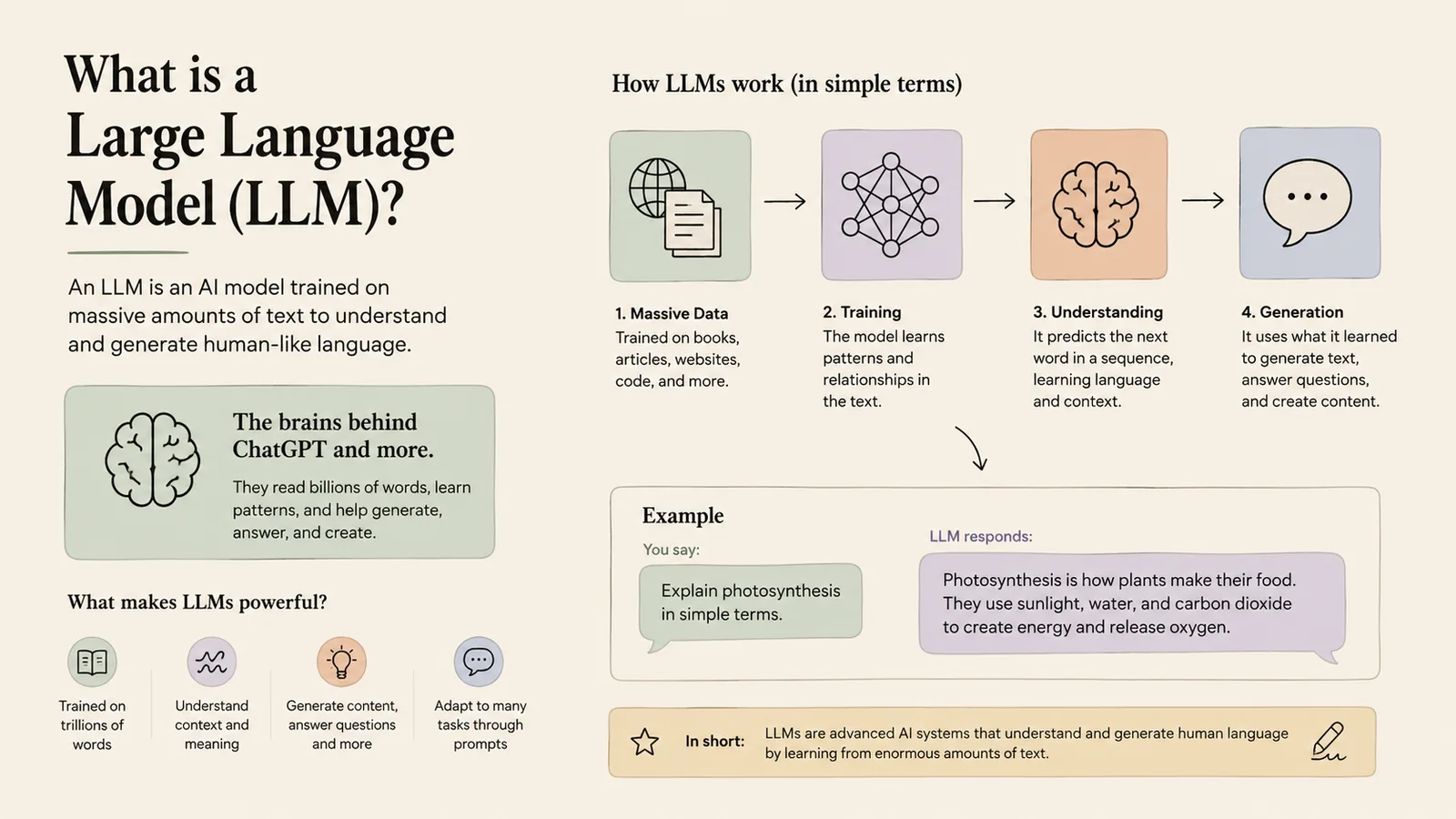
A Large Language Model (LLM) is an AI model trained on massive amounts of text to understand and generate human-like language. It reads billions of words, learns the patterns in how words are used, and uses that to answer questions, write and explain.
In simple terms
Massive data → training → understanding → generation.
How it works
- 1Massive data: the model is trained on books, articles, websites and code.
- 2Training: it learns patterns and relationships in the text.
- 3Understanding: it predicts the next word in a sequence, learning language and context.
- 4Generation: it uses what it learned to generate text, answer questions and create content.
Key points
- LLMs are trained on trillions of words, capturing knowledge, style and reasoning.
- They understand context and meaning, not just keywords.
- They adapt to many tasks through prompts — no retraining needed.
- They are the brains behind ChatGPT, Claude, Gemini and more.
Why it matters
LLMs power the current wave of AI products — chat assistants, copilots, search and summarisation. Understanding the simple pipeline (data → training → generation) demystifies what these tools are really doing.
Frequently asked questions
- Does an LLM understand language like a human?
- It models statistical patterns of language extremely well, but it has no consciousness or true understanding — it predicts likely next tokens.
- How does it answer questions it wasn't explicitly taught?
- By generalising patterns learned during training, and by using the context you give it in the prompt.
More in Language Models
What is a Large Language Model (LLM)?
Inside an LLM — tokenization, embeddings, transformer.
GPT (Generative Pre-trained Transformer)
How GPT predicts text, one token at a time.
GPT-4
OpenAI's multimodal model — text and images.
ChatGPT
From your question to the answer, step by step.
Claude
Anthropic's helpful, harmless and honest AI assistant.
PaLM / Bard
Google's conversational AI powered by PaLM.