
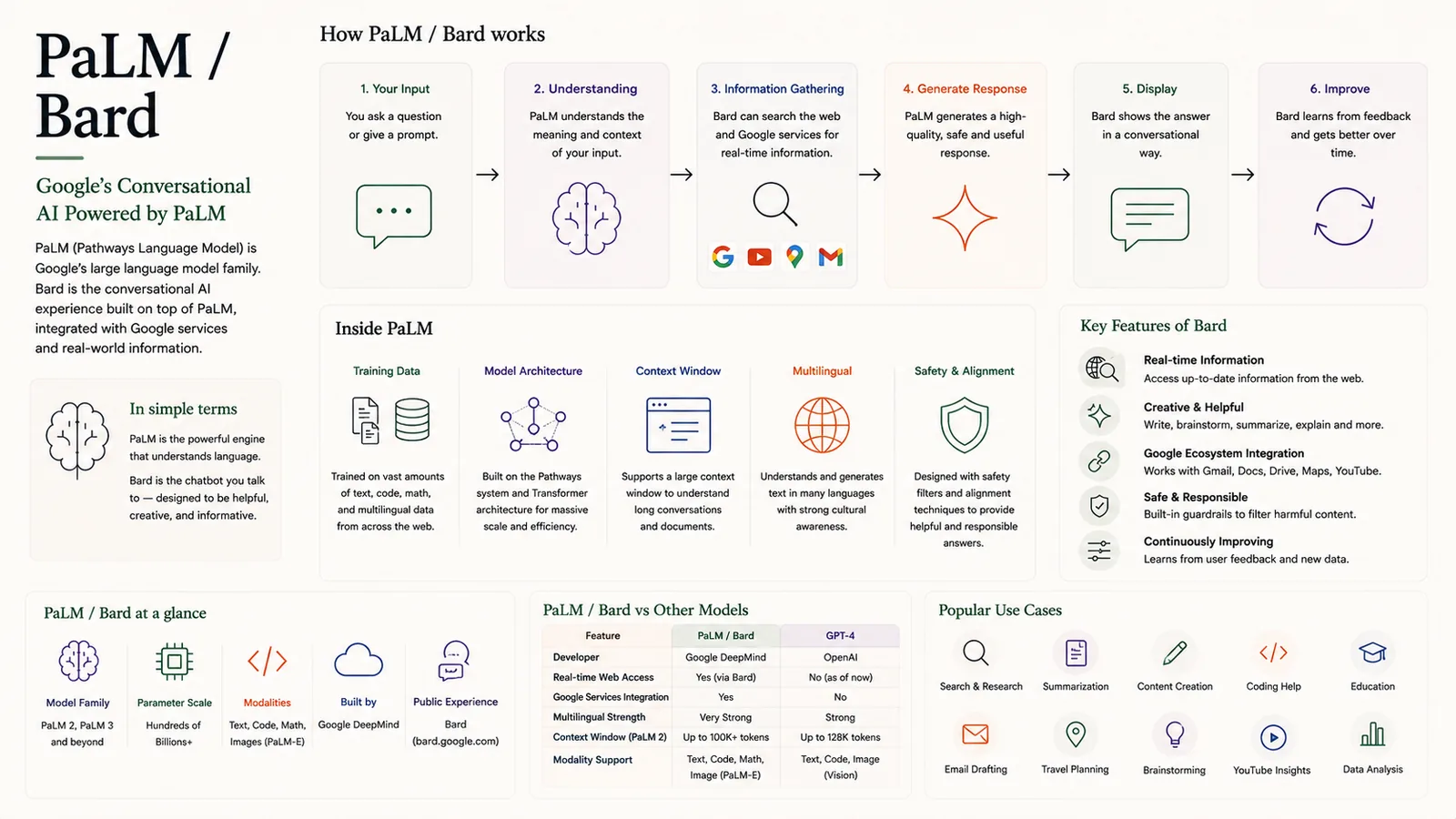
PaLM (Pathways Language Model) is Google's family of large language models, and Bard was the conversational AI built on top of it. Bard connected the model to Google services and real-time web information.
In simple terms
Google's conversational AI, powered by the PaLM language model and connected to live web information.
How it works
- 1Your input: you ask a question or give a prompt.
- 2Understanding: PaLM understands the meaning and context.
- 3Information gathering: Bard can search the web and Google services for real-time information.
- 4Generate response: it produces a high-quality, safe, useful answer.
- 5Display & improve: it shows the answer and learns from feedback.
Key points
- PaLM is trained on vast, multilingual text and code.
- Bard added real-time web access, unlike models limited to training data.
- Deep integration with Google apps like Gmail, Docs, Drive and Maps.
- Built with safety filters and alignment for responsible answers.
Why it matters
PaLM/Bard represented Google's push into conversational AI, emphasising real-time information and ecosystem integration. It has since evolved into the Gemini family, but the core idea — an LLM connected to live data and apps — remains influential.
Frequently asked questions
- Is Bard the same as Gemini?
- Bard was the earlier product on PaLM; Google later rebranded and upgraded its assistant to Gemini.
- What made Bard different?
- Its real-time web access and tight integration with Google's services.
More in Language Models
Large Language Model (LLM) — The Basics
Massive data → training → understanding → generation.
What is a Large Language Model (LLM)?
Inside an LLM — tokenization, embeddings, transformer.
GPT (Generative Pre-trained Transformer)
How GPT predicts text, one token at a time.
GPT-4
OpenAI's multimodal model — text and images.
ChatGPT
From your question to the answer, step by step.
Claude
Anthropic's helpful, harmless and honest AI assistant.