
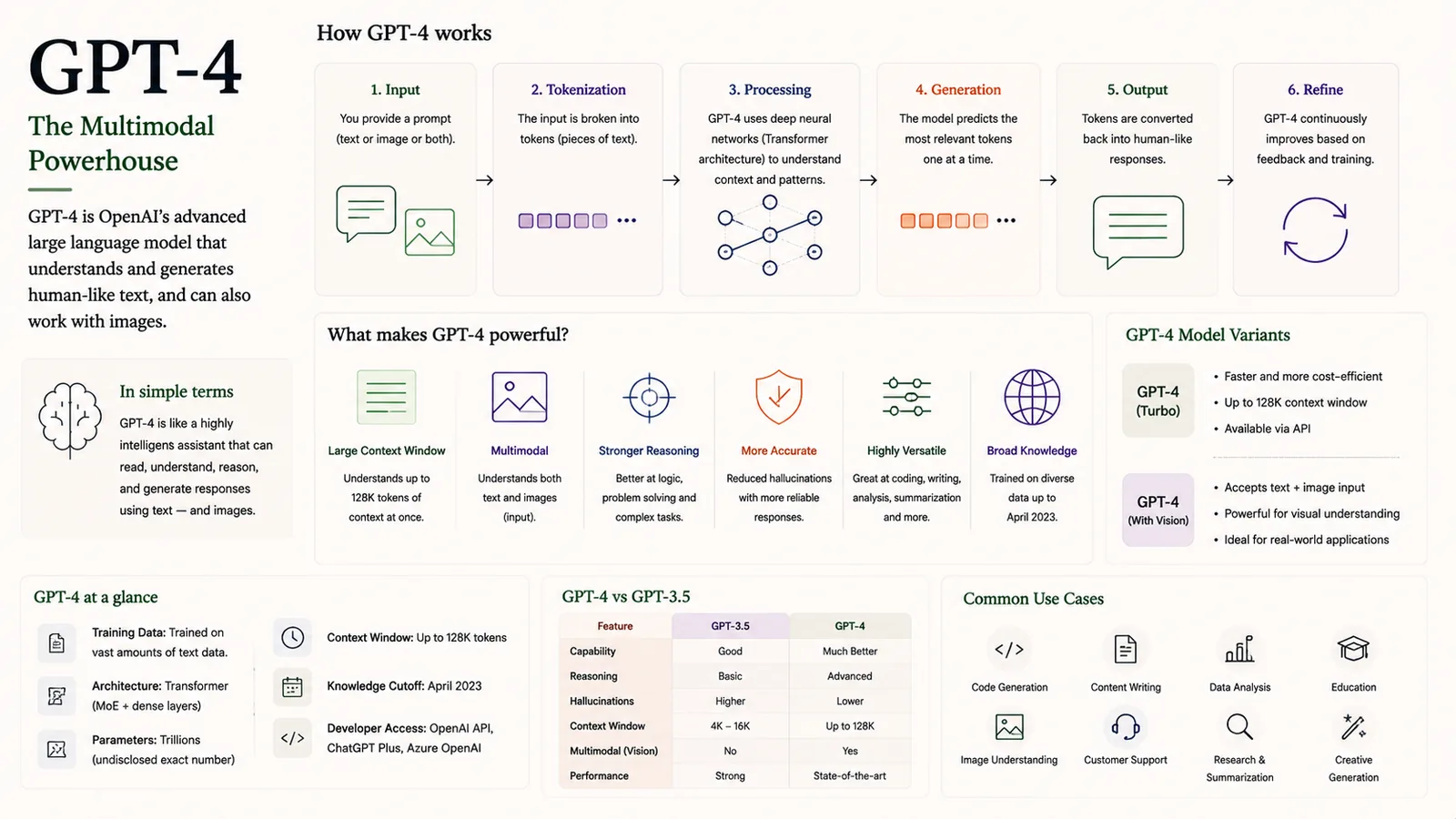
GPT-4 is OpenAI's advanced large language model that understands and generates human-like text and can also work with images. It offers a large context window, stronger reasoning and broad knowledge, making it a versatile multimodal assistant.
In simple terms
A highly capable multimodal model that can read and reason over both text and images.
How it works
- 1Input: you provide a prompt — text, image, or both.
- 2Tokenization: the input is broken into tokens.
- 3Processing: deep transformer layers understand context and patterns.
- 4Generation: the model predicts the most relevant tokens, one at a time.
- 5Output: tokens are converted back into a human-like response.
- 6Refine: it improves through feedback and training.
Key points
- Large context window — it can consider a lot of text at once.
- Multimodal — it understands both text and images.
- Stronger reasoning and higher accuracy than earlier models.
- Variants include GPT-4 Turbo (faster, larger context) and GPT-4 with Vision.
Why it matters
GPT-4 raised the bar for reliability, reasoning and multimodality, powering serious use cases in coding, analysis, education and content. It made LLMs dependable enough for many real products.
Frequently asked questions
- What makes GPT-4 'multimodal'?
- It can take images as input alongside text, so it can describe, analyse and reason about pictures.
- How is GPT-4 different from GPT-3.5?
- It reasons better, hallucinates less, handles longer context and supports vision.
More in Language Models
Large Language Model (LLM) — The Basics
Massive data → training → understanding → generation.
What is a Large Language Model (LLM)?
Inside an LLM — tokenization, embeddings, transformer.
GPT (Generative Pre-trained Transformer)
How GPT predicts text, one token at a time.
ChatGPT
From your question to the answer, step by step.
Claude
Anthropic's helpful, harmless and honest AI assistant.
PaLM / Bard
Google's conversational AI powered by PaLM.