
What Is J-Space?
A silent internal workspace inside Claude's neural network.
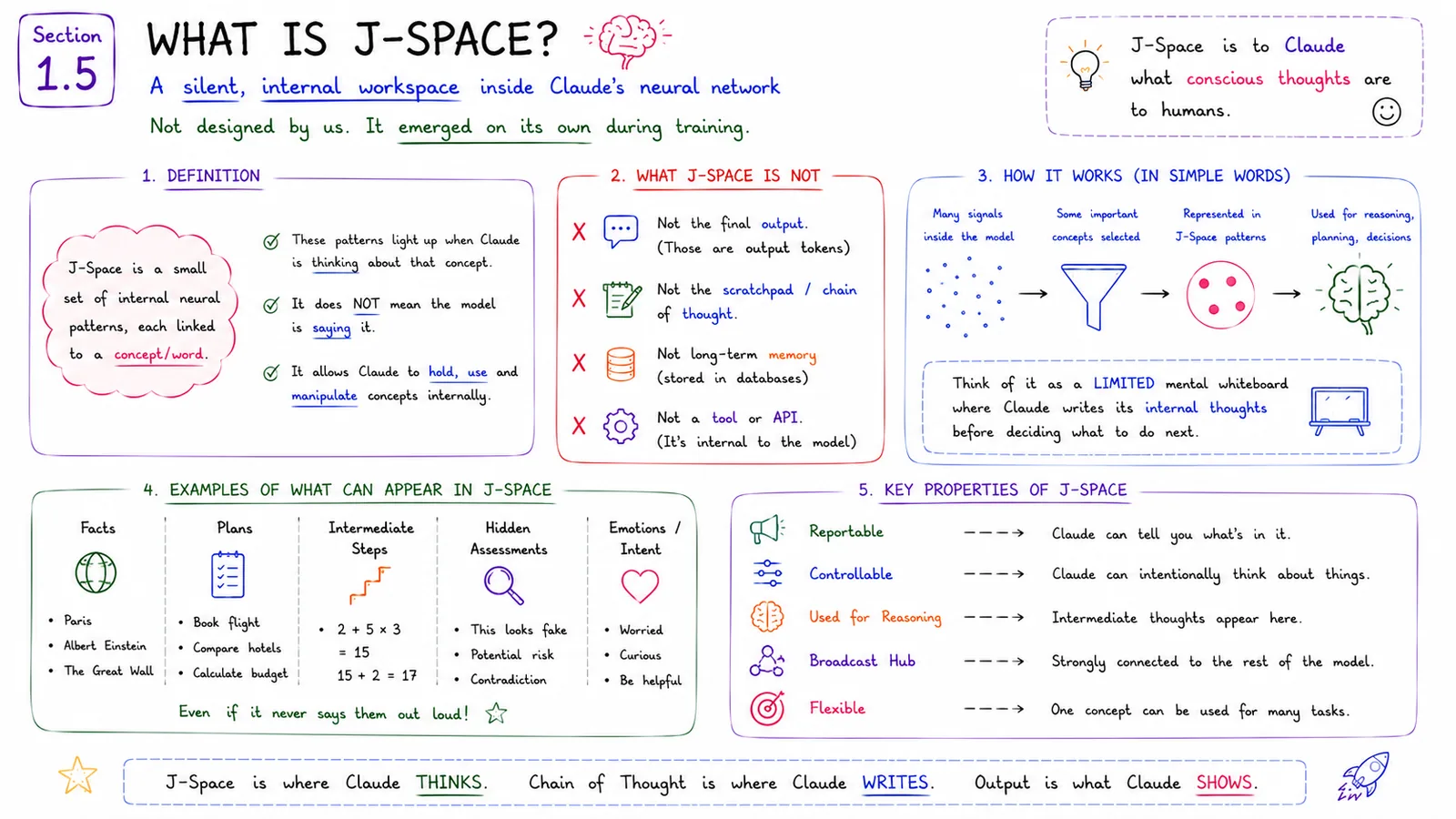
This defines the internal 'workspace' concept used in the series — a small set of internal patterns a model uses to hold and manipulate concepts while thinking. It is not the model's final output or a stored memory.
In simple terms
An internal scratch space where a model holds concepts while it reasons, before producing output.
How it works
- 1Definition: a small set of internal patterns, each tied to a concept or word.
- 2These patterns light up when the model is thinking about a concept.
- 3It is not the final output, not the chain of thought, and not long-term memory.
- 4Many signals inside the model are narrowed to a few active concepts used for reasoning.
- 5Those concepts guide planning and decisions before the answer.
Key points
- It's reportable, controllable and used for reasoning.
- It's a broadcast hub — strongly connected to the rest of the model.
- It's flexible — one concept can be reused for many tasks.
- It's where a model 'thinks', distinct from where it writes (chain of thought) and shows (output).
Why it matters
Framing internal reasoning as a small, inspectable workspace helps explain how researchers study and steer what a model is 'thinking' before it answers.
Frequently asked questions
- Is this the same as memory?
- No — it's internal reasoning activity in the moment, not stored long-term memory.
- Is it the chain of thought?
- No — chain of thought is written out; this workspace is the hidden internal thinking behind it.
More in Claude Interpretability (J-Space)
Inside Claude's Brain
What happens before Claude speaks — the J-Space workspace.
Global Workspace Theory (GWT)
The theory that inspired J-Space.
How Claude Thinks Silently
Claude thinks first, reasons, then speaks.
How Anthropic Reads Claude's Thoughts
The J-Lens (Jacobian Lens) tool explained.
J-Space vs Chain of Thought
Two layers of thinking: hidden vs visible.
Reading Claude's Thoughts — The Pipeline
Neural activity → J-Lens → words/concepts.