
Claude Interpretability (J-Space)
How Claude Thinks Silently
Claude thinks first, reasons, then speaks.
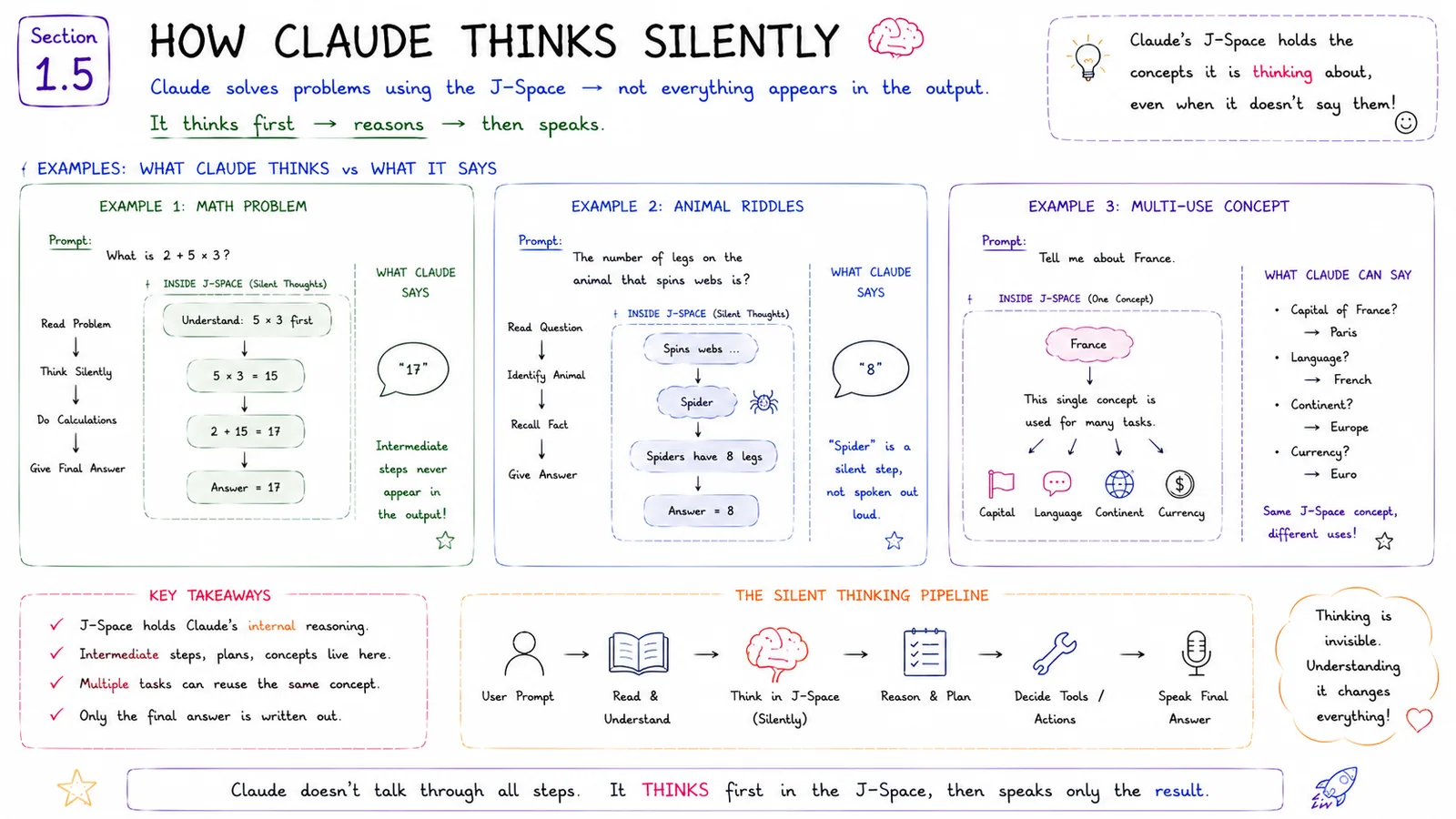
This shows how a model solves problems using its internal workspace — thinking first and reasoning before it speaks — so not everything appears in the output.
In simple terms
The model thinks silently, reasons, then speaks — intermediate steps often stay hidden.
How it works
- 1Read and understand the prompt.
- 2Think silently in the internal workspace (concepts, intermediate steps).
- 3Do the reasoning or calculations internally.
- 4Decide on tools or actions if needed.
- 5Speak only the final answer.
Key points
- Example: for '2 + 5 × 3', intermediate steps happen silently; only the final answer is written.
- The internal workspace holds the reasoning; only the result is output.
- One internal concept can be reused for many tasks.
- Thinking is invisible — understanding it changes how we monitor models.
Why it matters
Because much reasoning is silent, we can't judge a model only by its final words. Studying hidden thinking is essential for safety and debugging.
Frequently asked questions
- Why don't I see all the steps?
- Much of the reasoning happens internally; the model typically writes only the final answer unless asked to show work.
- Can we see the hidden steps?
- Interpretability research aims to read internal activity to reveal them — that's the point of this series.
More in Claude Interpretability (J-Space)
Inside Claude's Brain
What happens before Claude speaks — the J-Space workspace.
What Is J-Space?
A silent internal workspace inside Claude's neural network.
Global Workspace Theory (GWT)
The theory that inspired J-Space.
How Anthropic Reads Claude's Thoughts
The J-Lens (Jacobian Lens) tool explained.
J-Space vs Chain of Thought
Two layers of thinking: hidden vs visible.
Reading Claude's Thoughts — The Pipeline
Neural activity → J-Lens → words/concepts.