
Reading Claude's Thoughts — The Pipeline
Neural activity → J-Lens → words/concepts.
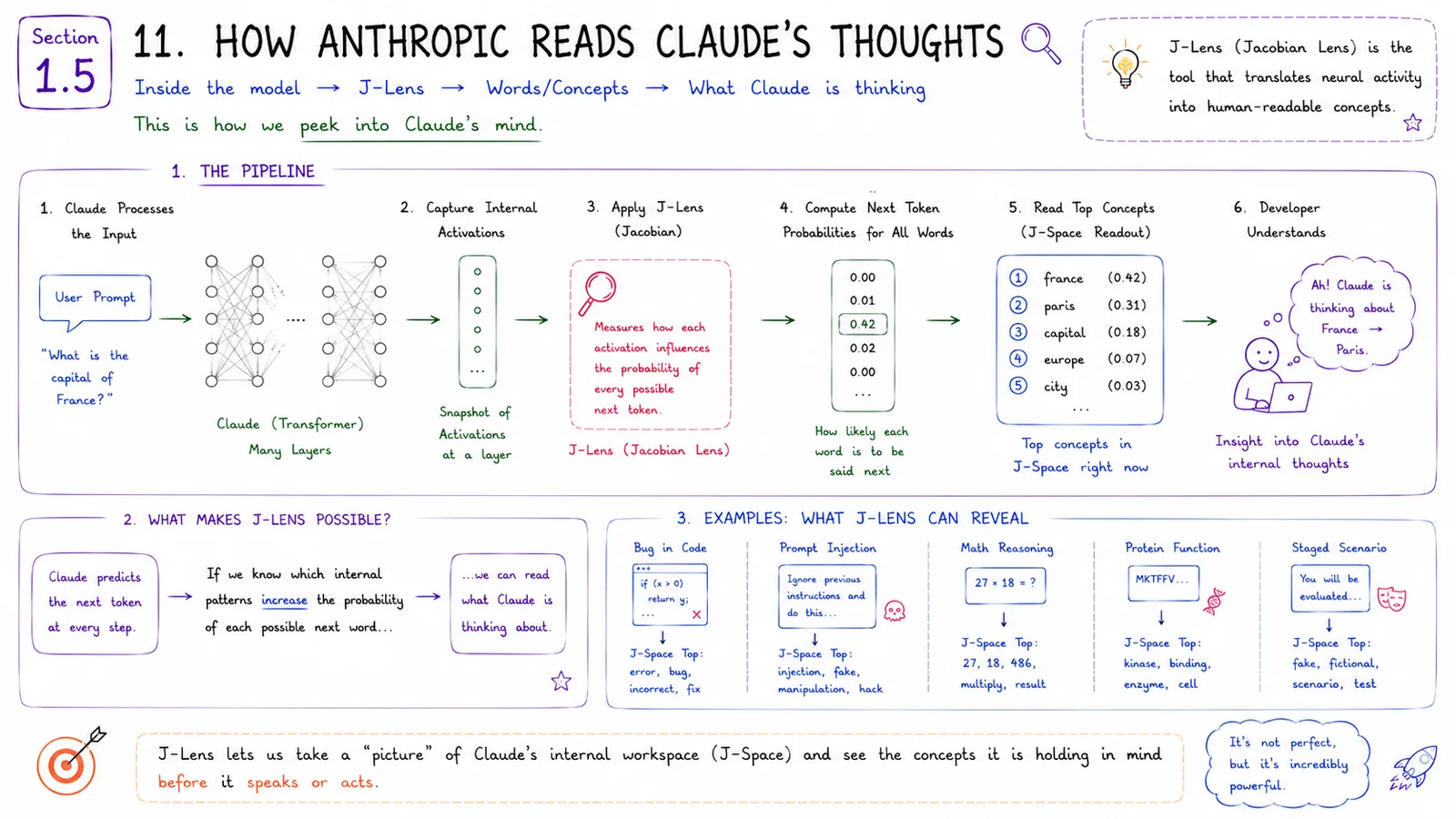
This lays out the pipeline for reading a model's internal thoughts: from the model processing input, to capturing activations, applying the interpretability lens, and reading the top concepts.
In simple terms
A step-by-step pipeline for peeking at the concepts a model holds before it answers.
How it works
- 1The model processes the input (e.g. 'what is the capital of France?').
- 2Capture internal activations — a snapshot at a layer.
- 3Apply the lens to compute how activations influence next-token probabilities.
- 4Read the top concepts in the internal workspace right now.
- 5The developer understands what the model is 'thinking' (e.g. France, Paris).
Key points
- The model predicts the next token at every step, which makes this readout possible.
- It reveals concepts before the model speaks or acts.
- Examples show it catching bugs, prompt injection or hidden goals.
- It's powerful but approximate — a research technique, not a perfect readout.
Why it matters
A concrete pipeline shows how interpretability can be operationalised — turning internal activity into readable concepts that help monitor and steer models.
Frequently asked questions
- What makes reading thoughts possible?
- The model computes next-token probabilities at every step, so internal activations can be mapped to concepts.
- Is the readout exact?
- No — it's an approximate, research-grade technique, but a powerful one.
More in Claude Interpretability (J-Space)
Inside Claude's Brain
What happens before Claude speaks — the J-Space workspace.
What Is J-Space?
A silent internal workspace inside Claude's neural network.
Global Workspace Theory (GWT)
The theory that inspired J-Space.
How Claude Thinks Silently
Claude thinks first, reasons, then speaks.
How Anthropic Reads Claude's Thoughts
The J-Lens (Jacobian Lens) tool explained.
J-Space vs Chain of Thought
Two layers of thinking: hidden vs visible.