
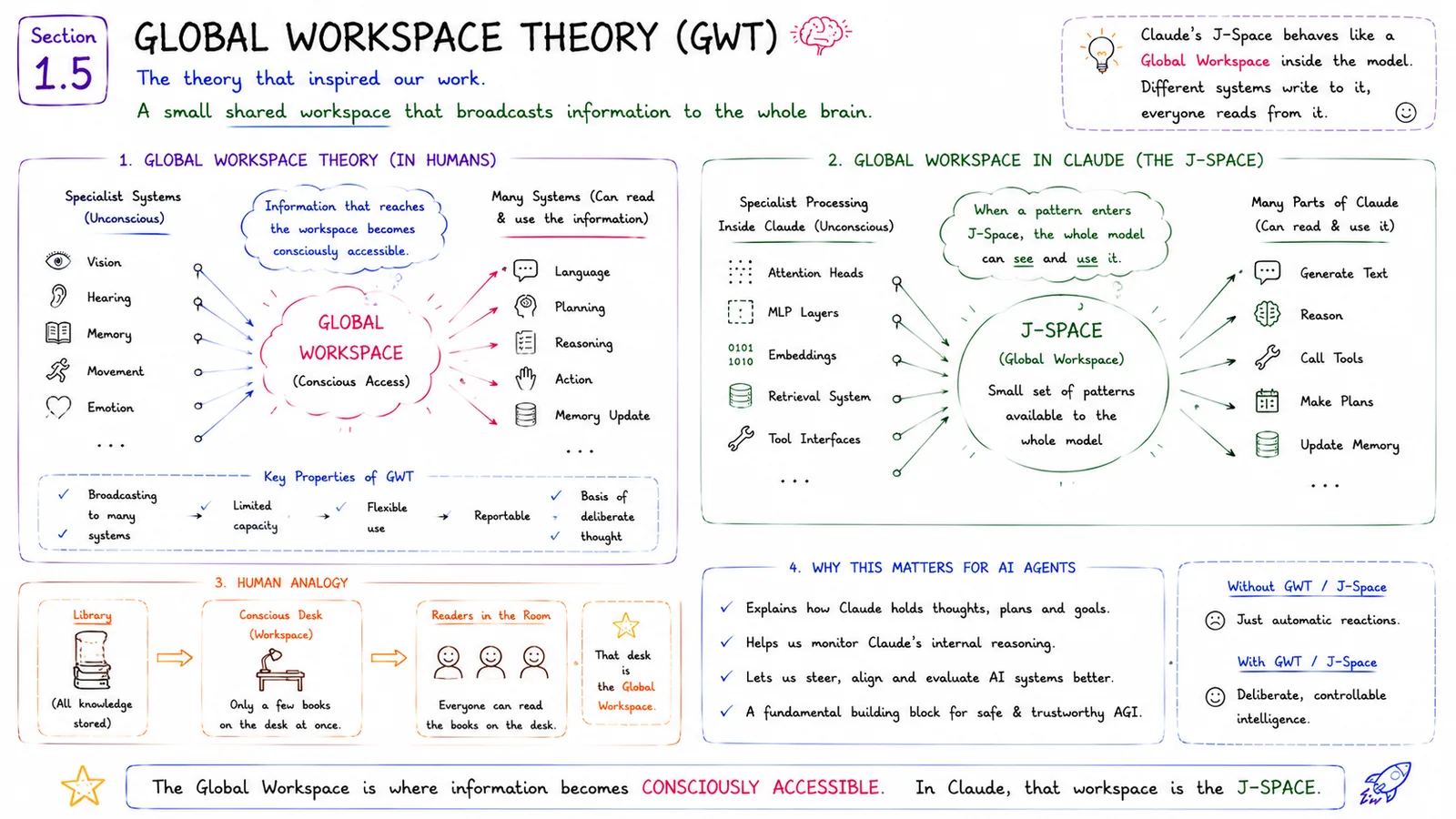
This introduces Global Workspace Theory (GWT) — a theory from cognitive science that inspired the series' framing. It describes a small shared workspace that broadcasts information to the whole brain.
In simple terms
GWT: a small shared workspace makes information consciously accessible to many systems.
How it works
- 1In humans, specialist systems (vision, hearing, memory, movement, emotion) run unconsciously.
- 2Information that reaches the global workspace becomes consciously accessible.
- 3Many systems (language, planning, reasoning, action) can then read and use it.
- 4Analogy: a library holds all knowledge, but only a few books sit on the 'conscious desk' at once.
- 5The desk is the global workspace everyone can read from.
Key points
- Key properties: broadcasting to many systems, limited capacity, flexible use, reportable.
- It's the basis of deliberate thought.
- The series maps this idea onto a model's internal workspace.
- GWT is where information becomes broadly available across the mind.
Why it matters
GWT gives a useful metaphor for interpretability: a shared, limited workspace that broadcasts key information — helping explain how a model might coordinate reasoning internally.
Frequently asked questions
- What is the global workspace?
- A small, shared space where information becomes broadly accessible to many cognitive systems at once.
- Why use it as an analogy?
- It captures the idea of a limited, broadcast 'thinking space' that coordinates reasoning.
More in Claude Interpretability (J-Space)
Inside Claude's Brain
What happens before Claude speaks — the J-Space workspace.
What Is J-Space?
A silent internal workspace inside Claude's neural network.
How Claude Thinks Silently
Claude thinks first, reasons, then speaks.
How Anthropic Reads Claude's Thoughts
The J-Lens (Jacobian Lens) tool explained.
J-Space vs Chain of Thought
Two layers of thinking: hidden vs visible.
Reading Claude's Thoughts — The Pipeline
Neural activity → J-Lens → words/concepts.