
Global Workspace Theory (in Humans)
A clean single-panel view of GWT.
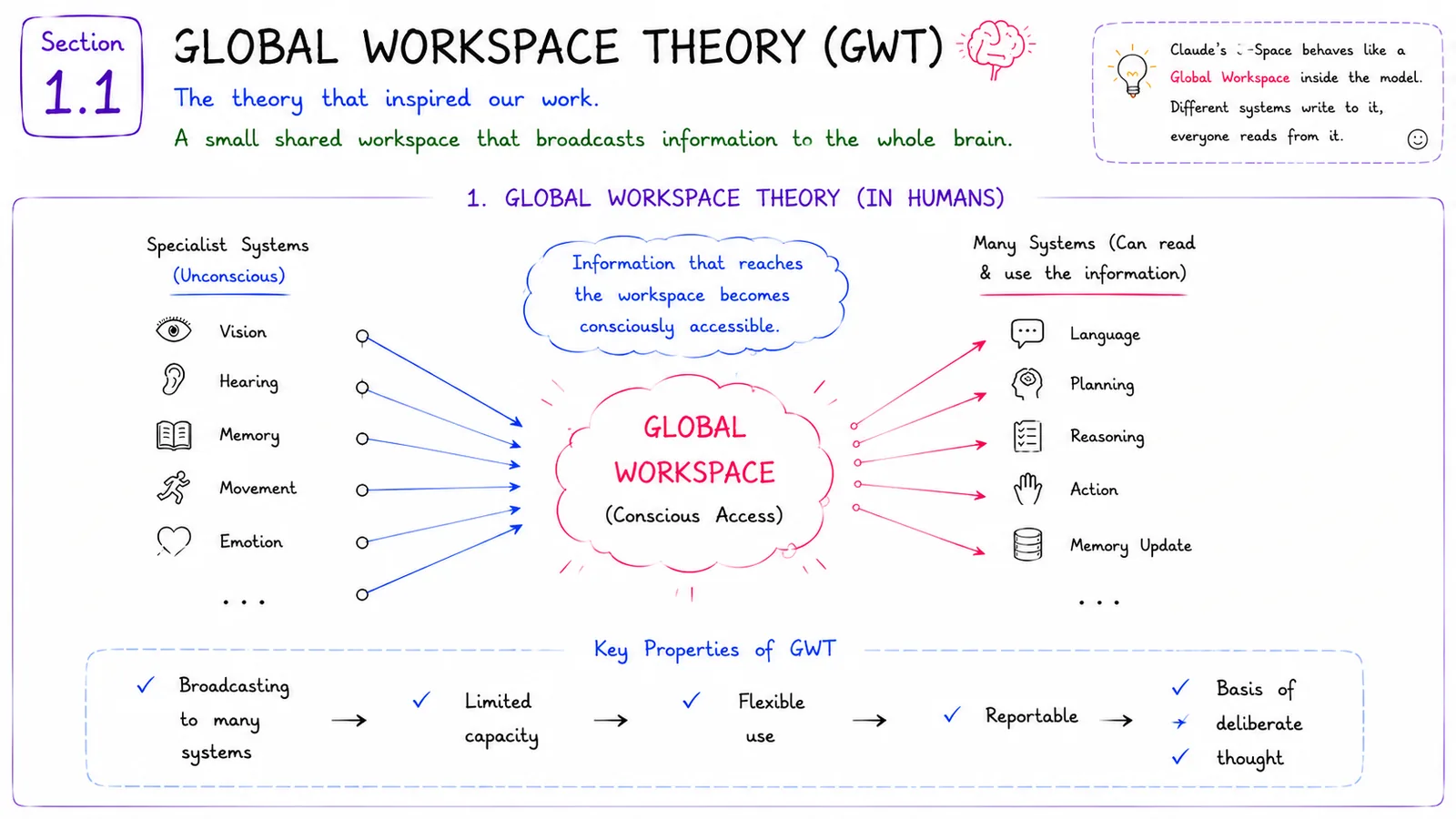
This is a clean, single-panel view of Global Workspace Theory (GWT) in humans — the shared workspace that broadcasts information to the whole brain, used as the anchor analogy for the series.
In simple terms
In humans, information that reaches the global workspace becomes consciously accessible to many systems.
How it works
- 1Specialist systems (vision, hearing, memory, movement, emotion) work unconsciously.
- 2Information that reaches the global workspace becomes consciously accessible.
- 3Many systems (language, planning, reasoning, action, memory update) can read and use it.
- 4The workspace has limited capacity — only a little is 'conscious' at once.
- 5This shared access is the basis of deliberate thought.
Key points
- Key properties: broadcasting to many systems, limited capacity, flexible use, reportable.
- It's the basis of deliberate, coordinated thought.
- The series uses this as the analogy for a model's internal workspace.
- The global workspace is where information becomes consciously accessible.
Why it matters
GWT grounds the whole series' analogy: a limited, shared workspace that coordinates thinking — a helpful lens for thinking about model reasoning.
Frequently asked questions
- What are GWT's key properties?
- Broadcasting to many systems, limited capacity, flexible use and being reportable.
- How does it relate to AI?
- The series uses it as a metaphor for a model's internal reasoning workspace.
More in Claude Interpretability (J-Space)
Inside Claude's Brain
What happens before Claude speaks — the J-Space workspace.
What Is J-Space?
A silent internal workspace inside Claude's neural network.
Global Workspace Theory (GWT)
The theory that inspired J-Space.
How Claude Thinks Silently
Claude thinks first, reasons, then speaks.
How Anthropic Reads Claude's Thoughts
The J-Lens (Jacobian Lens) tool explained.
J-Space vs Chain of Thought
Two layers of thinking: hidden vs visible.