
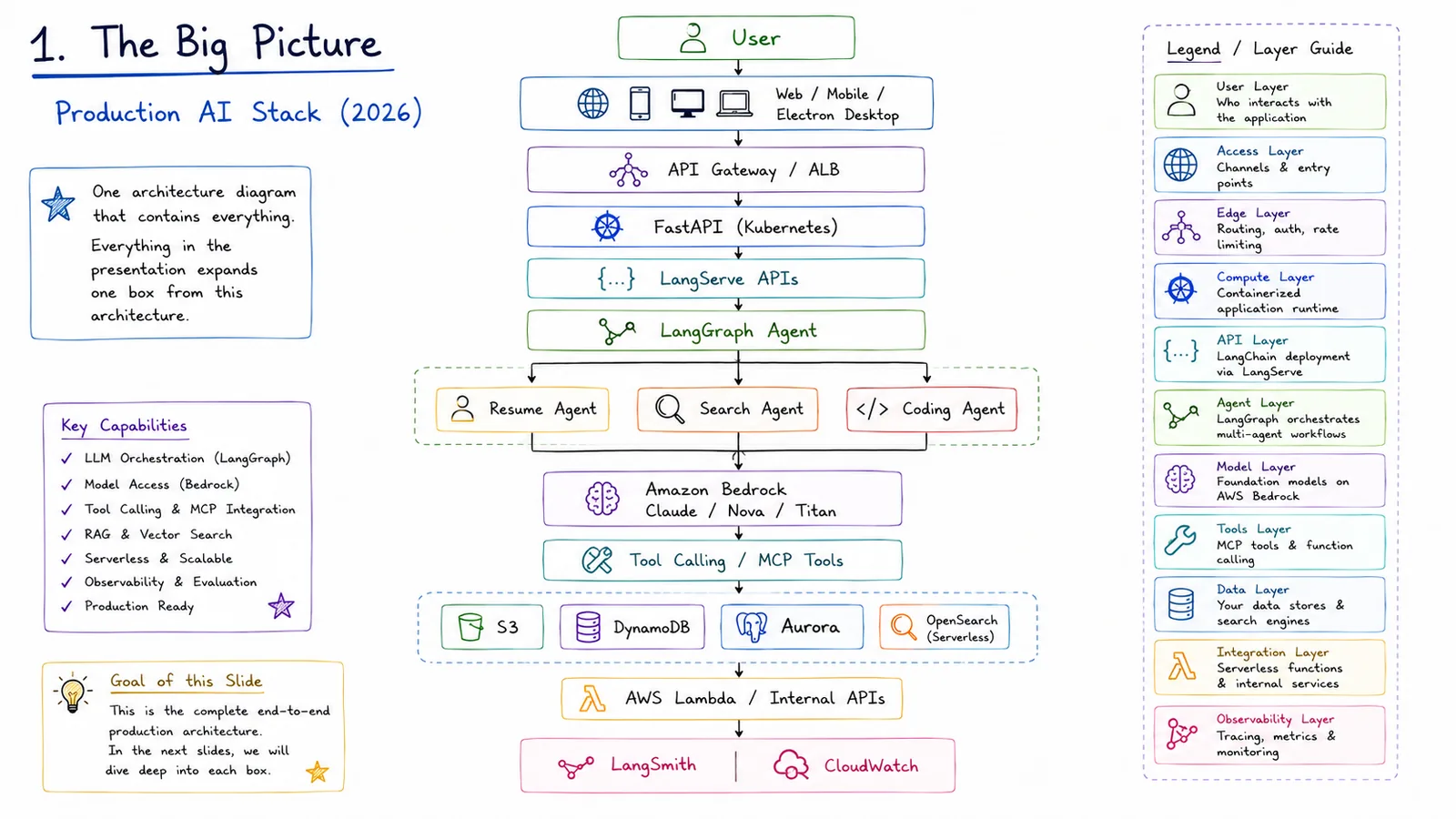
This is the big-picture architecture of a complete production AI stack for 2026 — a single diagram that contains everything. Every later diagram in the series zooms into one box from this one.
In simple terms
One end-to-end map of a production AI system, from user request to model, tools and observability.
How it works
- 1A user reaches the app via web, mobile or desktop.
- 2Requests flow through an API gateway / load balancer to FastAPI on Kubernetes.
- 3LangServe exposes APIs; a LangGraph agent orchestrates the work.
- 4The agent calls Amazon Bedrock models plus tools/MCP, backed by S3, DynamoDB, Aurora and OpenSearch.
- 5Everything is observed with LangSmith and CloudWatch.
Key points
- Key capabilities: LLM orchestration, model access, tool calling/MCP, RAG, observability.
- Serverless and scalable, production-ready by design.
- Each layer expands into its own diagram later in the series.
- The goal: a complete, end-to-end production architecture.
Why it matters
Seeing the whole stack first makes every detailed diagram easier to place. It shows how orchestration, models, data, tools and observability fit into one production system.
Frequently asked questions
- What does this stack use for orchestration?
- LangGraph agents on LangServe/FastAPI, calling Amazon Bedrock models and tools via MCP.
- How is it observed?
- LangSmith for LLM/agent traces and CloudWatch for infrastructure metrics and logs.
More in Production AI Stack (2026)
2 · User Request Lifecycle
How one request flows through the whole system.
3 · LangChain Ecosystem
How LangChain, LangGraph, LangServe and LangSmith fit together.
4 · LangGraph Orchestration
Stateful, multi-step agent workflows.
5 · AWS Bedrock Integration
How LangChain talks to models through Amazon Bedrock.
6 · Amazon AgentCore
The enterprise runtime for LangChain/LangGraph agents.
7 · Memory & State Management
The four memory layers that make agents reliable.