
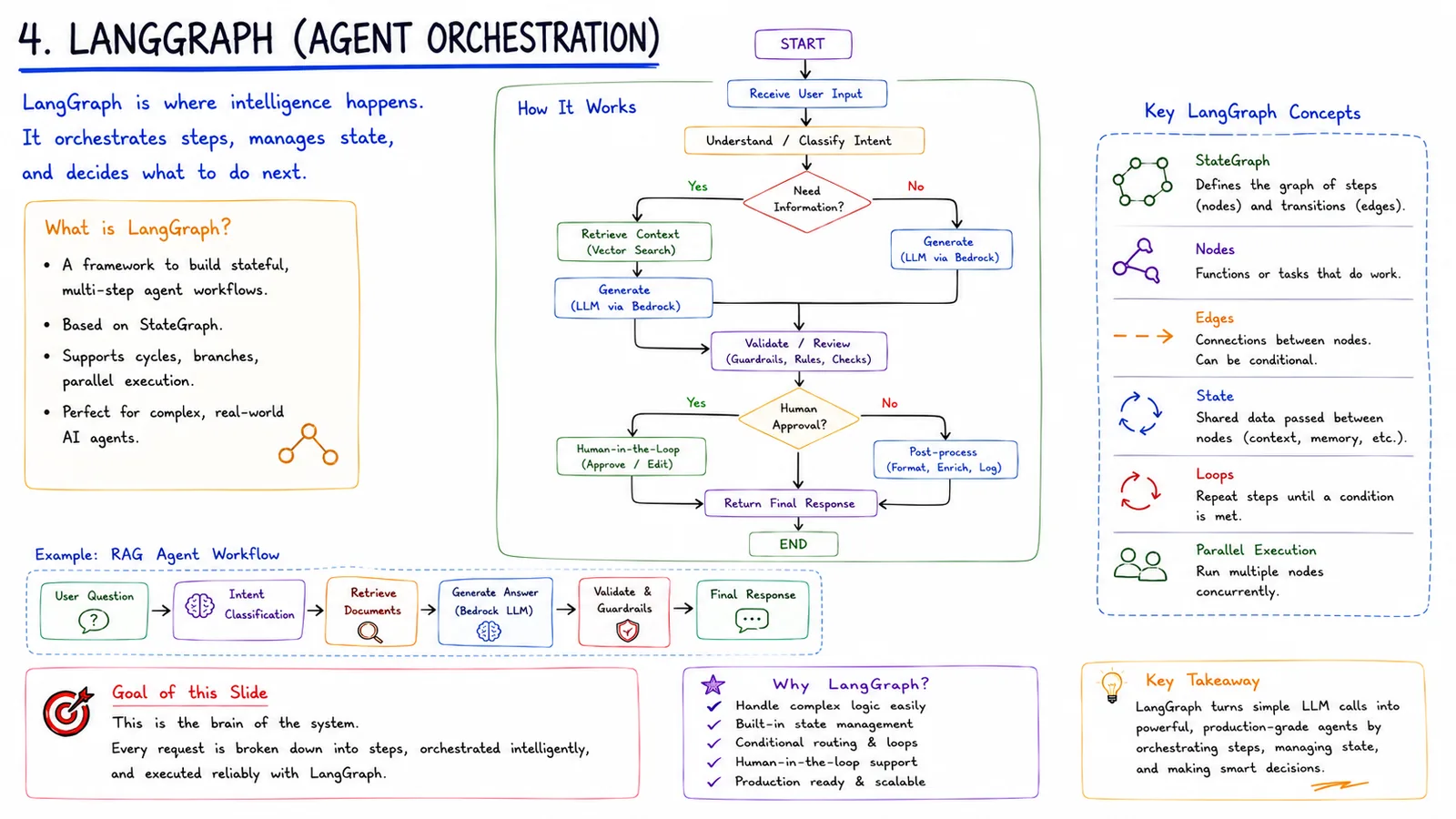
LangGraph is where the intelligence lives: it orchestrates steps, manages state and decides what to do next. It models agent workflows as a stateful graph of nodes and edges.
In simple terms
A framework to build stateful, multi-step agent workflows as a graph.
How it works
- 1Receive user input and understand/classify intent.
- 2Decide if more information is needed; retrieve context (vector search) if so.
- 3Generate with the LLM via Bedrock.
- 4Validate/review against guardrails and rules; optionally add human-in-the-loop.
- 5Post-process, then return the final response.
Key points
- Built on StateGraph — nodes are tasks, edges are transitions (which can be conditional).
- Supports cycles, branching and parallel execution.
- State is shared data passed between nodes (context, memory).
- Perfect for complex, real-world agents that loop until a condition is met.
Why it matters
LangGraph turns simple LLM calls into reliable, production-grade agents by making branching, loops and state explicit and controllable.
Frequently asked questions
- What is a StateGraph?
- A graph that defines the nodes (steps) and edges (transitions) of an agent, with shared state passed between them.
- Why use a graph instead of a chain?
- Graphs handle loops, branches and human approval that simple linear chains can't express cleanly.
More in Production AI Stack (2026)
1 · The Big Picture
The complete end-to-end production AI stack (2026).
2 · User Request Lifecycle
How one request flows through the whole system.
3 · LangChain Ecosystem
How LangChain, LangGraph, LangServe and LangSmith fit together.
5 · AWS Bedrock Integration
How LangChain talks to models through Amazon Bedrock.
6 · Amazon AgentCore
The enterprise runtime for LangChain/LangGraph agents.
7 · Memory & State Management
The four memory layers that make agents reliable.