
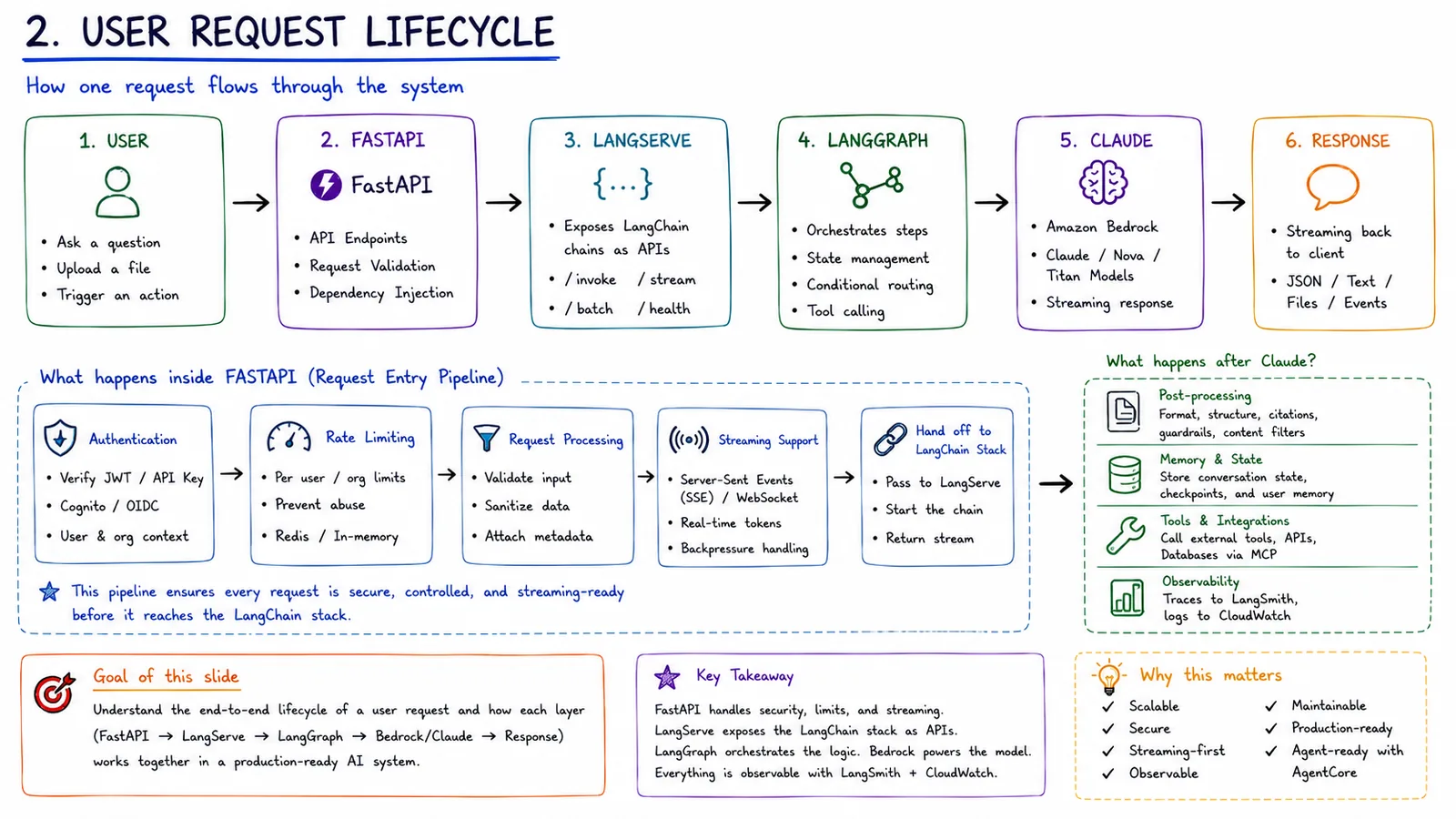
This diagram follows one request through the whole production AI system — from the user, through FastAPI, LangServe, LangGraph and Bedrock, back to a streamed response.
In simple terms
How a single user request flows through each layer of the stack, end to end.
How it works
- 1User: asks a question, uploads a file or triggers an action.
- 2FastAPI: handles API endpoints, request validation and dependency injection.
- 3LangServe: exposes LangChain chains as APIs (invoke, stream, batch).
- 4LangGraph: orchestrates steps, state and conditional routing.
- 5Bedrock (Claude/Nova/Titan): generates the response, which is streamed back.
Key points
- The entry pipeline handles authentication, rate limiting and streaming before the LangChain stack.
- After the model, post-processing formats output, stores memory and adds observability.
- FastAPI + LangServe + LangGraph + Bedrock work together as one secure, streaming-ready system.
- Everything is observable via LangSmith and CloudWatch.
Why it matters
Understanding the request lifecycle shows where security, streaming and orchestration each live — essential for debugging and building reliable AI APIs.
Frequently asked questions
- Where does authentication happen?
- In the FastAPI entry pipeline, before the request reaches the LangChain stack.
- How are responses streamed?
- Via server-sent events from LangServe, so tokens arrive in real time.
More in Production AI Stack (2026)
1 · The Big Picture
The complete end-to-end production AI stack (2026).
3 · LangChain Ecosystem
How LangChain, LangGraph, LangServe and LangSmith fit together.
4 · LangGraph Orchestration
Stateful, multi-step agent workflows.
5 · AWS Bedrock Integration
How LangChain talks to models through Amazon Bedrock.
6 · Amazon AgentCore
The enterprise runtime for LangChain/LangGraph agents.
7 · Memory & State Management
The four memory layers that make agents reliable.