
5 · AWS Bedrock Integration
How LangChain talks to models through Amazon Bedrock.
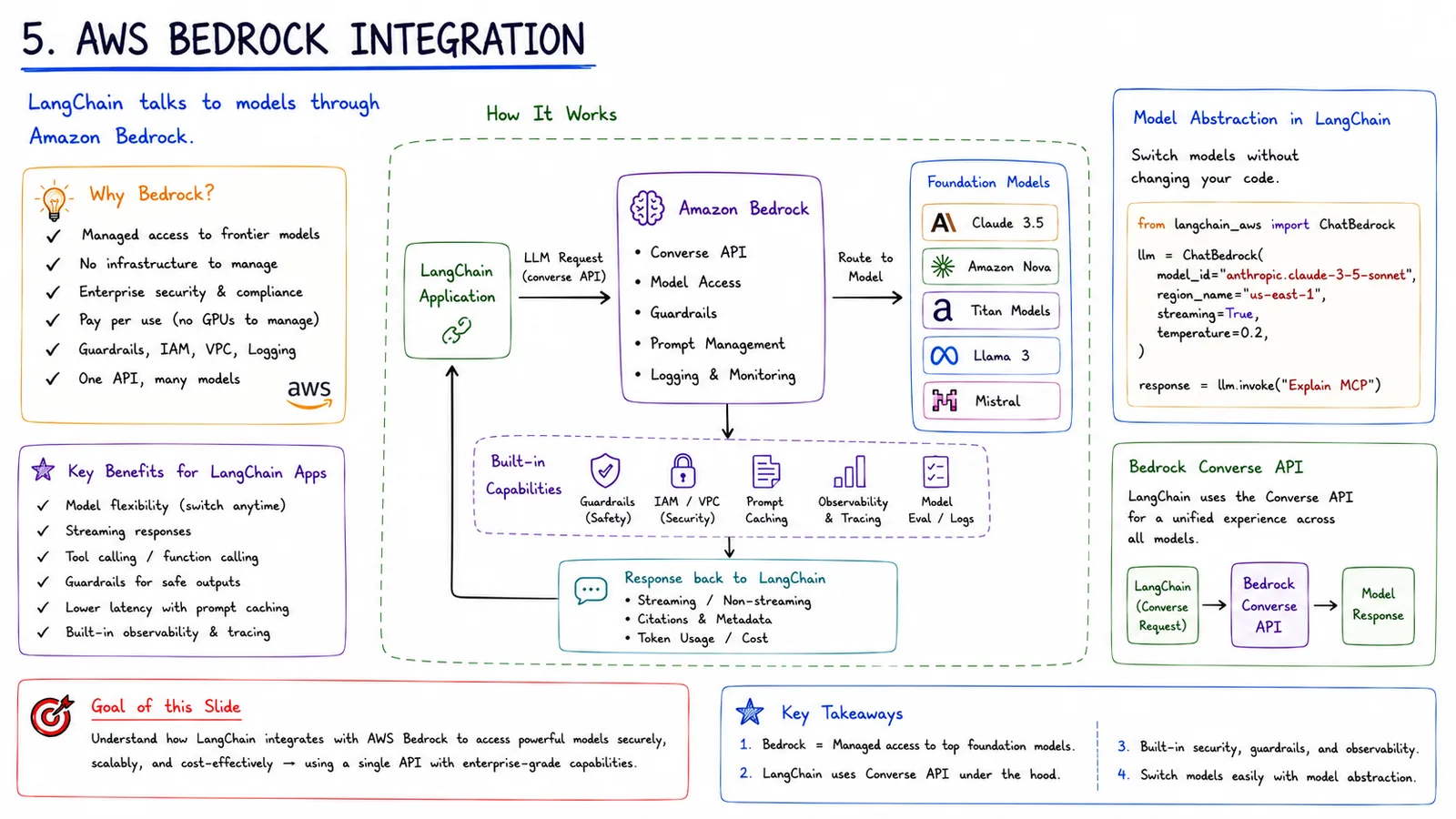
This shows how LangChain talks to models through Amazon Bedrock — a single, managed API that gives access to Claude, Nova, Titan, Llama and Mistral with enterprise-grade security.
In simple terms
One managed API (Bedrock) to reach many foundation models, with built-in security and observability.
How it works
- 1The LangChain application sends an LLM request via the Converse API.
- 2Amazon Bedrock handles model access, guardrails, prompt management and logging.
- 3Bedrock routes the request to the chosen foundation model.
- 4The response streams back to LangChain with citations, metadata and token usage.
Key points
- Managed access to frontier models — no infrastructure to run.
- One API, many models, with easy model swapping via model abstraction.
- Built-in guardrails, IAM/VPC security, logging and prompt caching.
- LangChain uses the Converse API for a unified experience.
Why it matters
Bedrock lets you use top models securely and swap between them without changing your code — key for cost control, compliance and avoiding lock-in.
Frequently asked questions
- What is the Converse API?
- Bedrock's unified chat API that works the same across different foundation models.
- Can I switch models easily?
- Yes — model abstraction lets you change the model id without rewriting your app.
More in Production AI Stack (2026)
1 · The Big Picture
The complete end-to-end production AI stack (2026).
2 · User Request Lifecycle
How one request flows through the whole system.
3 · LangChain Ecosystem
How LangChain, LangGraph, LangServe and LangSmith fit together.
4 · LangGraph Orchestration
Stateful, multi-step agent workflows.
6 · Amazon AgentCore
The enterprise runtime for LangChain/LangGraph agents.
7 · Memory & State Management
The four memory layers that make agents reliable.