
3 · LangChain Ecosystem
How LangChain, LangGraph, LangServe and LangSmith fit together.
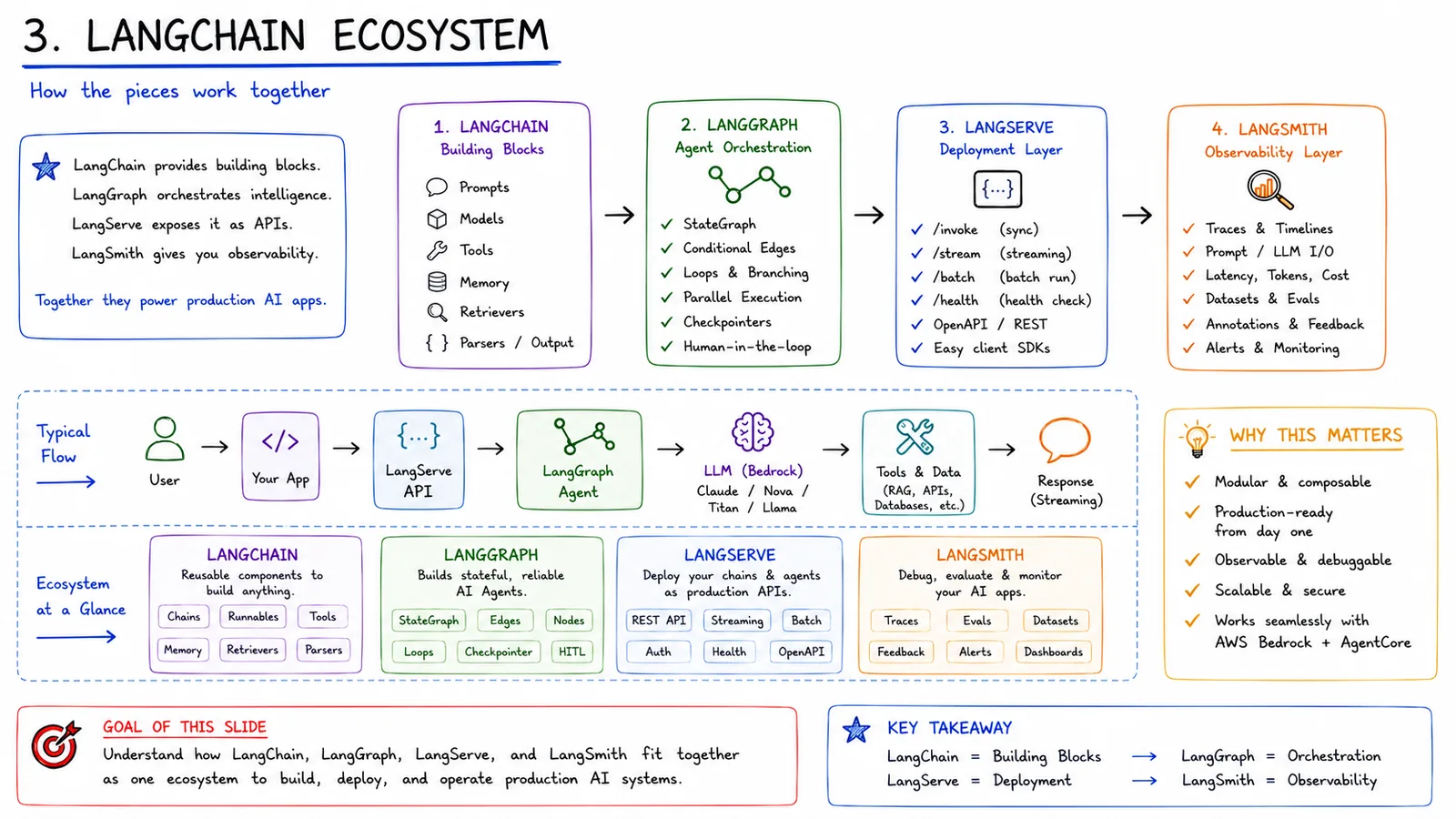
This explains how the LangChain ecosystem fits together: LangChain provides building blocks, LangGraph orchestrates intelligence, LangServe exposes it as APIs, and LangSmith gives observability.
In simple terms
LangChain = building blocks, LangGraph = orchestration, LangServe = deployment, LangSmith = observability.
How it works
- 1LangChain: reusable building blocks — prompts, models, tools, memory, retrievers, parsers.
- 2LangGraph: agent orchestration with stateful graphs, loops and human-in-the-loop.
- 3LangServe: deployment layer exposing chains and agents as production APIs.
- 4LangSmith: observability — traces, evals, datasets, feedback and monitoring.
Key points
- Modular and composable — pieces snap together.
- Production-ready from day one, observable and debuggable.
- Scalable and secure, integrating with Bedrock and AgentCore.
- Together they cover build, deploy and operate.
Why it matters
Knowing which tool does what prevents confusion: you build with LangChain, orchestrate with LangGraph, deploy with LangServe and observe with LangSmith.
Frequently asked questions
- What's the difference between LangChain and LangGraph?
- LangChain gives building blocks; LangGraph orchestrates them into stateful, multi-step agent workflows.
- What does LangSmith add?
- Tracing, evaluation, datasets and monitoring so you can debug and improve your app.
More in Production AI Stack (2026)
1 · The Big Picture
The complete end-to-end production AI stack (2026).
2 · User Request Lifecycle
How one request flows through the whole system.
4 · LangGraph Orchestration
Stateful, multi-step agent workflows.
5 · AWS Bedrock Integration
How LangChain talks to models through Amazon Bedrock.
6 · Amazon AgentCore
The enterprise runtime for LangChain/LangGraph agents.
7 · Memory & State Management
The four memory layers that make agents reliable.