
RAG & Retrieval (Enterprise)
Where Hallucinations Come From
Failures across the query, retrieval and model layers.
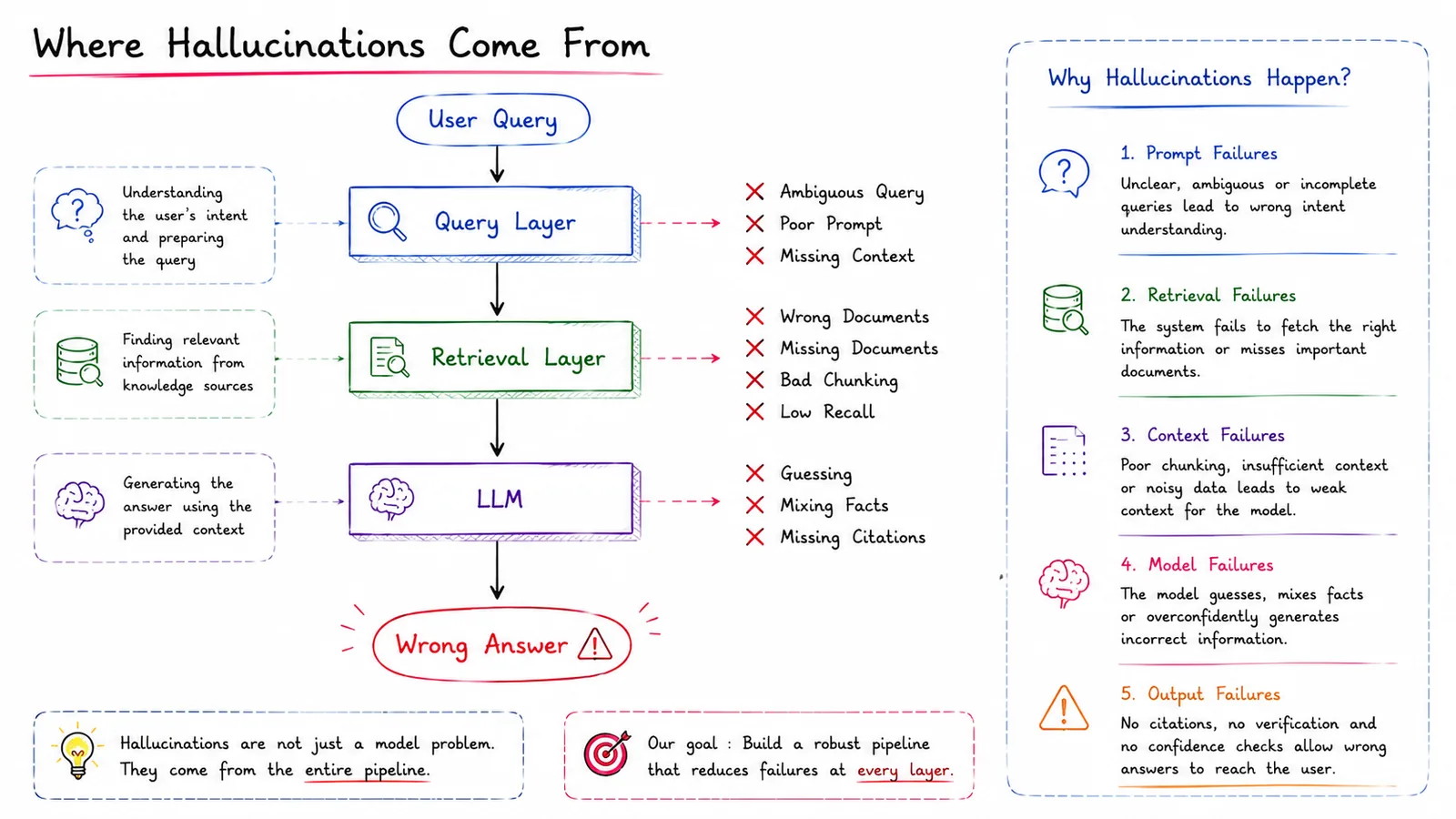
Hallucinations are not just a model problem — they come from the entire pipeline. This traces where hallucinations originate across the query, retrieval and model layers of a RAG system.
In simple terms
Hallucinations come from failures at every layer, not just the LLM.
How it works
- 1Query layer: ambiguous queries, poor prompts and missing context cause wrong intent.
- 2Retrieval layer: wrong or missing documents, bad chunking and low recall starve the model of facts.
- 3LLM layer: guessing, mixing facts and missing citations produce wrong answers.
- 4Each weak layer compounds into a wrong final answer.
- 5The goal: a robust pipeline that reduces failures at every layer.
Key points
- Prompt failures: unclear or incomplete queries lead to wrong intent.
- Retrieval failures: the system fetches the wrong or missing information.
- Context failures: poor chunking or noisy data weakens the model's context.
- Model & output failures: guessing plus no verification lets wrong answers through.
Why it matters
If you treat hallucination as only a model issue, you'll never fix it. Understanding its pipeline-wide origins lets you reduce failures at each layer.
Frequently asked questions
- Are hallucinations only the model's fault?
- No — ambiguous queries, bad retrieval and poor context all contribute before the model even generates.
- How do I reduce them?
- Improve the query, retrieval and context layers, then add citations, verification and guardrails at the output.
More in RAG & Retrieval (Enterprise)
RAG Retrieval Optimization Layer
Retrieve the right context with high recall and relevance.
RAG: Retrieval Re-ranking
Re-rank retrieved docs to keep only the most relevant.
RAG Optimization 1 · Hybrid Search
Keyword + semantic search for higher recall.
RAG Optimization 2 · Re-ranking
Find the most relevant docs before the LLM.
RAG Optimization 3 · Context Pruning
Remove noise; keep only what matters.
RAG Optimization 4 · Semantic Cache
Stop asking the same question twice.