
RAG & Retrieval (Enterprise)
RAG Retrieval Optimization Layer
Retrieve the right context with high recall and relevance.
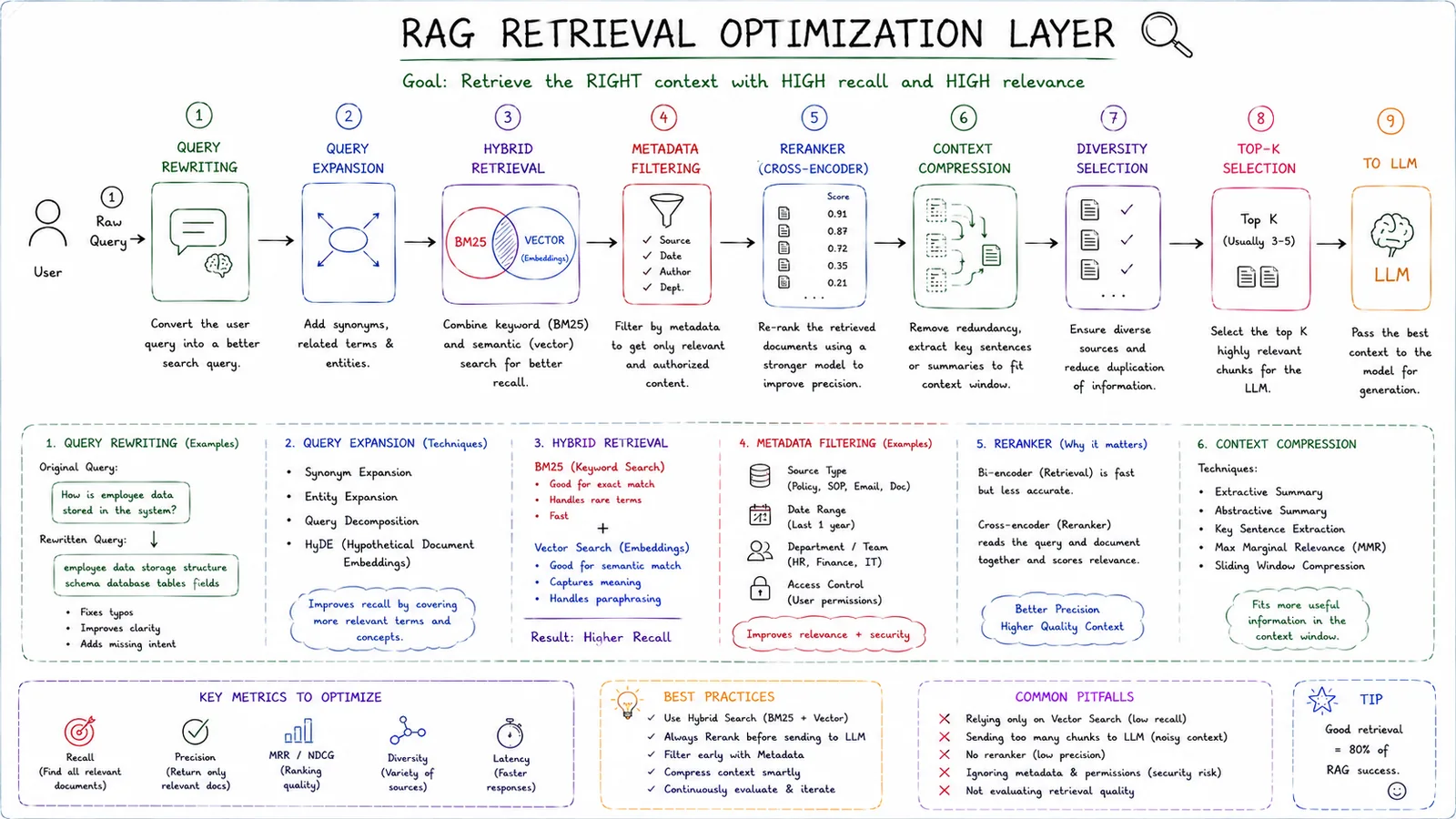
This is a RAG retrieval optimization layer whose goal is to retrieve the right context with high recall and high relevance, using a sequence of techniques from query rewriting to reranking.
In simple terms
A pipeline of techniques to fetch the most relevant context for the LLM.
How it works
- 1Query rewriting: expand, decompose or clarify the query.
- 2Query expansion adds synonyms and related terms; hybrid retrieval combines BM25 and vector search.
- 3Metadata filtering keeps only authorized, relevant content.
- 4Reranking (cross-encoder) reorders by true relevance; context compression removes noise.
- 5Diversity selection and top-K selection pick the best few chunks to send to the LLM.
Key points
- Optimise for recall (find all relevant docs) and precision (return only relevant docs).
- Always rerank before sending to the LLM; filter early with metadata.
- Compress context and continuously evaluate and iterate.
- Common pitfalls: relying only on vector search, sending too many chunks, no reranking.
Why it matters
Retrieval quality caps RAG quality. This optimization layer is how you get high-recall, high-relevance context — the biggest lever on RAG accuracy.
Frequently asked questions
- Why rerank before the LLM?
- It filters out weak matches so the model only sees the truly most relevant chunks, improving accuracy and cost.
- What's a common pitfall?
- Relying on vector search alone (low recall) or dumping too many chunks into the model (noisy context).
More in RAG & Retrieval (Enterprise)
Where Hallucinations Come From
Failures across the query, retrieval and model layers.
RAG: Retrieval Re-ranking
Re-rank retrieved docs to keep only the most relevant.
RAG Optimization 1 · Hybrid Search
Keyword + semantic search for higher recall.
RAG Optimization 2 · Re-ranking
Find the most relevant docs before the LLM.
RAG Optimization 3 · Context Pruning
Remove noise; keep only what matters.
RAG Optimization 4 · Semantic Cache
Stop asking the same question twice.