
RAG Optimization 1 · Hybrid Search
Keyword + semantic search for higher recall.
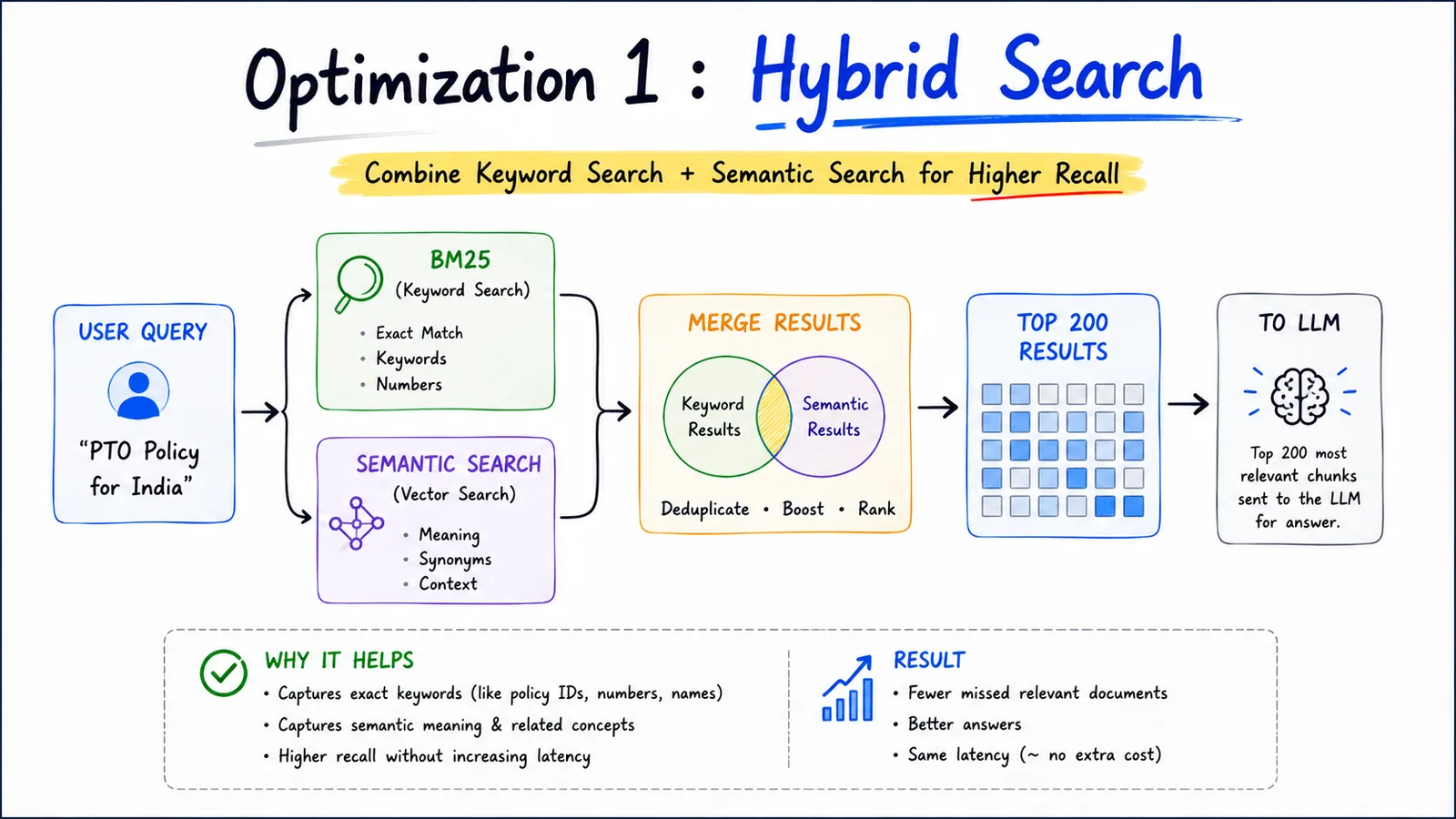
Hybrid search combines keyword search (BM25) and semantic search (vectors) for higher recall. It captures exact terms and meaning at the same time, so fewer relevant documents are missed.
In simple terms
Combine keyword and semantic search to catch both exact terms and meaning.
How it works
- 1A user query runs BM25 keyword search (exact match, keywords, numbers).
- 2The same query runs semantic (vector) search for meaning, synonyms and context.
- 3Merge the results: deduplicate, boost and rank.
- 4Keep the top results (e.g. top 200).
- 5Send the most relevant chunks to the LLM.
Key points
- Captures exact keywords (policy IDs, numbers, names) that vectors miss.
- Captures semantic meaning and related concepts that keywords miss.
- Higher recall without increasing latency.
- Result: fewer missed documents and better answers at similar cost.
Why it matters
Vector search alone misses exact terms; keyword search alone misses meaning. Hybrid search gets both, raising recall — the foundation of good retrieval.
Frequently asked questions
- Why not just vector search?
- It can miss exact identifiers like policy numbers; BM25 catches those, so hybrid gets the best of both.
- Does hybrid search add latency?
- Usually little — both searches run in parallel and results are merged.
More in RAG & Retrieval (Enterprise)
Where Hallucinations Come From
Failures across the query, retrieval and model layers.
RAG Retrieval Optimization Layer
Retrieve the right context with high recall and relevance.
RAG: Retrieval Re-ranking
Re-rank retrieved docs to keep only the most relevant.
RAG Optimization 2 · Re-ranking
Find the most relevant docs before the LLM.
RAG Optimization 3 · Context Pruning
Remove noise; keep only what matters.
RAG Optimization 4 · Semantic Cache
Stop asking the same question twice.