
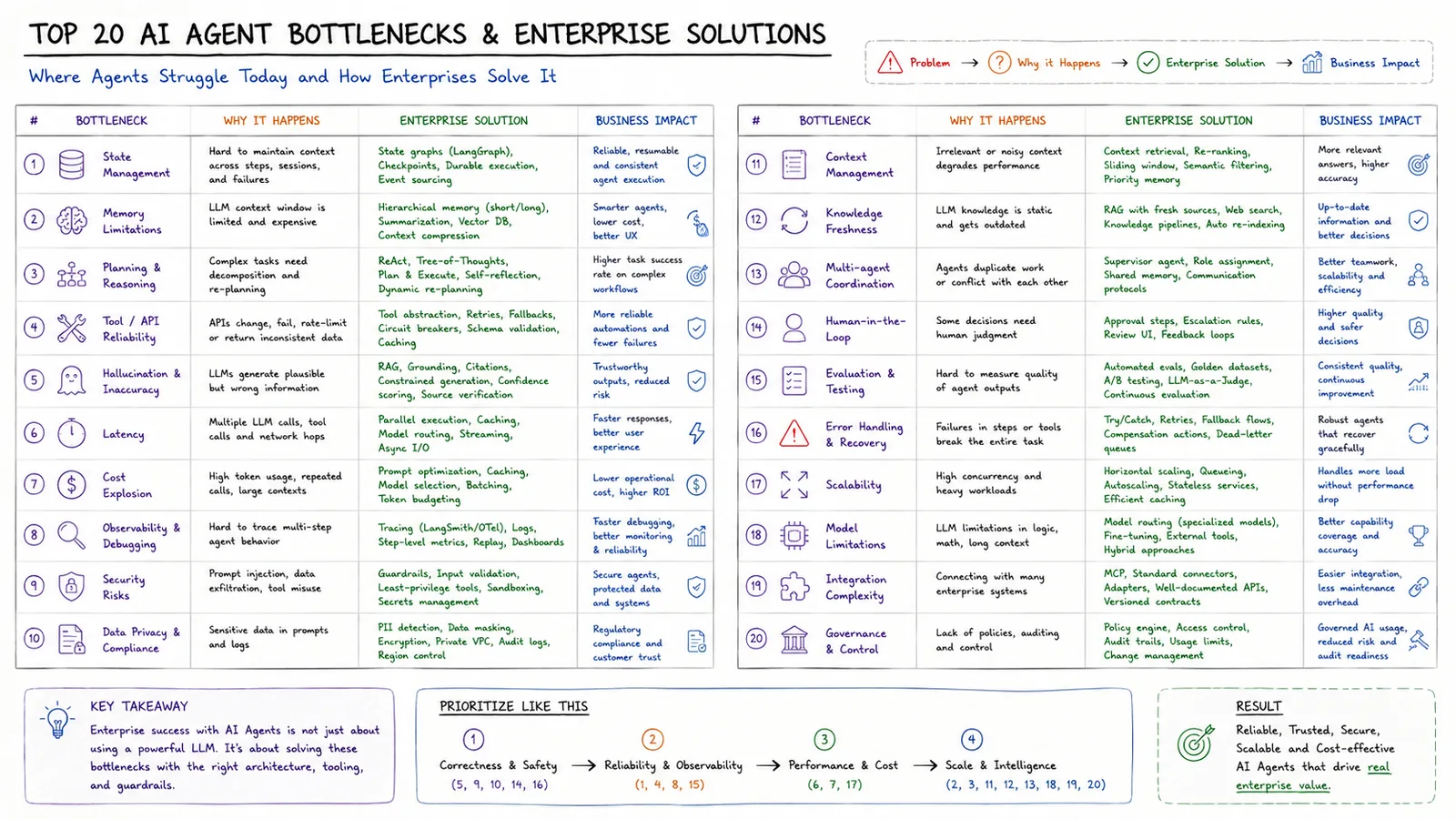
This cheat sheet covers the top 20 AI agent bottlenecks and how enterprises solve them — where agents struggle today and the proven fixes, with business impact for each.
In simple terms
The 20 ways agents get stuck, and how enterprises solve each.
How it works
- 1State management → state graphs (LangGraph), checkpoints, durable execution.
- 2Memory limitations → hierarchical short/long-term memory and context management.
- 3Planning & reasoning → ReAct, Tree-of-Thoughts, Plan-and-Execute, self-reflection.
- 4Tool/API reliability → schema validation, circuit breakers, retries and caching.
- 5Hallucination, latency, cost, observability and security each get a targeted fix.
Key points
- Prioritise correctness & safety first, then reliability & observability, then performance & cost.
- Fixes span orchestration (graphs), memory, guardrails and monitoring.
- Measure task success, reliability, latency and cost.
- Enterprise success comes from architecture, tooling and guardrails, not just a bigger model.
Why it matters
Agents fail in specific, recurring ways. This cheat sheet maps each failure to a solution, helping teams build reliable, secure agents faster.
Frequently asked questions
- What should I fix first?
- Correctness and safety, then reliability and observability, then performance and cost.
- How do I fix state loss?
- Use stateful orchestration (LangGraph), checkpoints and durable execution.
More in Top 20 Cheat Sheets
Top 20 Bottlenecks in LLMs
From prompt to production — fixing what breaks LLMs.
Top 20 Token & Cost Bottlenecks
Optimize token usage and control cost.
Top 20 Python Libraries for AI Engineers
Essential libraries and the problems they solve.
Top 20 RAG System Bottlenecks
Fixing what breaks RAG in production.