
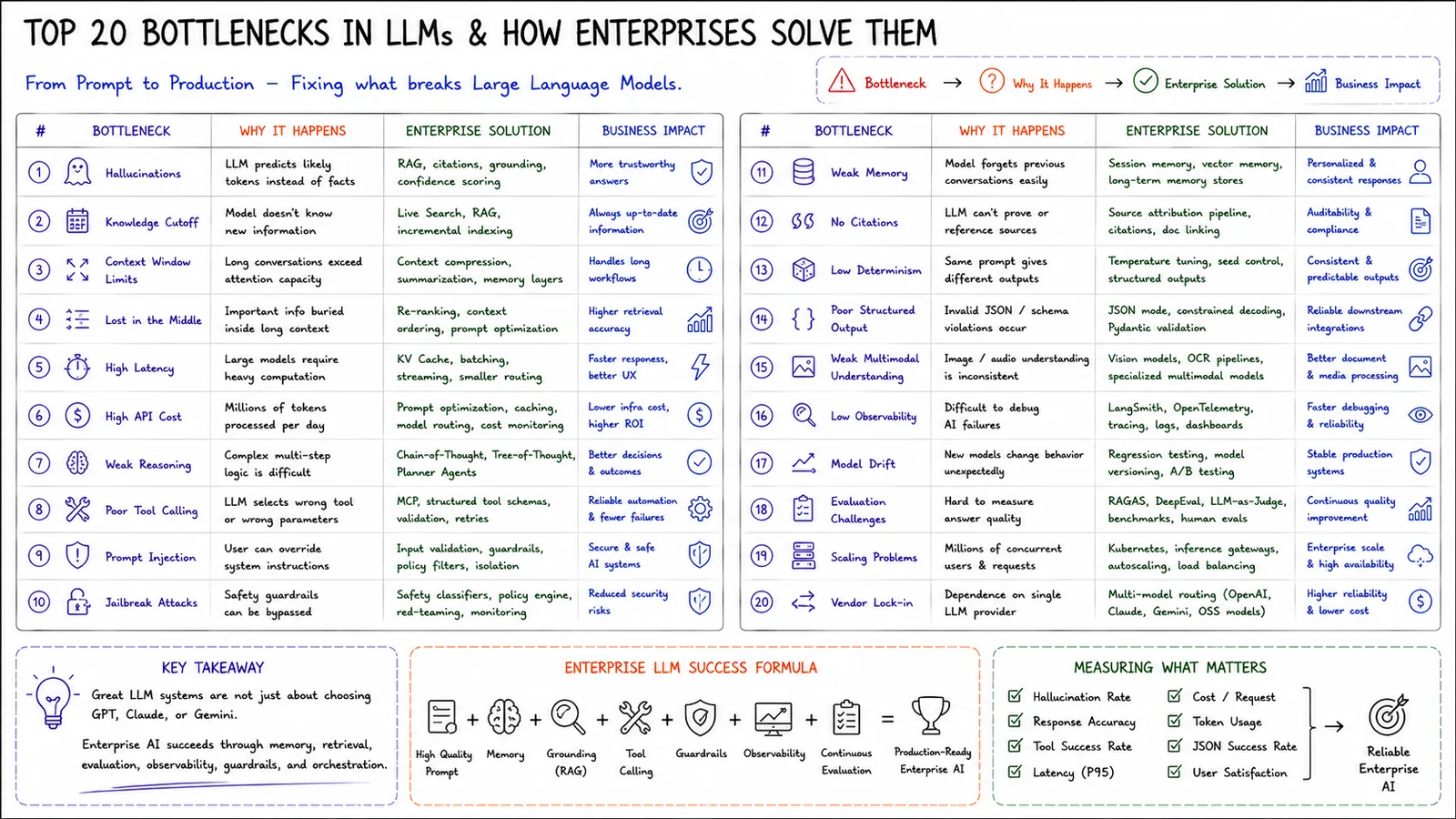
This cheat sheet lists the top 20 bottlenecks in LLMs and how enterprises solve them — from prompt to production. Each row pairs a bottleneck with its enterprise solution and business impact.
In simple terms
The 20 things that break LLM apps in production, and how to fix each.
How it works
- 1Each bottleneck is mapped to why it happens, the enterprise solution and the business impact.
- 2Examples: hallucinations → RAG, citations, grounding; knowledge cutoff → live search / incremental indexing.
- 3Context window limits → compression, summarization, memory layers.
- 4High latency and cost → caching, batching, streaming, model routing.
- 5Weak reasoning, poor tool calling, prompt injection → CoT/planning, structured schemas, guardrails.
Key points
- Great LLM systems aren't just about picking a model — they add memory, retrieval, evaluation and observability.
- Fixes cluster into grounding (RAG), efficiency (caching/routing) and safety (guardrails).
- Measure hallucination rate, response accuracy, tool success and latency.
- Enterprise success = high-quality prompt + memory + grounding + evaluation + observability.
Why it matters
Knowing the common LLM bottlenecks and their proven fixes is a shortcut to production-ready systems — you avoid rediscovering each problem the hard way.
Frequently asked questions
- What's the biggest source of LLM problems?
- Ungrounded generation — fixed with RAG, citations and grounding — plus cost/latency, fixed with caching and routing.
- How do I measure success?
- Track hallucination rate, accuracy, tool success rate and latency.