
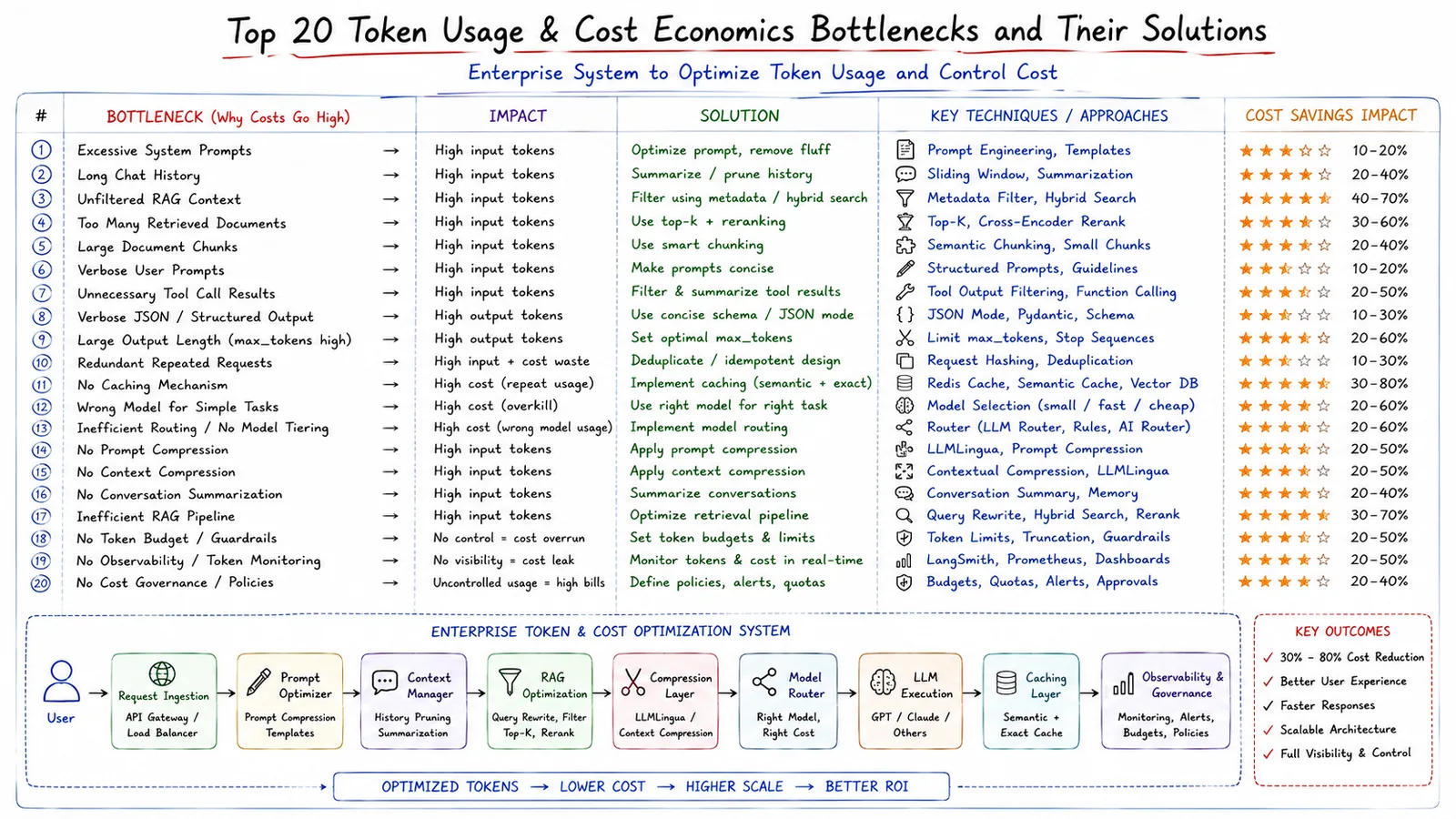
This cheat sheet lists the top 20 token usage and cost bottlenecks and their solutions — an enterprise system to optimize token usage and control cost, each with its cost-savings impact.
In simple terms
The 20 reasons AI bills go high, and the techniques to cut each.
How it works
- 1Excessive system prompts → prompt engineering and templates.
- 2Long chat history → sliding window and summarization.
- 3Unfiltered RAG context → metadata filtering and hybrid search.
- 4Too many retrieved chunks → top-K and cross-encoder reranking.
- 5Verbose output, redundant requests, wrong model → concise schemas, caching, model routing.
Key points
- Optimize input tokens (prompt, history, context) and output tokens (concise, structured).
- Cache (semantic + exact) to avoid repeated LLM calls.
- Route simple tasks to smaller, cheaper models.
- Optimized tokens → lower cost → higher scale → better ROI.
Why it matters
Token cost often decides whether an AI feature is viable. This cheat sheet is a menu of proven levers — many cut cost 30–80% without hurting quality.
Frequently asked questions
- What's the fastest way to cut cost?
- Trim prompts and history, filter RAG context, cache repeated queries and route simple tasks to smaller models.
- Do these hurt quality?
- Done well, no — they remove waste (noise, redundancy) rather than useful content.