
What is AI (Artificial Intelligence)?
How AI works and its types — narrow, general, super.
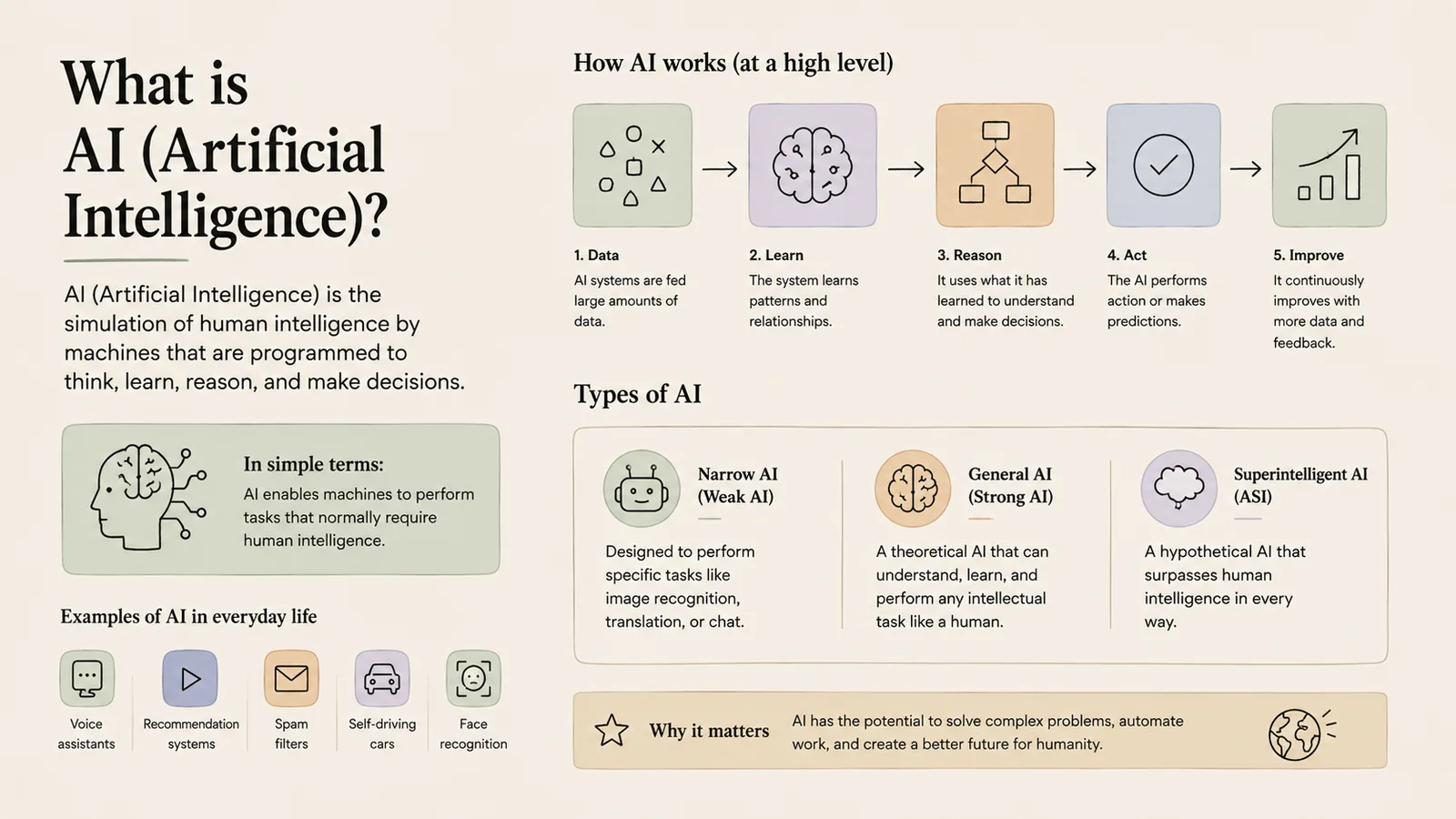
Artificial Intelligence (AI) is the simulation of human intelligence by machines that are programmed to think, learn, reason and make decisions. Instead of following fixed rules for every situation, modern AI learns patterns from data and uses them to handle new inputs.
In simple terms
AI lets machines perform tasks that normally require human intelligence.
How it works
- 1Data: AI systems are fed large amounts of data.
- 2Learn: the system finds patterns and relationships in that data.
- 3Reason: it uses what it learned to understand new situations and make decisions.
- 4Act: the AI performs an action or makes a prediction.
- 5Improve: it gets better over time with more data and feedback.
Key points
- Narrow AI (Weak AI) is built for one task — image recognition, translation or chat.
- General AI (Strong AI) is a theoretical AI that could do any intellectual task a human can.
- Superintelligent AI (ASI) is a hypothetical AI that surpasses humans in every way.
- Everyday AI is already around us: voice assistants, recommendations, spam filters and self-driving cars.
Why it matters
AI can solve complex problems, automate repetitive work and unlock products that were impossible before. Understanding the difference between today's narrow AI and the general AI of science fiction keeps expectations realistic.
Frequently asked questions
- Is all AI the same?
- No. Almost all AI today is 'narrow' — it does one job well. General and superintelligent AI are still theoretical.
- Does AI actually think?
- Not like a human. It predicts patterns learned from data; it has no understanding or intent of its own.
More in AI Foundations
What is Machine Learning?
Supervised, unsupervised and reinforcement learning.
What is Deep Learning?
Multi-layer neural networks that learn features.
What is a Neural Network?
Layers of connected neurons that learn patterns.
What is a Transformer?
The attention-based architecture behind modern AI.
Inference
Turning a trained model into predictions.
Batch Inference
Process many inputs at once for efficiency.