
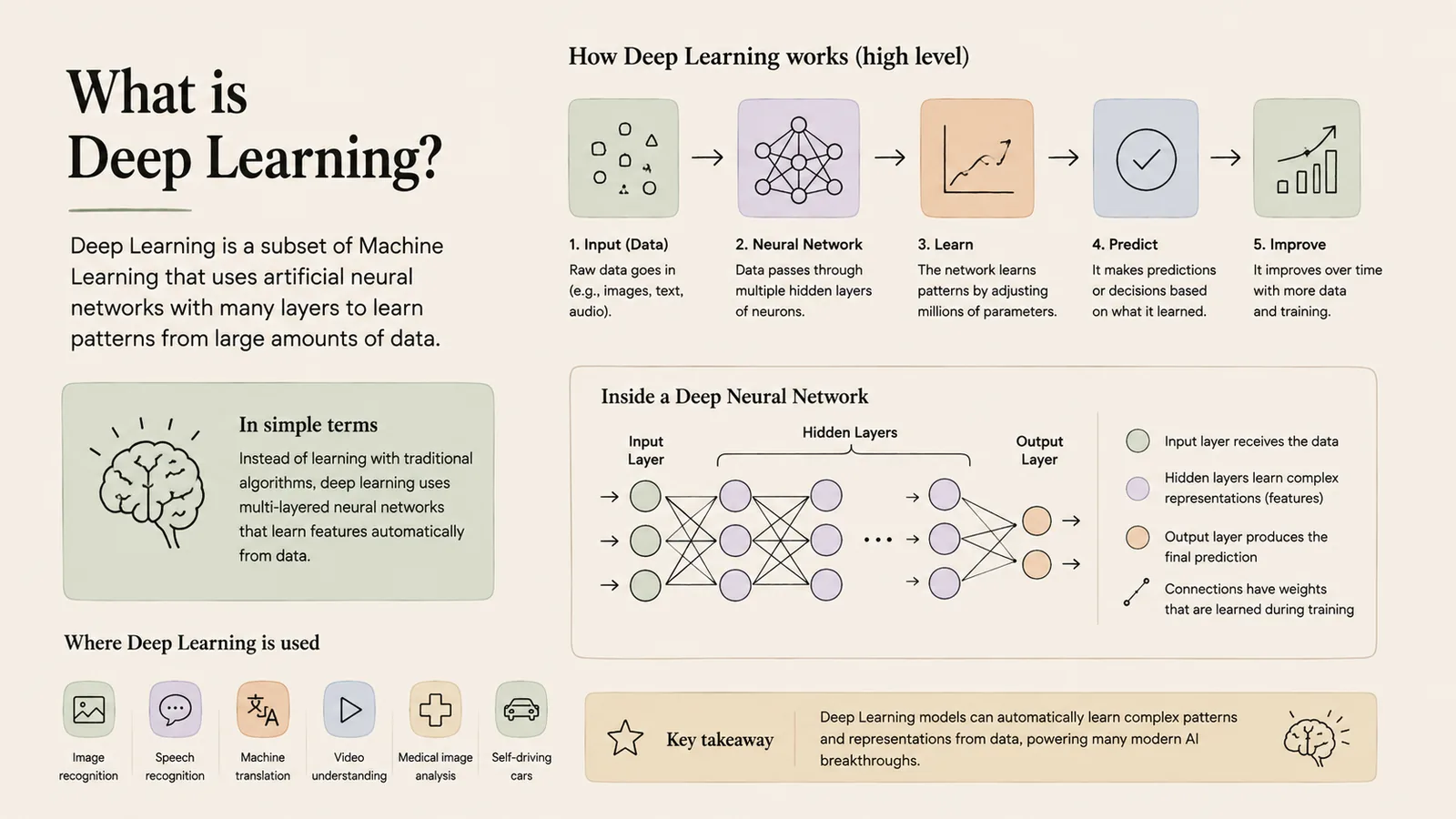
Deep Learning is a subset of Machine Learning that uses artificial neural networks with many layers to learn patterns from large amounts of data. The 'deep' refers to the many stacked layers that let the model learn increasingly abstract features on its own.
In simple terms
Multi-layered neural networks that learn features automatically from data.
How it works
- 1Input: raw data goes in — images, text or audio.
- 2Neural network: the data passes through multiple hidden layers of neurons.
- 3Learn: the network adjusts millions of parameters to capture patterns.
- 4Predict: it makes a prediction or decision from what it learned.
- 5Improve: performance rises with more data and training.
Key points
- Input layers receive the data, hidden layers learn features, output layers produce the result.
- Connections carry weights that are tuned during training.
- Deep learning removed the need for hand-crafted features — the network discovers them.
- It powers image recognition, speech, translation, medical imaging and self-driving cars.
Why it matters
Deep learning is behind most modern AI breakthroughs. Because it learns features automatically, it scales to complex problems — vision, language, audio — where writing explicit rules is impossible.
Frequently asked questions
- Is deep learning the same as a neural network?
- Deep learning uses neural networks with many hidden layers. A shallow network is a neural network but not 'deep'.
- Why does deep learning need so much data?
- It has millions of parameters to tune; large datasets are what let it learn reliable patterns instead of memorising.
More in AI Foundations
What is AI (Artificial Intelligence)?
How AI works and its types — narrow, general, super.
What is Machine Learning?
Supervised, unsupervised and reinforcement learning.
What is a Neural Network?
Layers of connected neurons that learn patterns.
What is a Transformer?
The attention-based architecture behind modern AI.
Inference
Turning a trained model into predictions.
Batch Inference
Process many inputs at once for efficiency.