
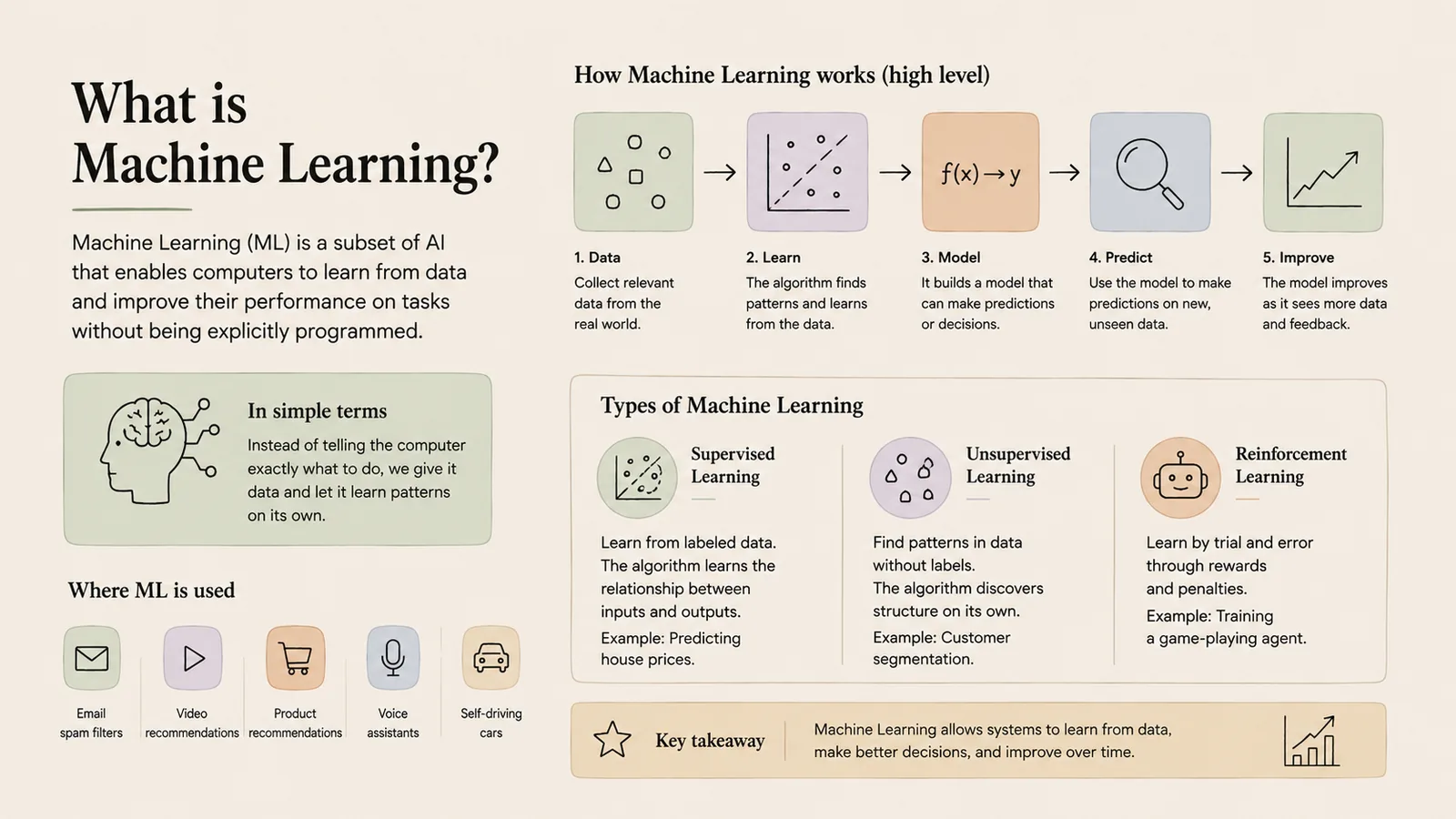
Machine Learning (ML) is a subset of AI that lets computers learn from data and improve at a task without being explicitly programmed. Rather than hand-coding rules, you give the algorithm examples and it discovers the patterns itself.
In simple terms
Instead of telling the computer exactly what to do, we give it data and let it learn the patterns.
How it works
- 1Data: collect relevant data from the real world.
- 2Learn: the algorithm finds patterns and learns from the data.
- 3Model: it builds a model that can make predictions or decisions.
- 4Predict: use the model on new, unseen data.
- 5Improve: the model gets better as it sees more data and feedback.
Key points
- Supervised learning trains on labelled data — it learns the mapping from inputs to outputs (e.g. predicting house prices).
- Unsupervised learning finds structure in unlabelled data (e.g. customer segmentation).
- Reinforcement learning learns by trial and error through rewards and penalties (e.g. game-playing agents).
- ML powers spam filters, recommendations, voice assistants and more.
Why it matters
ML is how software adapts to messy, real-world data. It lets systems make better decisions and keep improving as more data arrives, instead of being frozen at whatever rules a developer wrote.
Frequently asked questions
- How is ML different from AI?
- AI is the broad goal of intelligent machines; ML is one way to get there — by learning from data.
- Does ML need labelled data?
- Supervised learning does. Unsupervised and reinforcement learning work without labels.
More in AI Foundations
What is AI (Artificial Intelligence)?
How AI works and its types — narrow, general, super.
What is Deep Learning?
Multi-layer neural networks that learn features.
What is a Neural Network?
Layers of connected neurons that learn patterns.
What is a Transformer?
The attention-based architecture behind modern AI.
Inference
Turning a trained model into predictions.
Batch Inference
Process many inputs at once for efficiency.