
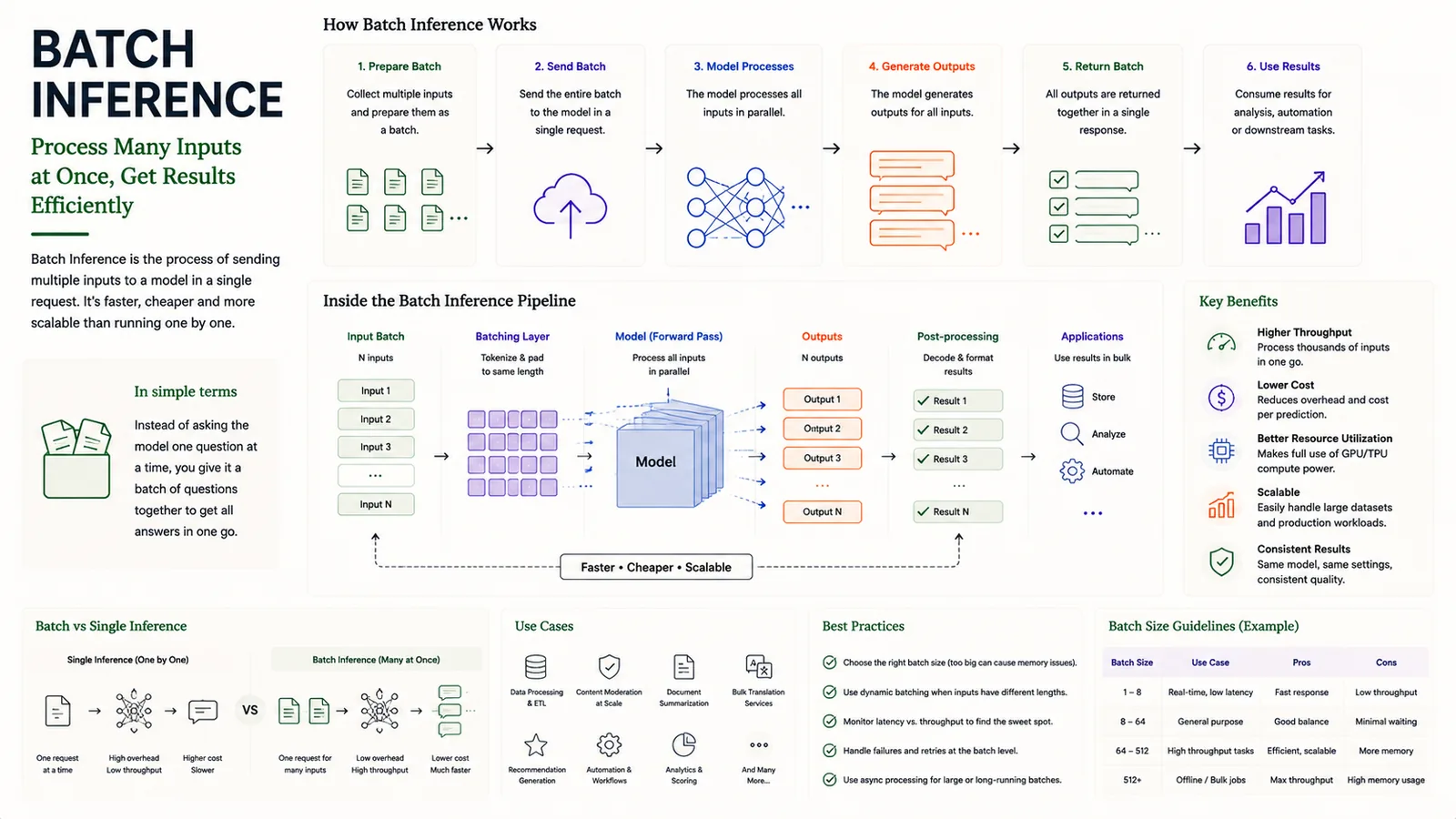
Batch Inference is the practice of sending many inputs to a model in a single request and getting all the results together, instead of one at a time. It trades a little latency for much higher throughput and lower cost per prediction.
In simple terms
Instead of asking the model one question at a time, you give it a batch and get all answers in one go.
How it works
- 1Prepare batch: collect multiple inputs and group them together.
- 2Send batch: send the entire batch to the model in one request.
- 3Model processes: the model runs all inputs in parallel.
- 4Return batch: all outputs come back together in a single response.
- 5Use results: consume the results for analysis, automation or downstream tasks.
Key points
- Higher throughput — process thousands of inputs in one pass.
- Lower cost by reducing per-prediction overhead.
- Better GPU/TPU utilisation because the hardware stays busy.
- Choose batch size carefully: too big can cause memory issues, too small wastes throughput.
Why it matters
For large workloads — data pipelines, moderation at scale, bulk translation — batch inference is dramatically cheaper and faster than calling the model one item at a time. It's the default for offline and high-volume jobs.
Frequently asked questions
- When should I use batch vs single inference?
- Use single (real-time) inference for interactive, low-latency needs; use batch for high-throughput, offline or bulk jobs.
- Does batching hurt latency?
- For any single item, yes slightly — but total time for the whole set drops sharply because the hardware is used efficiently.
More in AI Foundations
What is AI (Artificial Intelligence)?
How AI works and its types — narrow, general, super.
What is Machine Learning?
Supervised, unsupervised and reinforcement learning.
What is Deep Learning?
Multi-layer neural networks that learn features.
What is a Neural Network?
Layers of connected neurons that learn patterns.
What is a Transformer?
The attention-based architecture behind modern AI.
Inference
Turning a trained model into predictions.