
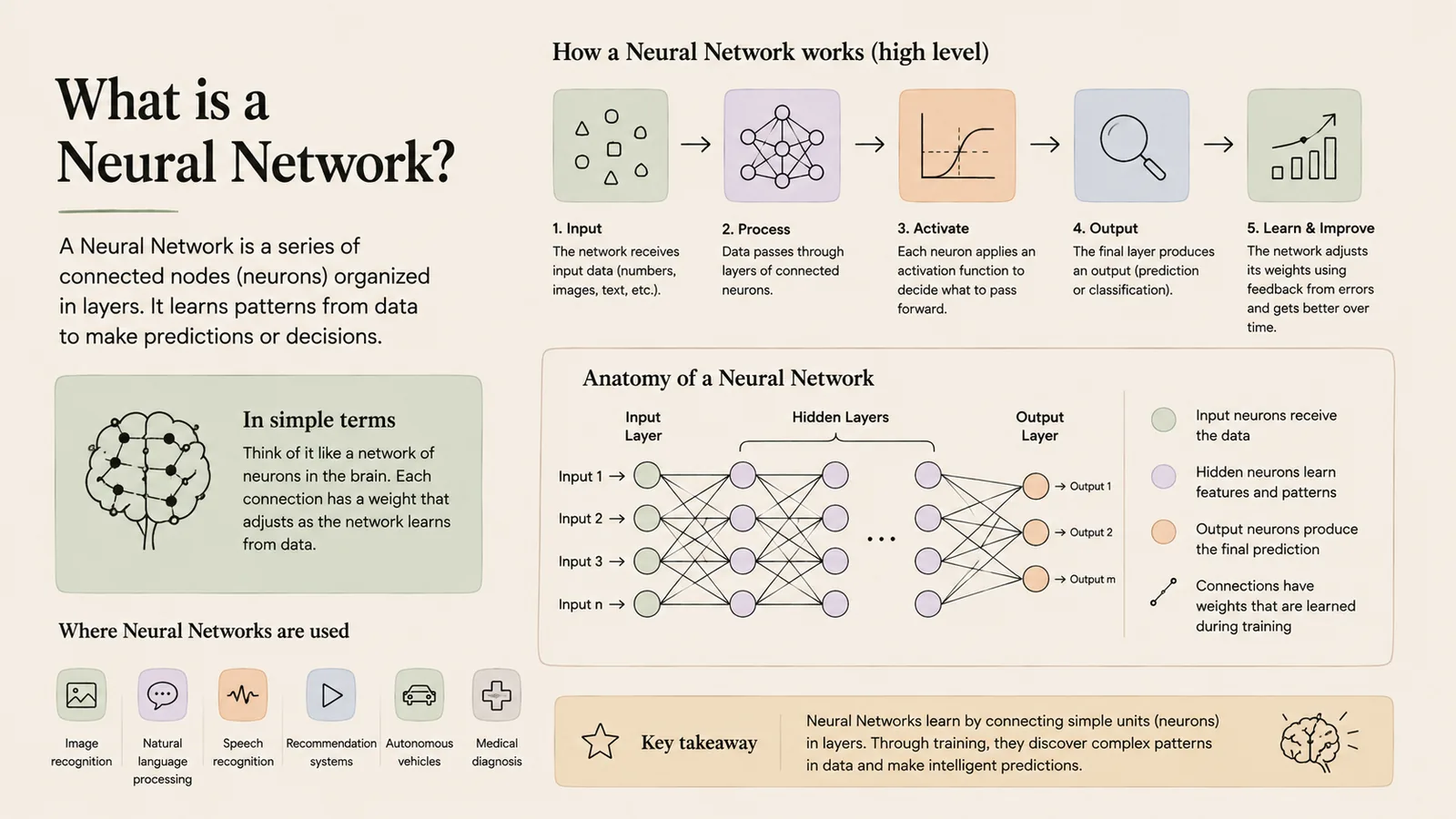
A Neural Network is a series of connected nodes (neurons) organised in layers that learns patterns from data to make predictions or decisions. It is loosely inspired by how neurons connect in the brain.
In simple terms
Layers of connected neurons, each connection carrying a weight that adjusts as the network learns.
How it works
- 1Input: the network receives input data (numbers, images, text).
- 2Process: data passes through layers of connected neurons.
- 3Activate: each neuron applies an activation function to decide what to pass forward.
- 4Output: the final layer produces a prediction or classification.
- 5Learn & improve: weights are adjusted using feedback from errors, getting better over time.
Key points
- Input neurons receive the data; hidden neurons learn features; output neurons produce the prediction.
- Each connection has a weight that is learned during training.
- Activation functions let the network model non-linear relationships.
- Used in image and speech recognition, NLP, recommendations and medical diagnosis.
Why it matters
Neural networks are the building block of deep learning and modern AI. By connecting simple units in layers and training on data, they discover complex patterns that rule-based programs never could.
Frequently asked questions
- What is a 'weight'?
- A number on each connection that controls how much one neuron influences the next. Training adjusts these weights.
- What is an activation function?
- A small function inside each neuron that decides how strongly it fires, letting the network learn non-linear patterns.
More in AI Foundations
What is AI (Artificial Intelligence)?
How AI works and its types — narrow, general, super.
What is Machine Learning?
Supervised, unsupervised and reinforcement learning.
What is Deep Learning?
Multi-layer neural networks that learn features.
What is a Transformer?
The attention-based architecture behind modern AI.
Inference
Turning a trained model into predictions.
Batch Inference
Process many inputs at once for efficiency.