
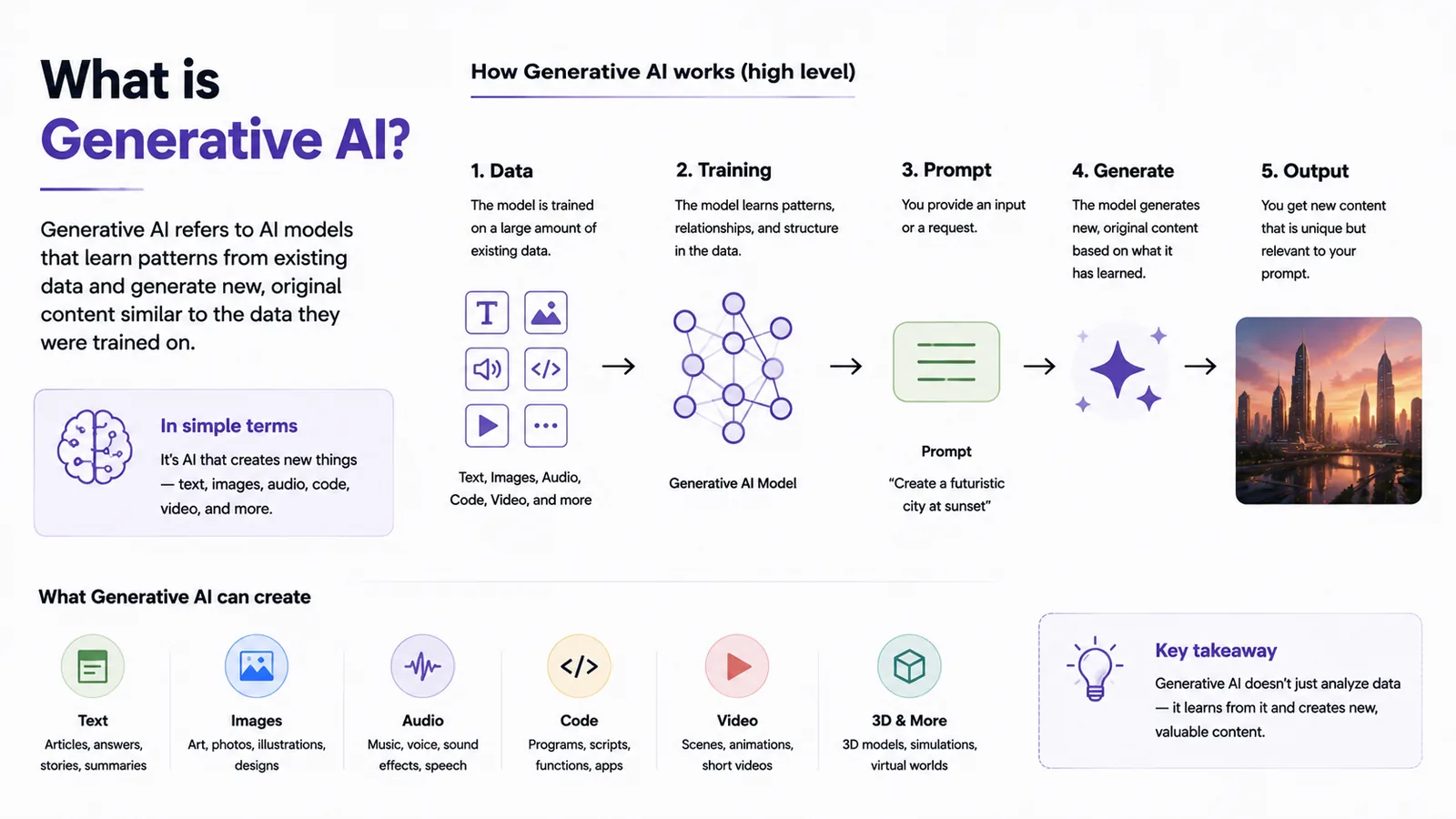
Generative AI refers to AI models that learn patterns from existing data and generate new, original content similar to what they were trained on — text, images, audio, code, video and more.
In simple terms
AI that creates new things instead of just analysing existing ones.
How it works
- 1Data: the model is trained on a large amount of existing data.
- 2Training: it learns patterns, relationships and structure in the data.
- 3Prompt: you provide an input or request.
- 4Generate: the model creates new, original content based on what it learned.
- 5Output: you get content that is unique but relevant to your prompt.
Key points
- Generates many formats: text, images, audio, code, video and 3D.
- It doesn't just analyse data — it learns from it and creates new value.
- Quality depends on the training data and the prompt you give.
- Powers tools like ChatGPT, DALL·E, Midjourney and Stable Diffusion.
Why it matters
Generative AI shifts computers from analysing to creating, unlocking new products across writing, design, media and software. It's the umbrella idea behind most of today's headline AI tools.
Frequently asked questions
- How is generative AI different from traditional AI?
- Traditional AI mostly classifies or predicts; generative AI produces new content — text, images, audio and more.
- Is the output truly original?
- It's newly generated from learned patterns; it recombines what it learned rather than copying a single source.
More in Language Models
Large Language Model (LLM) — The Basics
Massive data → training → understanding → generation.
What is a Large Language Model (LLM)?
Inside an LLM — tokenization, embeddings, transformer.
GPT (Generative Pre-trained Transformer)
How GPT predicts text, one token at a time.
GPT-4
OpenAI's multimodal model — text and images.
ChatGPT
From your question to the answer, step by step.
Claude
Anthropic's helpful, harmless and honest AI assistant.