
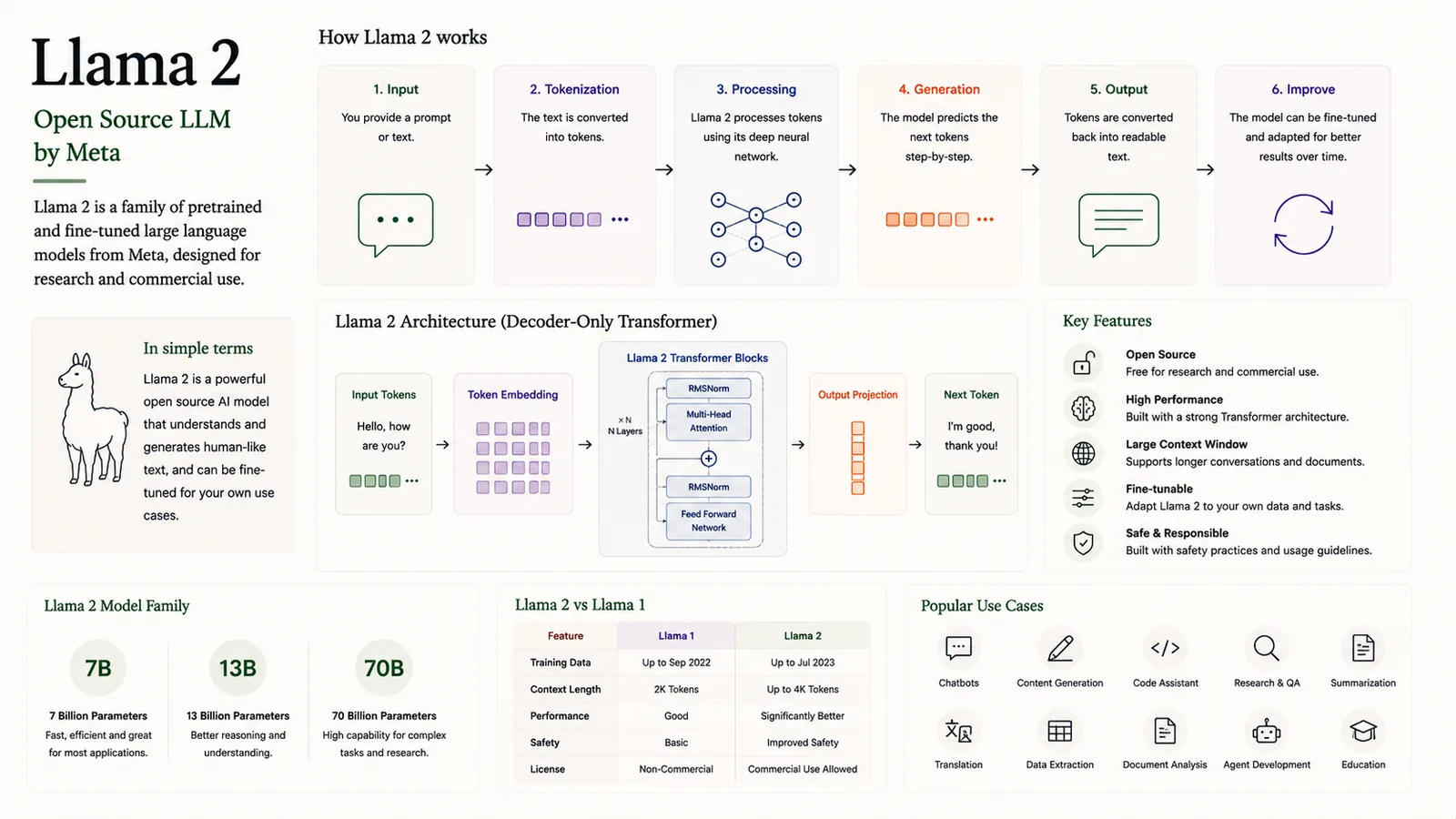
Llama 2 is a family of pretrained and fine-tuned large language models from Meta, designed for research and commercial use. Being open source, it can be downloaded, run locally and fine-tuned on your own data.
In simple terms
A powerful open-source LLM you can run yourself and fine-tune for your own use cases.
How it works
- 1Input: you provide a prompt or text.
- 2Tokenization: the text is converted into tokens.
- 3Processing: Llama 2 processes tokens using its deep neural network.
- 4Generation: the model predicts the next tokens step by step.
- 5Output: tokens are converted back into readable text.
- 6Improve: the model can be fine-tuned and adapted for better results.
Key points
- Open source — free for research and commercial use.
- Decoder-only transformer architecture with strong performance.
- Comes in 7B, 13B and 70B parameter sizes for different needs.
- Fine-tunable on your own data and tasks.
Why it matters
Llama 2 made high-quality LLMs freely available, enabling teams to run models privately, control costs and fine-tune for their domain — a major boost for open-source AI.
Frequently asked questions
- Can I run Llama 2 myself?
- Yes — it is open source, so you can download and run it on your own hardware or cloud.
- Which size should I use?
- Smaller (7B) for speed and cost, larger (70B) for the hardest reasoning tasks.
More in Language Models
Large Language Model (LLM) — The Basics
Massive data → training → understanding → generation.
What is a Large Language Model (LLM)?
Inside an LLM — tokenization, embeddings, transformer.
GPT (Generative Pre-trained Transformer)
How GPT predicts text, one token at a time.
GPT-4
OpenAI's multimodal model — text and images.
ChatGPT
From your question to the answer, step by step.
Claude
Anthropic's helpful, harmless and honest AI assistant.