
Why This Changes AI Engineering Forever
From blind trust to informed engineering.
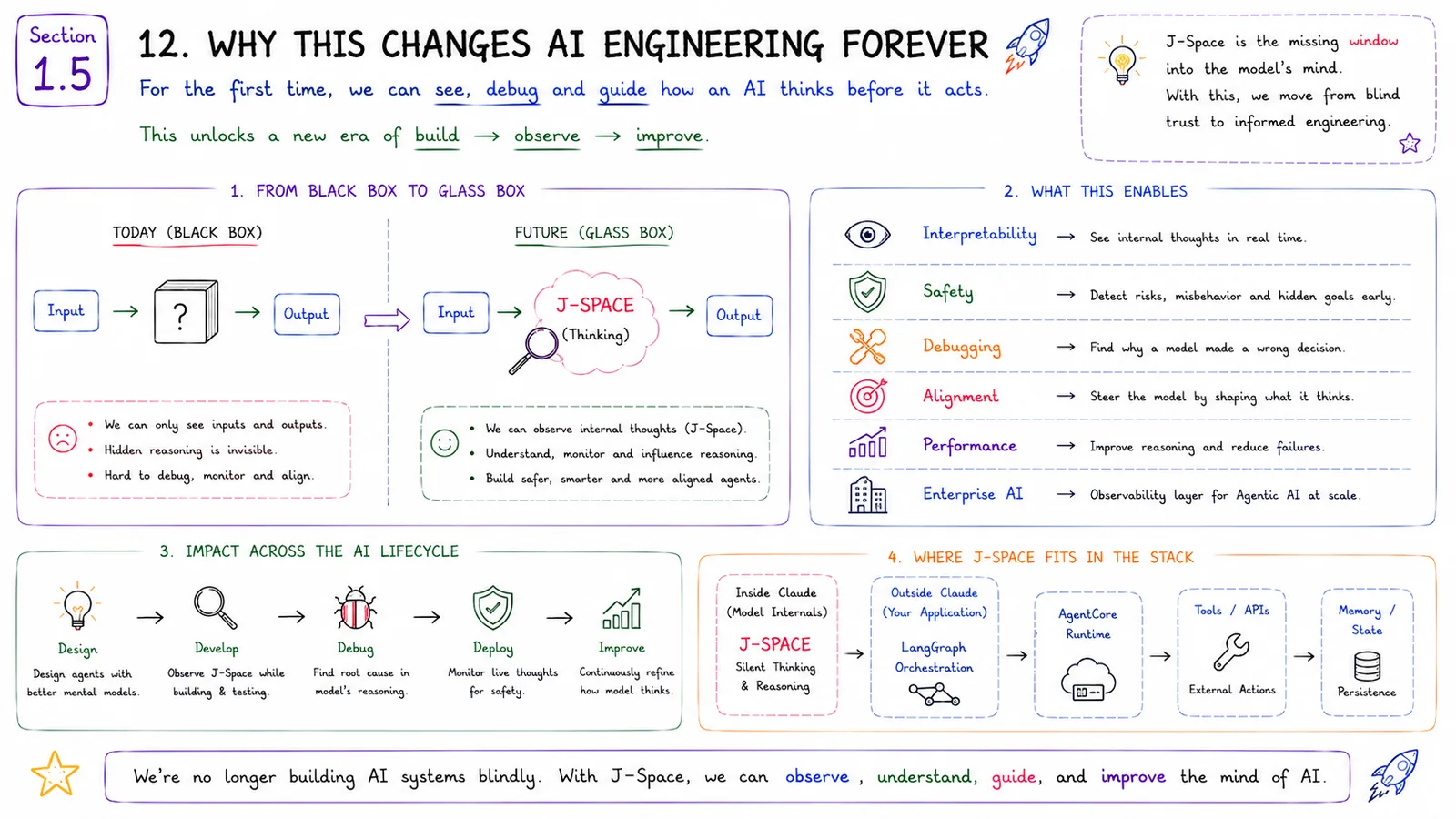
This argues that being able to see, debug and guide how an AI thinks before it acts changes AI engineering — moving from blind trust to informed engineering, from black box to glass box.
In simple terms
If we can observe a model's internal thinking, we can build, debug and steer it far better.
How it works
- 1Today (black box): we see only inputs and outputs; hidden reasoning is invisible.
- 2Future (glass box): we can observe internal thoughts, understand and influence reasoning.
- 3This enables interpretability, safety, debugging, alignment and better performance.
- 4Across the lifecycle: design with better mental models, observe while building, debug root causes, monitor live.
- 5We move from blind trust to informed engineering.
Key points
- Interpretability: see internal thoughts in real time.
- Safety: detect risks, misbehaviour and hidden goals early.
- Debugging: find why a model made a wrong decision.
- Alignment: steer the model by shaping what it thinks.
Why it matters
Observability into a model's reasoning could make AI far safer and more reliable — the difference between hoping a model behaves and being able to verify and guide it.
Frequently asked questions
- What does 'glass box' mean here?
- Being able to observe a model's internal reasoning, not just its inputs and outputs.
- Why does it change engineering?
- It lets teams debug, monitor and align models based on how they reason, not just what they output.
More in Claude Interpretability (J-Space)
Inside Claude's Brain
What happens before Claude speaks — the J-Space workspace.
What Is J-Space?
A silent internal workspace inside Claude's neural network.
Global Workspace Theory (GWT)
The theory that inspired J-Space.
How Claude Thinks Silently
Claude thinks first, reasons, then speaks.
How Anthropic Reads Claude's Thoughts
The J-Lens (Jacobian Lens) tool explained.
J-Space vs Chain of Thought
Two layers of thinking: hidden vs visible.